
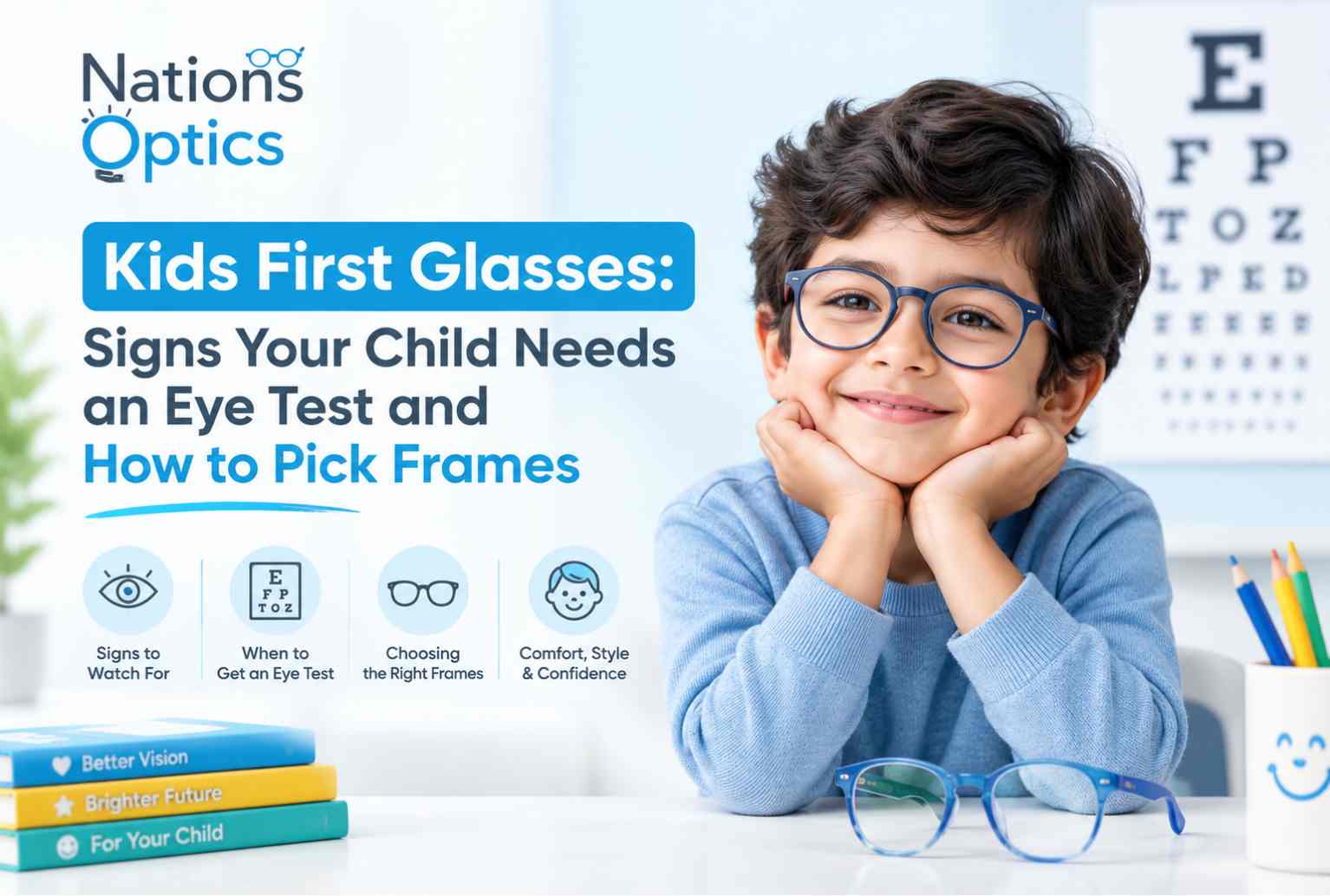
Kids First Glasses: Signs Your Child Needs an Eye Test and How to Pick Frames
Oct 21, 2026
By Rahul Jain
0 comment(s)
Kids Eye Care
Kids First Glasses: Signs Your Child Needs an Eye Test and How to Pick Frames
What to watch for, when to book an eye test and how to pick a first pair your child will really wear.
A quick note: This article is general information and not medical advice. Only a qualified eye-care professional can say whether your child needs glasses. If you're worried about your child's vision, please book an eye test.
Most children never say "I can't see properly." They don't know what clear vision looks like, so blurry feels normal to them. That's why parents are usually the first to notice something's off, if they know what to look for.
Here are the everyday signs, when to book an eye test, and how to pick a first pair of frames that fit well and survive school life.
Signs of Poor VisionEye TestKids FramesFirst Glasses
Signs Your Child May Need an Eye Test
None of these proves a vision problem on its own. But if you keep seeing them, or see a few together, get your child checked. One less obvious cause of eye strain and double vision in kids is covered in our guide to convergence insufficiency.
Squinting
Your child narrows their eyes to see the board, the TV or a far-away sign. It's a quick trick to make a blurry picture a little sharper.
Sitting close to the TV
They keep inching closer to the screen, or hold a phone, tablet or book right up to their face.
Headaches
Headaches or tired eyes after reading, homework or screen time can mean the eyes are working too hard.
Rubbing their eyes
A bit of rubbing is normal. If it happens all the time, especially while reading or watching TV, take note.
Tilting the head
A child who tilts or turns their head to look at things, or covers one eye, may be trying to see better.
Slipping marks at school
A child who can't see the board can look like they're not paying attention. Falling marks or losing interest in reading sometimes have a simple cause.
Other things to notice
- Losing their place while reading, or using a finger to follow the line.
- Avoiding reading, drawing or colouring that they used to enjoy.
- Watery eyes, or eyes that look red or tired.
- Clumsiness with ball games, or misjudging distances.
- Saying things look blurry, though many young children never do.
See an eye doctor soon if you notice:
- An eye that turns in or out, or eyes that don't seem to point the same way.
- A sudden change in how your child sees.
- Eye pain, redness that won't go away, or sensitivity to light.
- Double vision, or a child who keeps one eye shut.
- An injury to the eye.
Myths Parents Hear About Kids and Glasses
✗
"Glasses will make my child's eyes weaker"
No. Glasses help your child see clearly. Not wearing them when they need them is what causes strain and headaches.
✗
"My child would tell me if they couldn't see"
Often they don't. A child who has always seen things blurry thinks everyone sees that way.
✗
"A school screening is enough"
Screenings can miss problems. A full eye test checks more and gives you a proper prescription.
✗
"Kids will outgrow it"
Some things do change with age, but a problem left alone can hold back reading and learning. Let a professional decide.
When to Book an Eye Test
- Ask your eye doctor about a first check in the early years. Many recommend one around age 3 and another before school starts.
- After that, a test every year or two is common. Your doctor will tell you what suits your child.
- Go sooner if you notice any signs above, or if there's a family history of strong glasses, squint or lazy eye.
- If your child already wears glasses and says things look blurry, don't wait for the next due date.
What Happens at a Child's Eye Test
- Your child doesn't need to read letters, so even young children can be tested.
- The doctor checks how well each eye sees, how the eyes work together and how healthy the eyes are.
- Some children get eye drops so the doctor can get an accurate reading. Your doctor will explain why.
- If glasses are needed, you'll get a prescription. Keep a copy and note the date.
How to Choose Your Child's First Frames
A good pair of kids' glasses is comfortable, fits well and can take a hit in the playground. Here's what to look for.
1
Light and flexible
Pick frames that feel light on the nose and can bend a little without snapping. Kids sit on glasses, squash them in school bags and fall asleep in them.
2
A secure fit
The frame shouldn't slide down when your child looks down. The arms should reach the ears without pinching.
3
Eyes in the middle
Your child's eyes should sit near the centre of each lens, not at the edge. That's what gives the clearest view.
4
Right size, not room to grow
A frame that's too big slips and tilts. Get the right size now and replace it as they grow.
5
A colour they like
If your child picks it, they're more likely to wear it. Show them a few options you're happy with and let them choose.
6
Easy to adjust
Kids grow fast, so go for a style you can adjust or replace without a big expense.
You can browse our Kids Frames, including frames for boys and frames for girls, to compare styles and sizes.
Quick Fit Check
| Check | What good fit looks like | Red flag |
|---|---|---|
| Nose bridge | Sits comfortably, no deep marks | Slides down, or leaves red marks |
| Width | Frame is about as wide as the face | Sticks out at the sides or pinches |
| Arms | Reach the ears and hold lightly | Too short, or squeezing the head |
| Lens position | Eyes near the centre of lenses | Eyes at the edge or the top |
| Movement | Stays put when your child shakes their head | Slips or tilts |
Lens Features That Help Kids
Lens features add to the price, so pick the ones that match your child's day.
- Impact-resistant lenses. Kids drop and knock their glasses a lot, so ask about lens materials that take impact better.
- Scratch-resistant coating. It helps lenses survive rough handling.
- UV protection. Playground and school hours outdoors add up.
- Anti-glare. It cuts reflections, which helps when your child reads or looks at the board.
See our lens coatings guide for more, and check the Lens Collection or Personalize Your Lenses for what's available with your child's prescription. Heading back to school? Our back-to-school kids' eyeglasses guide covers fit and durability.
Helping Your Child Wear Their Glasses
- Let your child help choose the frame. This matters more than anything else.
- Start with short stretches at home, then build up.
- Make it a routine: glasses on in the morning, in the case at night.
- Tell the teacher, so they can encourage your child and give them a good seat.
- Stay positive. Tell them they look great, and don't allow teasing.
- If you can, keep a spare pair at home or in the school bag, especially for a strong prescription.
- Explain what glasses do in words a child understands.
Looking After Kids' Glasses
- Teach your child to take glasses off with both hands, so the arms don't bend.
- Clean with a microfibre cloth and lens spray, not a shirt or tissue.
- Use a hard case in the school bag.
- Don't leave glasses on the floor, on a seat or in a hot car.
- Check the fit every few months, since kids grow fast.
- Replace frames when they get too small, and update the prescription when the doctor says so.
Mistakes to Avoid
Mistakes parents often make
- Waiting for the child to complain before booking an eye test.
- Buying a frame to 'grow into', which only slips and tilts.
- Sticking with an old prescription after the child complains.
- Forcing glasses on without letting the child choose.
- Skipping the case, so the lenses get scratched in the bag.
- Believing glasses make eyes weaker.
Frequently Asked Questions
At what age can a child wear glasses?
Children can wear glasses from a very young age if the doctor prescribes them. Fit matters more than age.
How do I know if my child needs an eye test?
Watch for squinting, sitting close to screens, headaches, eye rubbing, head tilting or falling marks. If you see any of them, book a test. A routine check before school starts is a good idea too.
Will glasses make my child's eyes weaker?
No. Glasses help your child see clearly, and wearing them as prescribed doesn't weaken the eyes.
Does screen time damage children's eyes?
Long hours of close-up screen use can tire the eyes, and some studies link it with nearsightedness. Breaks, outdoor play and sensible limits all help. Our screen tips can help. If you're worried about nearsightedness, read can myopia progression be slowed, and talk to your eye doctor.
How often should kids' prescriptions be updated?
It depends on the child, but a yearly check is common while the eyes are still changing. Your doctor will tell you what's right. Here's why prescriptions expire.
What is the best frame material for kids?
Light, flexible frames suit kids best, since they're rough on glasses. Check the details on each product page in our Kids Frames.
What if my child's frame breaks or doesn't fit?
Please read our Returns & Exchanges page before ordering. If you still need help, contact us and we'll guide you.
Should kids wear anti-glare or blue-cut lenses?
For most children, scratch-resistant and UV protection are the most useful. Anti-glare can help with reading. Blue-cut is a comfort extra, so read our lens coatings guide before deciding.
Can I order kids' prescription glasses online?
Yes, if you have a current prescription. Our step-by-step guide on how to order glasses online takes you through it, and we deliver within India.
Is it okay for my child to stop wearing glasses sometimes?
Follow your doctor's advice. Some children need glasses all the time, others only for certain tasks. Don't decide on your own.
Find a First Pair They'll Love
Browse our kids' frames and let your child help choose.
Browse Kids FramesExclusive Offers
Sitewide
33%
OFF
Flat 33% off on all products
Already applied on every price · no coupon needed
Auto-applied
10%
OFF
On orders ₹1,200 – ₹1,799
No coupon needed · saves automatically
Auto-applied
15%
OFF
On orders ₹1,800 – ₹3,199
No coupon needed · saves automatically
Best Deal 🔥
20%
OFF
On orders above ₹3,200
No coupon needed · saves automatically
Pay Advance
₹50
SAVED
Pay advance amount at checkout
Flat ₹50 off · pay balance on delivery
Pay Full ✓
₹100
SAVED
Pay full amount at checkout
Maximum saving · instant confirmation
N
Nations Optics Assistant
● Online
👋 Hi! I'm your Nations Optics assistant. Ask me anything about lenses, frames, or prescriptions!