
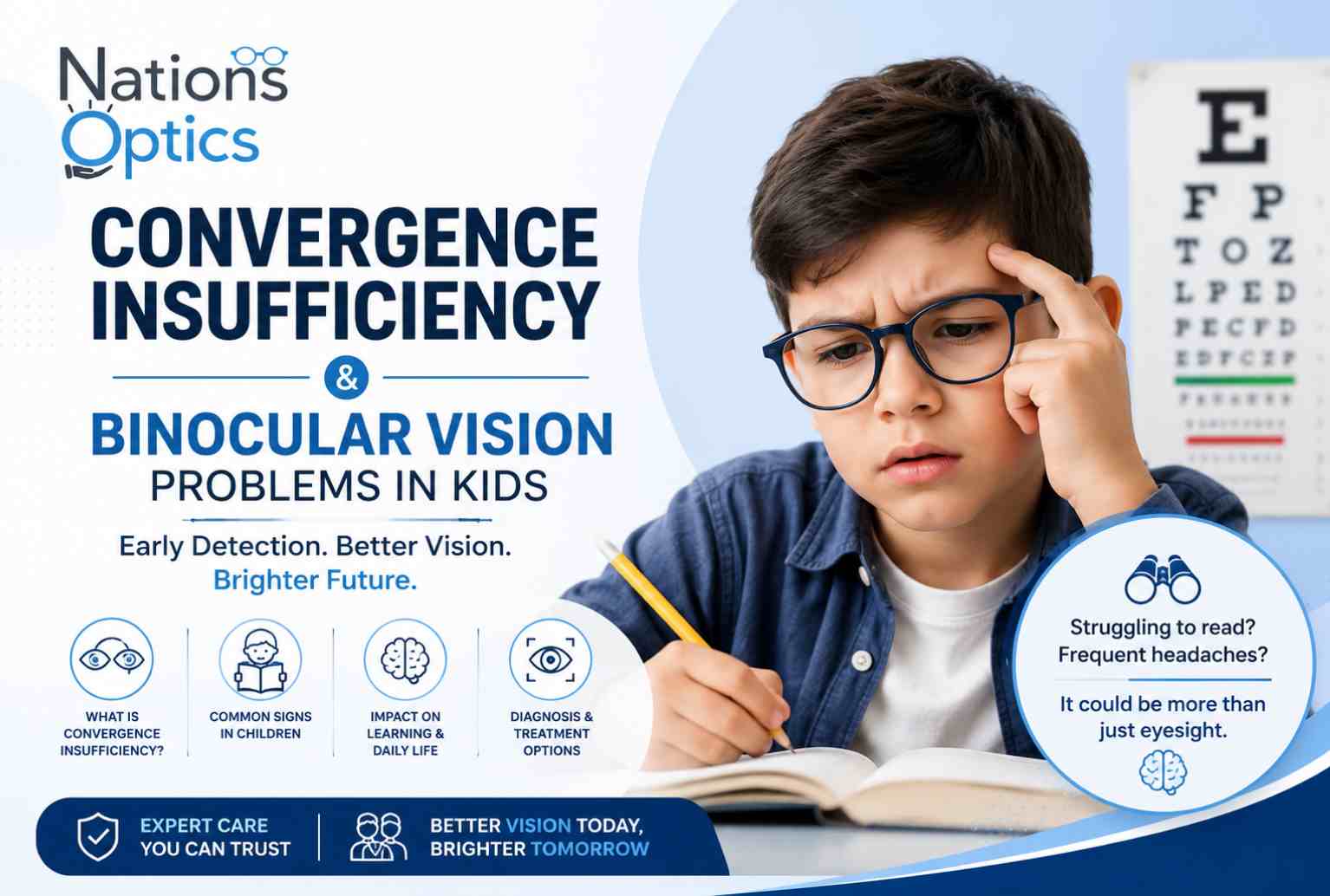
Convergence Insufficiency in Kids: Signs, Causes & Treatment
Aug 29, 2026
By Saksham Dhiman
0 comment(s)
A note before you read: This article is for general educational purposes only and is not a substitute for professional diagnosis or treatment. Binocular vision problems in children should always be evaluated and managed by a qualified optometrist, ophthalmologist, or vision therapist.
Children's Eye Health
Convergence Insufficiency & Binocular Vision Problems in Kids
Not every reading struggle is a learning problem. Sometimes it's the eyes not working together the way they should.
A child who avoids reading, complains of headaches after homework, or seems to lose their place constantly on the page is often assumed to have a learning difficulty or a simple lack of interest. In some cases, though, the real issue is physical: the child's two eyes aren't working together properly for close-up tasks, a category of conditions broadly known as binocular vision problems — and one of the most common is called convergence insufficiency.
This guide explains what convergence insufficiency and related binocular vision problems actually are, the signs parents and teachers can watch for, how these conditions are diagnosed, and what treatment approaches typically involve.
Convergence Insufficiency
Binocular Vision
Reading Difficulties
Vision Therapy
Pediatric Eye Exams
What Is Binocular Vision, and Why Does It Matter?
Binocular vision is the ability of both eyes to work together as a coordinated team, aiming, focusing, and moving in sync so the brain can merge two slightly different images into one clear, single picture with depth. This coordination happens automatically for most people, but for some children, the eye muscles and the brain's control of them don't develop or function this way efficiently — leading to a binocular vision problem.
These aren't the same as simple refractive errors like myopia or hyperopia, which affect how sharply each eye focuses on its own. Binocular vision problems are about how well the two eyes coordinate and work as a team, and they can exist even when each eye individually has clear, 20/20 vision on a standard eye chart.
What Is Convergence Insufficiency?
Convergence insufficiency is one of the most commonly discussed binocular vision problems in children. It describes a reduced ability of the eyes to turn inward (converge) and stay comfortably aligned when looking at something up close, such as a book, a tablet, or a page of homework.
When convergence doesn't work efficiently, the visual system has to work much harder than normal to keep near objects single and clear. For some children this extra effort is manageable for short periods; for others it becomes uncomfortable or unsustainable fairly quickly, especially during sustained near tasks like reading or schoolwork.
Important distinction: Convergence insufficiency is not the same as a lazy eye (amblyopia) or crossed eyes (strabismus), although all three fall under the broader category of binocular vision problems. Each has different causes and different management approaches, which is why a proper professional evaluation matters rather than guessing based on symptoms alone.
Signs Parents and Teachers Should Watch For
Possible Signs of a Binocular Vision Problem
- Avoiding reading or near work
- Complaints of eye strain or discomfort
- Frequent headaches, especially after homework
- Losing their place while reading
- Rereading the same line repeatedly
- Double vision during close work
- Words appearing to move on the page
- Rubbing eyes frequently during near tasks
- Covering or closing one eye while reading
- Short attention span specifically for reading or homework
- Poor reading comprehension despite adequate decoding skills
- Tilting the head or leaning unusually close to the page
These signs overlap significantly with symptoms often attributed to attention difficulties or learning challenges, which is part of why binocular vision problems are sometimes missed or misattributed for a long time before being properly identified.
Why This Often Gets Mistaken for a Learning or Attention Problem
What It Might Look Like
- Trouble focusing during reading time
- Seeming disinterested in books
- Slow reading pace
- Comprehension not matching decoding ability
- Restlessness during near-work tasks
What It Might Actually Be
- Eyes struggling to converge comfortably
- Physical discomfort during sustained near focus
- Words genuinely appearing to move or double
- Fatigue building up specifically during close work
- A physical, not attentional or cognitive, root cause
This is exactly why a comprehensive binocular vision assessment — not just a standard visual acuity chart test — is worth requesting if a child is struggling with reading or school performance despite otherwise seeming capable and engaged.
Why a Standard Vision Screening May Not Catch This
A routine school vision screening, or even a basic eye chart test, is generally designed to check visual acuity — how sharply each eye sees at a distance. Convergence insufficiency and other binocular vision problems can be completely missed by this type of screening because a child can have perfect distance visual acuity in each eye individually while still struggling significantly with how the two eyes work together up close.
A comprehensive binocular vision evaluation, performed by an optometrist trained in this area, typically involves specific tests of eye teaming, focusing ability, and eye movement control that go well beyond a standard acuity check.
Related Binocular Vision Conditions
Convergence Insufficiency
Difficulty turning the eyes inward and maintaining that alignment comfortably for near tasks, as described above.
Accommodative Dysfunction
Difficulty with the eyes' focusing mechanism itself, separate from eye alignment — can cause similar symptoms of blur or fatigue during near work and sometimes occurs alongside convergence problems.
Strabismus (Crossed or Misaligned Eyes)
A more visible misalignment where one eye may turn in, out, up, or down relative to the other, which can be constant or intermittent and may require different management than convergence insufficiency.
Amblyopia (Lazy Eye)
Reduced vision in one eye that developed because the brain favored the other eye during early visual development — often linked to strabismus or a significant difference in refractive error between the eyes, and generally most effectively treated when caught early in childhood.
How Is Convergence Insufficiency Diagnosed?
1
Comprehensive Eye Examination
A full exam covering visual acuity, eye health, and refractive status as a baseline.
2
Near Point of Convergence Testing
Measuring how close an object can be brought toward the child's eyes before they can no longer keep it single and in focus.
3
Eye Teaming and Focusing Assessment
Specific tests of how well the two eyes coordinate and sustain focus together during near tasks.
4
Symptom History
A detailed discussion of reading habits, school performance, and specific symptoms noticed at home or reported by teachers.
What Treatment Typically Involves
Management is individualized based on the specific diagnosis and the child's age, but commonly discussed approaches include:
- Vision therapy — structured, supervised exercises designed to improve eye teaming, focusing, and coordination over time
- Prescription lenses, in some cases with a specific optical design to ease the visual demand of near work
- Prism lenses, used in select cases to help reduce visual strain
- Regular follow-up visits to monitor progress and adjust the approach as needed
The right combination and duration of treatment depends entirely on the specific diagnosis, severity, and the child's response — this is a decision for the treating eye-care professional, not something to self-select based on symptoms alone.
Frequently Asked Questions
What is convergence insufficiency?
A reduced ability of the eyes to turn inward and stay comfortably aligned when focusing on something up close, making near tasks like reading more effortful or uncomfortable.
Can my child have 20/20 vision and still have a binocular vision problem?
Yes. Binocular vision problems relate to how the two eyes coordinate as a team, not how sharply each eye sees individually — a child can pass a standard vision screening and still have a significant convergence or eye-teaming issue.
How is convergence insufficiency different from a learning disability?
The symptoms can look similar — trouble focusing, losing place while reading, poor comprehension — but convergence insufficiency has a physical, visual root cause rather than a cognitive or attentional one. A comprehensive binocular vision evaluation can help distinguish between the two.
Will a school vision screening catch this?
Usually not. Standard screenings typically check visual acuity at a distance and often don't include the specific tests needed to identify convergence or eye-teaming problems.
What does treatment for convergence insufficiency involve?
Approaches vary by case and may include vision therapy exercises, specific prescription lens designs, or prism lenses, determined by the treating eye-care professional after a comprehensive evaluation.
When should I get my child evaluated?
If your child shows signs like avoiding reading, frequent headaches during homework, losing their place often, or complaints of double vision during near work, it's worth requesting a comprehensive binocular vision evaluation rather than a standard screening alone.
Start With an Accurate Prescription and Fit
At Nations Optics, we help ensure your child's prescription and frame fit support their comfort, whatever their eye-care professional recommends for treatment.
- Accurate pediatric prescription fitting
- Comfortable, durable frames built for kids
- Support for prescription lenses recommended by your specialist
- Guidance connecting you with appropriate eye-care follow-up
- A wide range of lightweight, kid-friendly frame styles
A child who struggles with reading or seems to dislike homework isn't always facing a learning or attention problem. Sometimes the underlying cause is physical — the two eyes not working together comfortably for the demands of near work. Convergence insufficiency and related binocular vision problems are real, diagnosable, and treatable conditions, but they require a comprehensive evaluation to identify, not just a standard vision chart test.
If any of the signs described here sound familiar, the most useful next step is simple: ask your child's eye-care professional specifically about a binocular vision assessment, rather than assuming a passed school screening rules out a vision-related cause.
Exclusive Offers
Sitewide
33%
OFF
Flat 33% off on all products
Already applied on every price · no coupon needed
Auto-applied
10%
OFF
On orders ₹1,200 – ₹1,799
No coupon needed · saves automatically
Auto-applied
15%
OFF
On orders ₹1,800 – ₹3,199
No coupon needed · saves automatically
Best Deal 🔥
20%
OFF
On orders above ₹3,200
No coupon needed · saves automatically
Pay Advance
₹50
SAVED
Pay advance amount at checkout
Flat ₹50 off · pay balance on delivery
Pay Full ✓
₹100
SAVED
Pay full amount at checkout
Maximum saving · instant confirmation
N
Nations Optics Assistant
● Online
👋 Hi! I'm your Nations Optics assistant. Ask me anything about lenses, frames, or prescriptions!