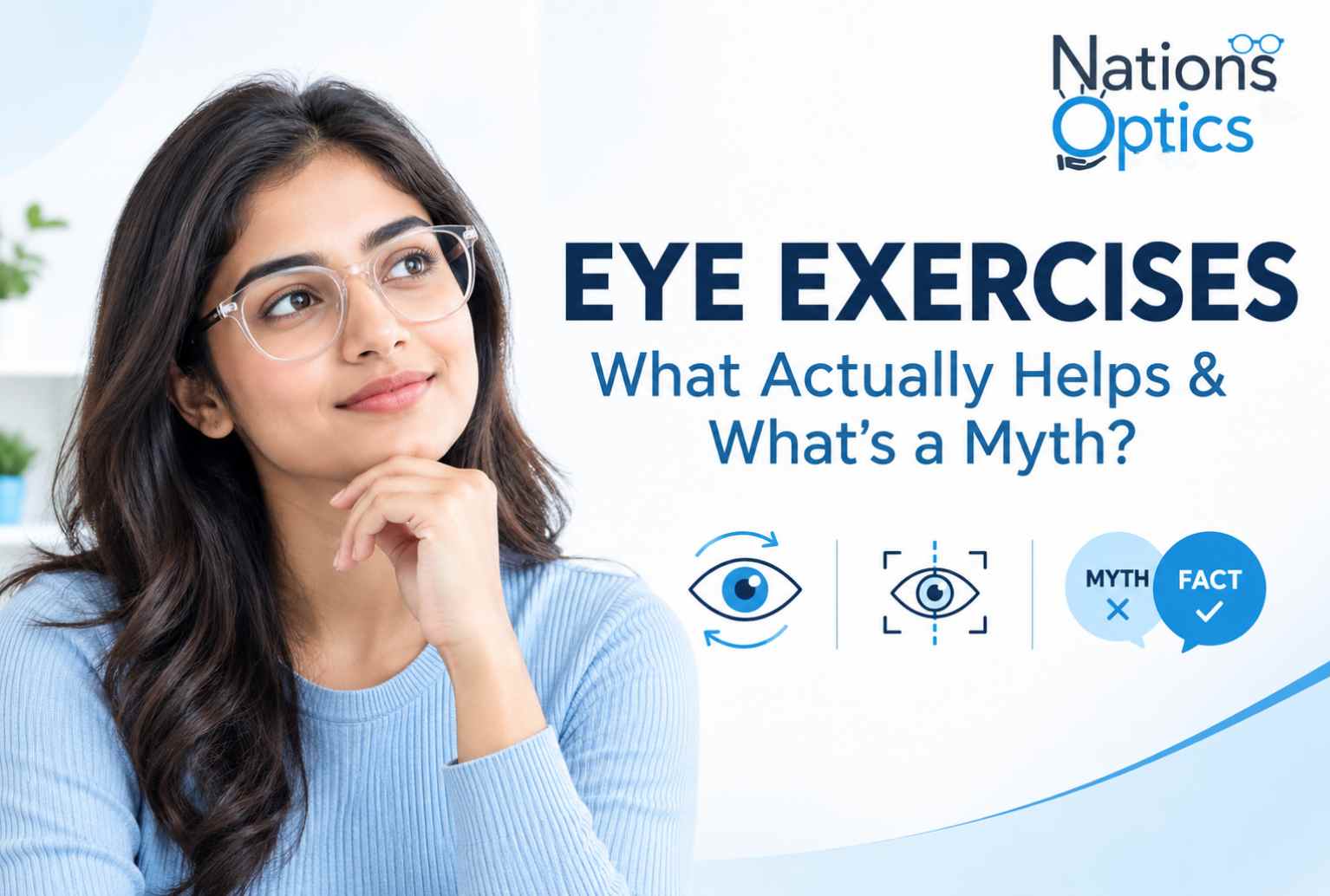
Eye Exercises: What Actually Helps and What’s a Myth?
Oct 12, 2026
By Rahul Jain
0 comment(s)
Myth vs Fact
Eye Exercises: What Actually Helps and What's a Myth?
Seven-day challenges and "throw away your glasses" videos are everywhere. We sort out what holds up, what doesn't, and what's worth doing.
Please note: This article is general information. It isn't a replacement for an eye test, diagnosis or treatment from a qualified professional.
You've probably seen the videos. Clearer eyesight in seven days. Glasses gone for good. Lower power with a few eye rolls. When you spend all day on a laptop or your phone, it's easy to want that to be true.
So, do eye exercises work? Sometimes, and only for certain things. A few help with specific eye problems. Most of the big promises online have no solid evidence behind them. Below, we go through what may help, which myths to ignore, and what you can do for comfortable eyes in daily life.
Eye Exercises 20-20-20 Rule Eye Strain Myths
What counts as an eye exercise?
It's any activity that works on how your eyes move, focus or team up. That might be shifting focus between near and far objects, following a moving target, or the exercises a professional prescribes as vision therapy. They're sometimes advised for conditions like convergence insufficiency, where the two eyes struggle to turn inward together for close work.
What they aren't is a cure-all. They don't reliably fix myopia, hyperopia, astigmatism or presbyopia (the age-related near-focus problem). Keep that in mind before you start any routine.
Do eye exercises work? What the evidence says
It depends what you're hoping for. Prescribed exercises can help certain eye-coordination problems. But nothing convincing shows that general exercises permanently improve eyesight, remove the need for glasses or reverse a refractive error.
What eye doctors say: the American Academy of Ophthalmology states that eye exercises don't improve or preserve vision or reduce the need for glasses. The main exception is that specific exercises may help people with convergence insufficiency.
So "eye exercises are useless" goes too far, and "they cure almost everything" goes much too far. Here's how it breaks down:
| What you're doing | What to expect |
|---|---|
| Exercises for a diagnosed eye-coordination problem | May help when a professional prescribes them. |
| Relaxing your eyes during breaks | Can feel good, but it won't change your prescription. |
| Exercises to get rid of glasses | No reliable evidence. |
| Exercises to lower myopia or astigmatism | Not proven. |
| Regular screen breaks | A practical way to ease digital eye strain. |
7 eye exercise myths, and what's actually true
Myth 1: Eye exercises can improve your eyesight naturally
Fact: No study has shown that general eye exercises reliably sharpen eyesight or fix a refractive error.
Your power comes from the shape and length of your eyeball and how it bends light onto the retina. Rolling your eyes or flicking focus between a pen and the wall doesn't change either of those.
If far things look blurry or small print is a struggle, book an eye test. That will tell you far more than any video routine.
Myth 2: Eye exercises can get rid of your glasses for good
Fact: They can't. Glasses do an optical job that exercises simply don't do.
Your eyes might feel fresher after a rest, sure. But feeling less tired isn't the same as seeing better.
If you've been prescribed glasses, keep wearing them while you try any routine.
Myth 3: Eye exercises can bring your power down
Fact: There's no reliable evidence that general exercises reduce myopia (short-sightedness).
Myopia usually happens because the eye is a bit too long for its focusing power. Eye rolling, palming and repeated focusing won't undo that.
If you're a parent and your child's power keeps going up, talk to an eye-care professional about myopia management. Exercises alone won't hold it back.
Myth 4: Palming cures blurry vision
Fact: Palming can feel nice, but it won't cure blur or correct your power.
You rub your hands warm, then cup them lightly over closed eyes without pressing. Plenty of people find it calming after a long day at the screen.
But if your vision keeps going blurry, get it checked. Don't just assume your eyes are tired.
Myth 5: Eye rolling makes your eyes stronger
Fact: Moving your eyes around doesn't build strength the way lifting builds muscle.
Your eyes already move all day long. Repeating the movement with no clinical reason hasn't been shown to fix common vision problems.
Some structured eye-coordination exercises are part of treatment for certain conditions. Whether they help depends on the diagnosis and on what's prescribed.
Myth 6: Carrots plus eye exercises will remove your glasses
Fact: Good food supports your eyes, but it won't usually make glasses unnecessary.
Carrots have beta-carotene, which your body turns into vitamin A. Your eyes need vitamin A, but eating enough of it doesn't fix myopia, hyperopia or astigmatism.
Eat well, by all means. Just don't let it stand in for an eye test or the right lenses.
Myth 7: Everyone should do the same routine
Fact: Different eye problems need different answers.
Sore eyes after hours on a laptop often settle with regular breaks and a better screen setup. Someone with convergence insufficiency may need a specific vision-therapy programme. And someone whose prescription is out of date may just need new lenses.
If you get regular headaches while reading, see double, or can't focus properly, talk to an eye-care professional before starting any therapy-style routine.
Habits worth keeping
Exercises won't sharpen everyone's eyesight, but a few simple habits can ease discomfort and help you spot when it's time to see a professional.
1
The 20-20-20 rule
Every 20 minutes, look at something about 20 feet away for at least 20 seconds. It breaks up close-up work and can ease digital eye strain. It's a break habit. It won't lower your power or improve your eyesight for good.
2
A quick look into the distance
After a long stretch on your phone or laptop, stop, look at something far away, and let your eyes settle without forcing it. Then go back to work. It's a rest, not a treatment for myopia or blur.
3
Blink like you normally would
When we stare at screens we blink less, and not fully. That can leave eyes dry, scratchy or tired. Blink naturally and take breaks. If dryness sticks around, ask an eye-care professional about lubricating drops. Blinking looks after the tear film, but it won't correct your power.
4
Break up close work
Split long sessions of reading, gaming or scrolling, keep the light comfortable and hold your screen at an easy distance. This helps comfort, but it doesn't replace glasses or a check-up if symptoms last.
Prescribed eye-coordination exercises
Some people have convergence insufficiency. Their eyes find it hard to turn inward together when reading or doing other near tasks. You might notice:
- Sore eyes while reading
- Headaches after close work
- Words that seem to move or blur
- Double vision up close
- Trouble concentrating on near tasks
If it's diagnosed, a professional may suggest vergence or accommodative therapy. Evidence supports some supervised treatments, especially for children with symptoms, though results vary with age and the type of treatment. A random online routine or pencil push-ups may not help. It starts with a proper assessment.
Eye exercise claims to be careful about
Plenty of "natural eyesight" methods promise more than anyone has shown. Be wary when you hear that:
- Eye rolling can wipe out your power
- Palming can cure myopia or astigmatism
- Pencil push-ups fix every kind of vision problem
- A seven-day challenge can remove glasses for good
- Looking at the sun improves eyesight
- Staring at far objects again and again reverses a refractive error
Never look at the sun as an "exercise". It can seriously damage the retina.
The line to draw is between exercises for a diagnosed functional problem and claims that exercises can change the physical structure of your eye. The first can be real. The second isn't supported.
Will eye exercises help with phone and laptop strain?
Lots of people search for this, especially if they sit at a screen all day. In most cases, changing your screen habits does more than repeated eye movements. Try these:
- Follow the 20-20-20 rule
- Set brightness to suit the room
- Cut glare and reflections
- Make text big enough to read easily
- Blink naturally and take breaks
- Wear your prescribed glasses when you need them
- Get advice if dryness, headaches or blur keep going
Screens can leave you with tired eyes, brief focusing trouble, headaches or dryness. But don't pin everything on screen time, especially if it lasts or gets worse. An eye test can show whether you need new glasses or whether something else is going on.
How to look after your eyesight, honestly
No natural routine has been proven to remove the need for glasses. But some habits do protect your eyes day to day.
Eat well
Fill your plate with vegetables, fruit and other good food. Your eyes need vitamin A. Supplements don't replace a balanced diet or medical advice, particularly if you have a deficiency or an eye condition.
Get your eyes tested
A test can pick up refractive errors, help spot certain eye conditions and confirm whether your prescription is still right. Don't wait until things are really blurry.
Wear the right prescription
The correct power helps you see clearly and comfortably. If your glasses don't seem to work any more, get a test instead of trying to change your power with exercises.
Protect your eyes day to day
Wear protective eyewear when the job calls for it, rest your eyes during close work, and follow the care advice for any condition you've been diagnosed with.
Don't ignore symptoms
Frequent headaches, double vision, eye pain or ongoing trouble focusing need attention. Finding the cause beats carrying on with a routine and hoping.
Myopia, hyperopia, astigmatism and presbyopia: can exercises fix them?
| Condition | What it means | Do exercises correct it? |
|---|---|---|
| Myopia (short-sightedness) | Far things look blurry. | No reliable evidence that general exercises reduce it or undo the underlying change. |
| Hyperopia (long-sightedness) | Near things can be hard to focus on, depending on age and degree. | Exercises don't reliably correct it. |
| Astigmatism | An unevenly curved cornea or lens makes light focus unevenly. | Not shown to correct it. |
| Presbyopia | With age the lens inside the eye gets stiffer, so close focus gets harder. | Exercises don't reliably reverse it. |
The usual fix is prescription glasses or contact lenses. Other options depend on you and on what an eye-care professional finds.
When to see an eye-care professional
Don't let an exercise routine delay a check-up if something worries you. Book one if you notice:
- Blurry vision that doesn't go away
- Frequent headaches when you read
- Eye strain that keeps coming back
- Double vision
- Trouble focusing on nearby things
Get urgent medical help for:
- Sudden loss of vision
- Double vision that comes on suddenly
- Severe eye pain
- New flashes and floaters, especially with a shadow or curtain across your vision
These can have causes that need quick attention. Home exercises aren't the answer.
Frequently Asked Questions
Do eye exercises really improve eyesight?
Not in general. Studies haven't shown that everyday eye exercises sharpen vision or correct common refractive errors. Specific prescribed exercises can help some conditions, such as convergence insufficiency.
Can eye exercises remove glasses permanently?
There's no reliable evidence that they can. Glasses correct a focusing error, and exercises don't reverse that.
Can eye exercises reduce eye power?
They aren't a proven way to lower myopia, hyperopia or astigmatism. If your power seems to have changed, see an eye-care professional.
What are the best eye exercises for tired eyes?
For eyes that tire after screen time, simple habits work best: regular breaks, the 20-20-20 rule, blinking normally and a comfortable screen position. If the tiredness doesn't go away, get an eye test.
Is the 20-20-20 rule scientifically proven to improve eyesight?
People commonly recommend it for screen-related eye strain. It's a break habit. It isn't a treatment that improves sharpness or corrects a refractive error.
Can eye exercises improve myopia naturally?
General exercises haven't been shown to reverse myopia. Whether you're a child or an adult, talk to an eye-care professional about the right correction and, where it fits, myopia management.
Are eye exercises scientifically proven?
Some are, for specific problems. The best evidence is for supervised therapy for convergence insufficiency in children. That doesn't mean general exercises improve eyesight for everyone.
How long should you do eye exercises daily?
There's no standard time, since it depends on why you're doing them. For screen strain, regular short breaks matter more than a set number of minutes. Therapy exercises should follow your professional's plan.
Can eye exercises improve astigmatism?
No. Nothing shows that exercises correct the uneven focus that astigmatism causes. Glasses or other options your eye-care professional recommends can do that.
Can you improve eyesight without glasses?
Healthy habits help your eyes, but they don't make a refractive error go away. If you need glasses to see well, keep wearing them.
The bottom line
Eye exercises get sold as an easy way to better eyesight, but the evidence is more specific than that. Some prescribed exercises help with certain eye-coordination problems. Regular breaks and comfortable screen habits can ease discomfort. What exercises can't do is reliably remove your glasses, bring down your power or cure common refractive errors.
So work out what's causing your symptoms, keep up the everyday habits that help, and get your eyes tested when you need to. At Nations Optics, we think better choices start with good information. Whether you need everyday glasses, a pair that's easy on the eyes for screen work, or just help understanding your lens options, it begins with knowing your eyes.
Clear vision starts with the right information, not big promises.
Need Glasses That Match Your Real Prescription?
Browse frames and lenses for everyday wear and screen work.
Explore Eyewear at Nations OpticsExclusive Offers
Sitewide
33%
OFF
Flat 33% off on all products
Already applied on every price · no coupon needed
Auto-applied
10%
OFF
On orders ₹1,200 – ₹1,799
No coupon needed · saves automatically
Auto-applied
15%
OFF
On orders ₹1,800 – ₹3,199
No coupon needed · saves automatically
Best Deal 🔥
20%
OFF
On orders above ₹3,200
No coupon needed · saves automatically
Pay Advance
₹50
SAVED
Pay advance amount at checkout
Flat ₹50 off · pay balance on delivery
Pay Full ✓
₹100
SAVED
Pay full amount at checkout
Maximum saving · instant confirmation
N
Nations Optics Assistant
● Online
👋 Hi! I'm your Nations Optics assistant. Ask me anything about lenses, frames, or prescriptions!