
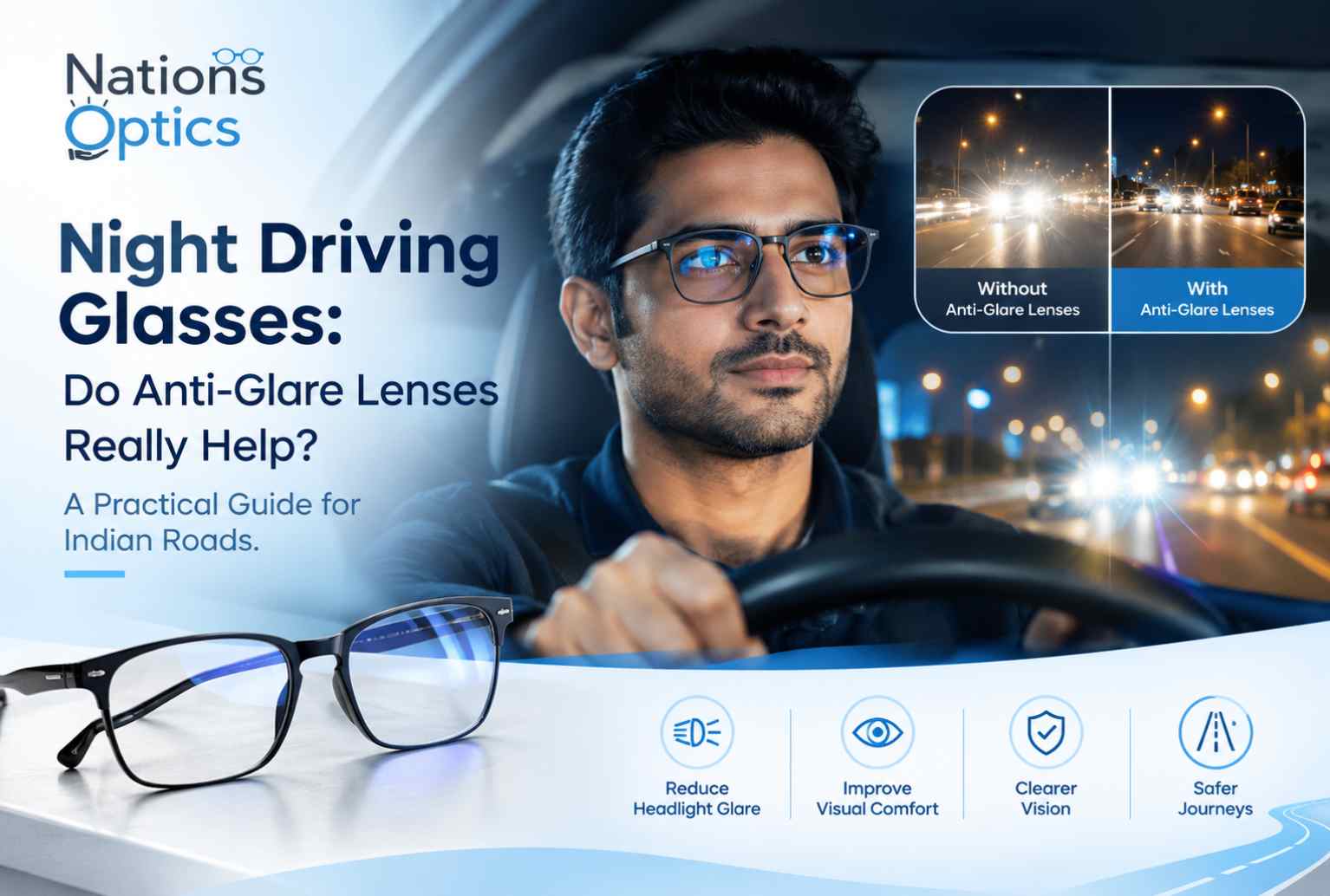
Night Driving Glasses: Do Anti-Glare Lenses Really Help? A Practical Guide for Indian Roads
Oct 9, 2026
By Rahul Jain
0 comment(s)
Lens & Driving Guide
Night Driving Glasses: Do Anti-Glare Lenses Really Help? A Practical Guide for Indian Roads
Bright LED headlights, high beams, potholes and wet roads make night drives tough. Here is what anti-glare lenses can and can't do, and what to avoid.
A quick note: This article is for general information only and is not a substitute for professional medical advice, diagnosis or treatment. If night driving has become difficult, please see a qualified eye-care professional.
Driving at night can be challenging, especially when bright LED headlights, high beams, poorly lit roads, unexpected potholes and reflections from wet surfaces make it hard to see clearly. Many drivers in India search for night driving glasses or anti glare glasses for night driving, hoping to cut headlight glare and see better.
But do anti-glare lenses really help? Are yellow-tinted glasses effective, or are clear lenses with an anti-reflective coating a better choice? The answer depends on the type of lens, your current prescription and the cause of the glare. In this guide, Nations Optics explains how anti-glare glasses work, which lenses may help, what to avoid, and how to make night journeys safer.
Night Driving Anti-Reflective Coating Headlight Glare Indian Roads
What Are Night Driving Glasses?
Night driving glasses are eyewear products marketed to help drivers deal with bright headlights, streetlights and other glare after dark. They are often sold as night vision glasses for driving and may have yellow or amber-tinted lenses. But they don't all work the same way.
Some use clear prescription lenses with an anti-reflective coating. Others use yellow-tinted or darkened lenses that filter some incoming light. Clear prescription glasses correct refractive errors such as myopia, hyperopia and astigmatism when prescribed correctly, and an AR coating reduces reflections from the lens surfaces. Yellow-tinted glasses are marketed as improving contrast and reducing glare, but research has not shown that they improve a driver's ability to detect hazards at night.
The short version: for most people who need corrective eyewear, the priority is clear lenses with the correct prescription and a suitable anti-reflective coating.
Do Anti-Glare Glasses Really Help With Night Driving?
Yes, anti-reflective coatings can reduce distracting reflections from eyeglass lenses. But it's important to know what they can and can't do. "Anti-glare glasses" usually means spectacles with an AR coating, which cuts reflections from the front and back lens surfaces so more light passes through. For some wearers, reflections from headlights, streetlights and dashboard lights become less distracting.
What AR lenses can do
- Reduce reflections from the surfaces of your lenses
- Help minimise distracting reflections when light hits them
- Make your eyes more visible through the lenses
- Work alongside an accurate prescription to support clear vision
What AR lenses cannot do
- Eliminate all glare from oncoming headlights
- Correct an outdated or inaccurate prescription
- Cure cataracts, dry eye or other eye conditions
- Guarantee better night vision for every driver
- Make unsafe speeds or poor visibility safe
Why Is Night Driving Difficult on Indian Roads?
Conditions vary a lot between cities, highways, residential streets and rural roads, and a single journey can throw several visual challenges at you.
1
Bright LED Headlights and High Beams
Oncoming high beams can briefly make road markings, pedestrians and cyclists hard to see. An AR coating may cut reflections from your own lenses, but it can't remove glare that starts inside the eye or tame an overly bright headlight.
2
Poorly Lit Roads
With little street lighting, potholes, animals and pedestrians are hard to spot. Dark or tinted lenses cut the light reaching your eyes and can make this worse.
3
Rain, Fog and Wet Roads
Rain and fog scatter light and lower contrast, and wet roads reflect headlights and signals. Anti-glare lenses can't fix this, so slow down, leave more distance and use the right vehicle lights.
4
Dust, Smudges and Scratches
Dust, fingerprints, oil and scratches scatter light and make bright sources more distracting. Clean lenses, or replacing badly scratched ones, can improve comfort.
5
An Incorrect Prescription
An outdated prescription or uncorrected astigmatism can cause blur, halos or trouble reading road signs at night. If problems persist even with your glasses on, get an eye exam.
What Is the Best Lens Coating for Night Driving?
If you need spectacles, clear prescription lenses with an anti-reflective coating are a sensible option to discuss with an eye-care professional. An AR coating is a thin optical treatment on the lens surfaces that reduces the amount of light reflected from them.
| Feature | Clear lenses without AR | Clear lenses with AR |
|---|---|---|
| Prescription correction | Yes, when prescribed correctly | Yes, when prescribed correctly |
| Surface reflections | May be more noticeable | Reduced |
| Headlight reflections from lens surfaces | May be distracting | May be less distracting |
| Correction of eye conditions | No | No |
| Guaranteed end to night glare | No | No |
An AR coating is not a substitute for the right prescription, and it can't remove every type of glare because some glare starts inside the eye or in the surroundings. When comparing lenses for night driving, look at the prescription, lens clarity, coating quality, fit and your own visual needs rather than marketing claims alone.
Are Yellow Night Driving Glasses Effective?
Yellow glasses are often promoted as a fix for headlight glare and low-light visibility. The tint changes how light and contrast look, but a change in perceived contrast doesn't necessarily mean you can see hazards better.
What the research says: a 2019 study in JAMA Ophthalmology tested yellow-lens glasses in simulated night driving. They did not improve pedestrian detection compared with clear lenses, with or without simulated headlight glare.
Yellow tints also cut some of the light entering your eyes, which can be a disadvantage when it's already dim. So don't rely on them to improve night vision. Clear lenses with the correct prescription and a suitable AR coating are generally the more sensible choice for spectacle wearers. If you want tinted eyewear for daytime driving, pick lenses made for daylight, and don't assume a tint that works in bright sun is right after dark.
Are Blue-Cut Lenses Useful for Night Driving?
Blue-cut lenses filter some blue light wavelengths and are usually marketed for screen use and general comfort. But blue-light filtering and anti-reflective coating are two different features. A blue-cut lens doesn't automatically have an effective AR coating, and blue filtering alone isn't a proven answer to headlight glare.
If glare while night driving is your main worry, ask about clear prescription lenses with an appropriate AR coating instead of choosing a lens just because it's labelled blue-cut.
How to Choose the Best Glasses for Night Driving in India
Choosing well takes more than picking something labelled "night driving glasses". Use this checklist.
1
Check your prescription
Make sure it's current. If distant objects, road signs or number plates look blurred, book an eye exam.
2
Choose clear lenses
Avoid dark, heavily tinted or yellow-tinted lenses at night. Clear lenses keep the available light reaching your eyes.
3
Consider an AR coating
It may reduce distracting reflections from your lens surfaces. If you often drive after dark, discuss it when choosing glasses.
4
Pick a suitable frame
It should fit securely, not slip, and not block your peripheral vision. Comfort matters on long drives.
5
Keep lenses clean
Use a proper lens-cleaning solution and a clean microfibre cloth. Rough fabrics and household cleaners can damage lenses and coatings.
6
Match the lens design
Single-vision, bifocal and progressive lenses suit different needs. If you use progressives, give yourself time to get used to them and raise any driving difficulty with your eye-care professional.
How to Reduce Headlight Glare While Driving at Night
Glasses are only one part of the picture. These steps help too, and they matter even more on Indian roads, where lighting, surfaces and traffic can change quickly.
- Clean your windscreen inside and outside
- Keep your vehicle's headlights clean and correctly aligned
- Use low beams when appropriate so you don't dazzle oncoming traffic
- Keep your glasses clean and replace badly scratched lenses
- Avoid staring at oncoming headlights; keep your eyes on the road and use the left edge of your lane as a reference when appropriate
- Reduce speed when visibility is limited
- Increase your following distance in rain, fog or poorly lit areas
- Avoid driving when tired or sleepy
- Get an eye exam if night vision gets worse or glare becomes unusually troublesome
Why Do Headlights Look Too Bright at Night?
Bright headlights bother many drivers, but frequent or worsening glare deserves attention. Possible contributors include:
- An outdated glasses prescription
- Uncorrected astigmatism or other refractive errors
- Dry eyes or an unstable tear film
- Dirty or scratched lenses
- Cataracts or other eye conditions
- Reflections from the windscreen or your lenses
Halos, starbursts, blurred road signs and trouble seeing pedestrians can each have different causes. AR lenses may reduce reflections from your lens surfaces, but they can't treat an underlying eye condition.
Are Polarized Glasses Suitable for Night Driving?
Polarized lenses mainly reduce certain glare from reflective surfaces in bright conditions, like sunlight bouncing off roads or water. They are not generally recommended for night driving because they can cut useful light when it's already dim. The same goes for dark sunglasses, heavily tinted lenses and mirrored sunglasses: none of them should be used against night-time headlight glare. For night driving, put clear vision and the right prescription first.
Can Prescription Glasses Help With Night Driving Glare?
They can, when the glare or blur is linked to a correctable refractive error. Someone with myopia may struggle to read distant road signs without the right correction, and someone with astigmatism may notice blur or distorted lights, though it varies from person to person.
Clear prescription lenses with an AR coating cover two separate needs: correcting refractive error and reducing reflections from the lens surfaces. Even so, they can't guarantee that every night-driving problem disappears. If your vision stays uncomfortable or unclear with the correct prescription, seek professional advice.
When Should You Get an Eye Test for Night Driving Problems?
Consider booking an eye exam if you regularly have:
- Excessive glare from oncoming headlights
- Halos or starbursts around lights
- Difficulty reading road signs after dark
- Blurred distance vision while driving
- Trouble seeing pedestrians or objects in dim conditions
- A noticeable decline in night vision
- Frequent discomfort even with your usual glasses
Don't just buy stronger anti-glare glasses. Night-driving difficulty can sometimes point to a treatable vision problem or eye condition. A qualified eye-care professional can check your vision and prescription and advise on further tests. Sudden changes in vision need prompt medical assessment.
Find the Right Eyewear for Your Vision Needs With Nations Optics
At Nations Optics, we believe choosing eyewear should start with understanding your vision requirements, not with exaggerated product claims. If you're comparing glasses for driving at night, focus on a suitable prescription, clear lenses, an appropriate AR coating and a comfortable frame.
We offer online eyewear options for different vision needs, including prescription-compatible frames and lens choices. Before ordering prescription glasses online, double-check your prescription details. And if you're having new or persistent night-driving problems, see an eye-care professional before assuming a lens upgrade alone will help.
Frequently Asked Questions
Do anti-glare glasses really work for night driving?
Clear prescription glasses with an anti-reflective coating can reduce reflections from the lens surfaces. They may improve comfort for some wearers, but they don't eliminate all headlight glare or correct underlying eye conditions.
What are the best glasses for driving at night in India?
For people who need spectacles, clear lenses with the correct prescription and an appropriate anti-reflective coating are a sensible starting point. Avoid dark or heavily tinted lenses at night.
Do yellow night driving glasses improve vision?
Current evidence doesn't show that yellow-tinted night driving glasses help a driver detect hazards better at night. The tint may also reduce useful light in low-light conditions.
Can anti-reflective coating stop headlight glare completely?
No. It reduces reflections from the surfaces of your lenses, but it can't remove glare from every source, including light scattering inside the eye and reflections from wet roads.
Are blue-cut lenses good for night driving?
Blue-cut lenses filter some blue wavelengths, which is not the same as reducing surface reflections. Blue-light filtering alone is not a proven fix for night-driving glare.
Are polarized glasses suitable for night driving?
Generally, no. Polarized or darkened lenses may reduce useful light in dim conditions. Clear lenses are preferable at night.
Can an incorrect glasses prescription cause night-driving problems?
Yes. An outdated or unsuitable prescription can contribute to blurred vision or trouble seeing clearly at night. An eye exam can show whether it needs updating.
Why do I see halos around headlights at night?
Halos may be linked to refractive errors, dry eyes, cataracts or other eye conditions. If they are persistent, new or worsening, get an eye exam.
How can I reduce glare from LED headlights while driving at night?
Keep your windscreen and glasses clean, keep your prescription up to date, avoid looking directly at oncoming headlights, and slow down when visibility is poor. If glare continues, see an eye-care professional.
Are anti-glare lenses worth buying for night driving?
They may be worth considering if you wear prescription glasses and reflections from the lens surfaces bother you. Ask about a suitable AR coating, but don't expect it to remove all glare.
Final Thoughts
Night driving glasses can sound like a simple fix for bright headlights, but the type of lens matters. Clear prescription lenses with a suitable AR coating can reduce reflections from your lens surfaces. Yellow-tinted or dark lenses shouldn't be relied on to improve night vision.
For safer night driving on Indian roads, keep your prescription accurate, keep your glasses and windscreen clean, drive to match visibility, and seek professional advice if night vision becomes difficult. At Nations Optics, our goal is to help you make informed eyewear choices based on your vision needs, not just marketing claims.
Drive Into the Night With Clear Vision
Browse prescription-ready frames and lens options chosen for clarity and comfort.
Explore Anti-glare LensesExclusive Offers
Sitewide
33%
OFF
Flat 33% off on all products
Already applied on every price · no coupon needed
Auto-applied
10%
OFF
On orders ₹1,200 – ₹1,799
No coupon needed · saves automatically
Auto-applied
15%
OFF
On orders ₹1,800 – ₹3,199
No coupon needed · saves automatically
Best Deal 🔥
20%
OFF
On orders above ₹3,200
No coupon needed · saves automatically
Pay Advance
₹50
SAVED
Pay advance amount at checkout
Flat ₹50 off · pay balance on delivery
Pay Full ✓
₹100
SAVED
Pay full amount at checkout
Maximum saving · instant confirmation
N
Nations Optics Assistant
● Online
👋 Hi! I'm your Nations Optics assistant. Ask me anything about lenses, frames, or prescriptions!