
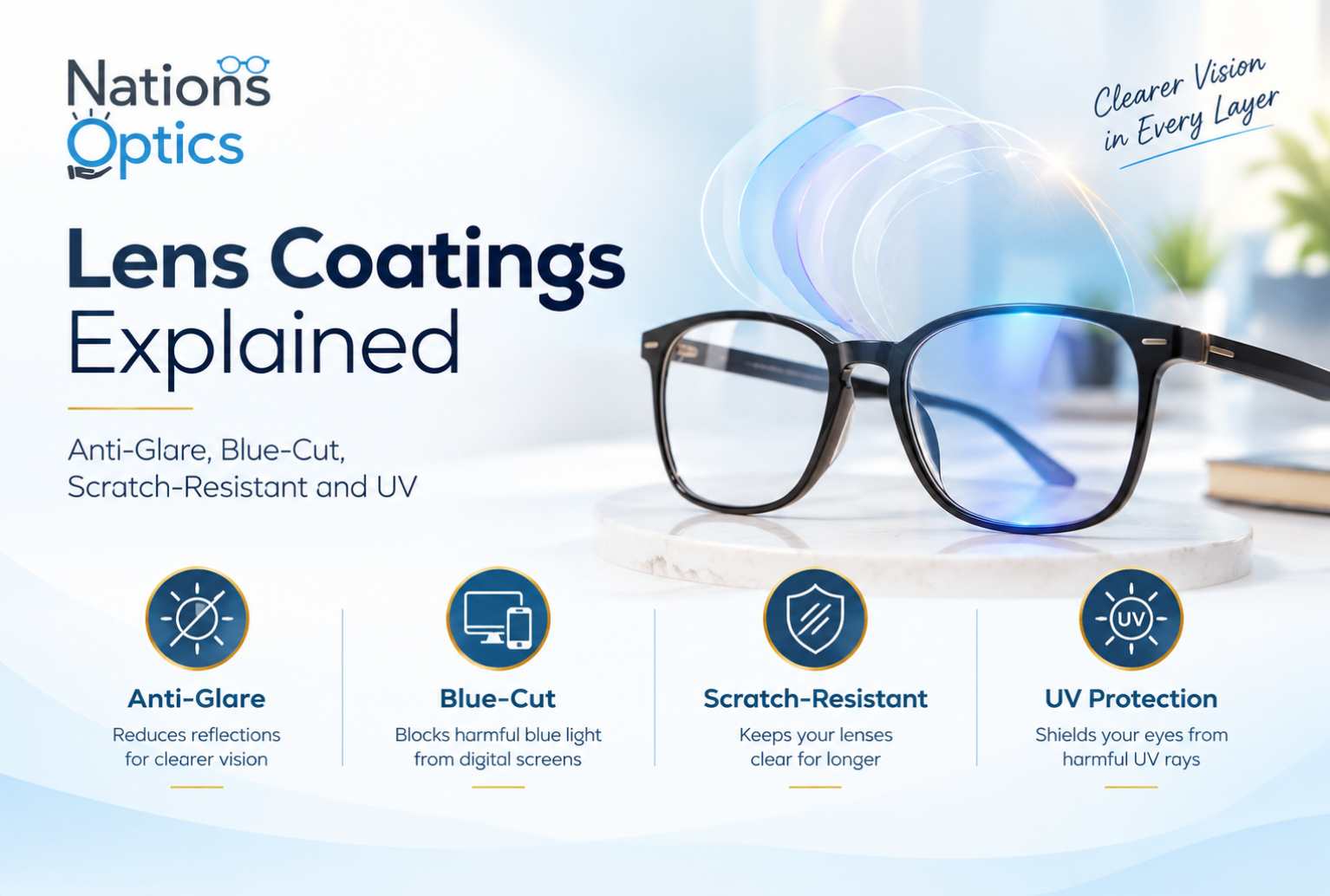
Lens Coatings Explained: Anti-Glare, Blue-Cut, Scratch-Resistant and UV
Oct 19, 2026
By Rahul Jain
0 comment(s)
Lens Guide
Lens Coatings Explained: Anti-Glare, Blue-Cut, Scratch-Resistant and UV
What each coating does, which ones you can skip, and how to pick without wasting money.
A quick note: This article is general information and not medical advice. If you have eye strain, headaches or vision changes, please see a qualified eye-care professional.
You pick a frame, choose a lens type, and then a list of options pops up: anti-glare, blue-cut, scratch-resistant, UV. Each one adds to the price, and it's hard to know which ones you really need.
So here's the short version. We'll go through what each coating does, who gets the most out of it, and which mix makes sense for different people.
Anti-GlareBlue-CutScratch-ResistantUV Protection
What Is a Lens Coating?
A coating is a very thin layer on the surface of a lens. You can't feel it, but it changes how the lens deals with light, dust and daily wear. It's added when the lenses are made, so decide before you order, not after.
The Four Coatings, Briefly
1
Anti-glare (AR) coating
A thin layer that cuts reflections. Vision looks cleaner, night glare drops and the lenses almost disappear on your face. If you wear glasses all day, this is the one you'll notice first.
2
Blue-cut coating
Filters some of the blue-violet light from screens and LEDs. Plenty of people say their eyes feel easier on long screen days. The science is still mixed, so read what we say about it below.
3
Scratch-resistant coating
A hard layer on the surface that helps lenses handle daily life: keys in a bag, a quick wipe on your shirt, a fall off the table. It lowers the risk of scratches, but it doesn't make lenses scratchproof.
4
UV protection
Blocks ultraviolet rays that can harm your eyes over the years. It matters outdoors, but UV is there on cloudy days too, and it also protects the skin around your eyes.
Anti-Glare Coating: Usually the First Pick
Plain lenses bounce back some of the light that hits them. You see it as glare, ghost images and shiny patches that hide your eyes. An anti-glare coating cuts most of that.
- Cuts the reflections that bounce off the front and back of your lenses.
- Lets people see your eyes properly, which looks better in photos and on video calls.
- Softens glare from headlights, street lamps and tube lights, so it's a big help for night driving.
- Shows fingerprints and dust more, so keep a microfibre cloth handy.
Blue-Cut Coating: What It Can and Can't Do
Screens and LED lights give off blue-violet light, and blue-cut lenses filter some of it. People often say their eyes feel more comfortable at the end of a long day.
Now the catch. Eye-care organisations say there's no strong evidence that screen blue light damages the eyes, or that blue-cut lenses reduce digital eye strain. Most of the strain comes from staring without blinking, poor lighting and no breaks. So think of blue-cut as a comfort extra, not a cure.
What helps more: blink often, take a short break every 20 minutes, keep the screen at arm's length and sort out your room lighting. Our Eye Exercises post has the full routine.
Scratch-Resistant Coating: Protection for Daily Wear
Lenses scratch easily, and a scratch never comes off. A hard coat gives the surface a tougher skin, so everyday knocks do less damage. It's especially handy for kids, commuters and anyone who tosses glasses into a bag.
It's not scratchproof, though, so good habits still matter. Care tips are below.
UV Protection: A Small Add-On for Your Eyes
Ultraviolet rays are linked to long-term eye problems like cataracts, and they also affect the delicate skin around your eyes. A UV-blocking lens helps with all of that, in bright sun and on cloudy days.
Look for UV400 protection, which blocks light up to 400 nanometres. If you're outdoors a lot, sunglasses are still the better tool for bright sun.
Quick Comparison
| Coating | Helps with | Best for | The catch |
|---|---|---|---|
| Anti-glare | Reflections, night glare, clear look | Almost everyone, especially night drivers and high-power lenses | Needs gentle cleaning |
| Blue-cut | Comfort during long screen use | Desk jobs, students, heavy phone users | Not a cure for eye strain |
| Scratch-resistant | Everyday wear and tear | Kids, busy commuters, anyone who is rough on glasses | Not scratchproof |
| UV protection | Sun exposure | Everyone, indoors and out | Check that it's UV400, or ask what your lens offers |
Which Coatings Suit Your Life?
Office worker or student
Anti-glare plus blue-cut, with a good habit of taking breaks. Our 20-20-20 tips are in the Eye Exercises post.
Frequent night driver
Anti-glare comes first. Read our night driving guide for more.
Kids
Scratch-resistant, because kids will drop them. Add UV protection for school and playground hours.
Outdoor lover
UV protection first. For sun, a separate pair of sunglasses does a better job than clear lenses with UV.
Heavy phone user
Anti-glare and blue-cut together, plus keeping the screen at a comfortable distance.
High-power wearer
Anti-glare makes a visible difference on thicker lenses, where reflections are stronger.
How to Pick Without Wasting Money
You don't need every option on every pair. Here's a simple way to decide.
- Start with anti-glare. For most people it's the best value.
- Add scratch-resistant if you're rough on glasses or buying for a child.
- Add UV protection for anyone who's outdoors during the day.
- Add blue-cut if you spend long hours on screens and like the extra comfort.
- If budget is tight, drop the coating that matters least for your day.
You can compare lens options on the Lens Collection page, and the lens step in Personalize Your Lenses lets you build your choice with your prescription.
Mistakes to Avoid
Coating mistakes to avoid
- Expecting blue-cut to fix tired eyes on its own. Breaks and good lighting do more.
- Believing any coating makes glasses scratchproof.
- Cleaning with your shirt, tissue paper or a dry cloth. Use a microfibre cloth and lens spray.
- Leaving glasses on a hot dashboard, since heat can damage coatings.
- Paying for a coating you don't need instead of one you do.
How to Care for Coated Lenses
- Rinse with lukewarm water first to wash off dust.
- Wipe with a clean microfibre cloth, not clothing or tissues.
- Use lens cleaning spray or a drop of mild dish soap, then rinse.
- Keep glasses in a case when you're not wearing them.
- Avoid hot cars, hot water and strong chemicals such as sanitiser or cleaning sprays.
Frequently Asked Questions
Which lens coating is the most important?
For most people, anti-glare. It improves how you see and how your glasses look. After that, choose by lifestyle: blue-cut for screens, scratch-resistant for rough use and UV for time outdoors.
Should I pay for blue-cut?
It depends on what you expect. Some people find screen work more comfortable with it. Eye-care bodies say there isn't enough proof that it prevents eye damage or fixes digital eye strain. Take regular breaks either way.
Are scratch-resistant lenses scratchproof?
No. The coating makes scratches less likely, but no lens is completely scratchproof. Cleaning and storing your glasses properly matters just as much.
Do I need UV protection if I wear glasses indoors?
UV levels are lower indoors, but you're still exposed near windows and when you step outside. It's a small add-on, and your eyes get the benefit for years.
Does anti-glare coating help with night driving?
Yes. It reduces the halos and reflections from oncoming headlights. If you drive at night often, it's the coating we'd put first.
Can I get all four coatings on one lens?
Often, yes, but options depend on the lens you choose. Look at the Lens Collection or the lens step in Personalize Your Lenses to see what is available for your prescription.
Why do my coated lenses show smudges more?
Anti-glare lenses are so clear that fingerprints and dust stand out. A microfibre cloth and lens spray fix it in seconds.
Can I add a coating to my old glasses later?
Usually not. Coatings are applied during lens making, so it's best to decide when you order new lenses.
Will coatings change how my glasses look?
Anti-glare makes lenses look almost clear. Blue-cut can show a faint blue or purple shine in some light. That's normal.
How long do lens coatings last?
With gentle cleaning and a case, they last for the life of the lenses. Heat, harsh chemicals and rough wiping shorten that.
Ready to Choose Your Lenses?
Browse our lens options and build the pair that suits your eyes and your budget.
Explore the Lens CollectionExclusive Offers
Sitewide
33%
OFF
Flat 33% off on all products
Already applied on every price · no coupon needed
Auto-applied
10%
OFF
On orders ₹1,200 – ₹1,799
No coupon needed · saves automatically
Auto-applied
15%
OFF
On orders ₹1,800 – ₹3,199
No coupon needed · saves automatically
Best Deal 🔥
20%
OFF
On orders above ₹3,200
No coupon needed · saves automatically
Pay Advance
₹50
SAVED
Pay advance amount at checkout
Flat ₹50 off · pay balance on delivery
Pay Full ✓
₹100
SAVED
Pay full amount at checkout
Maximum saving · instant confirmation
N
Nations Optics Assistant
● Online
👋 Hi! I'm your Nations Optics assistant. Ask me anything about lenses, frames, or prescriptions!