
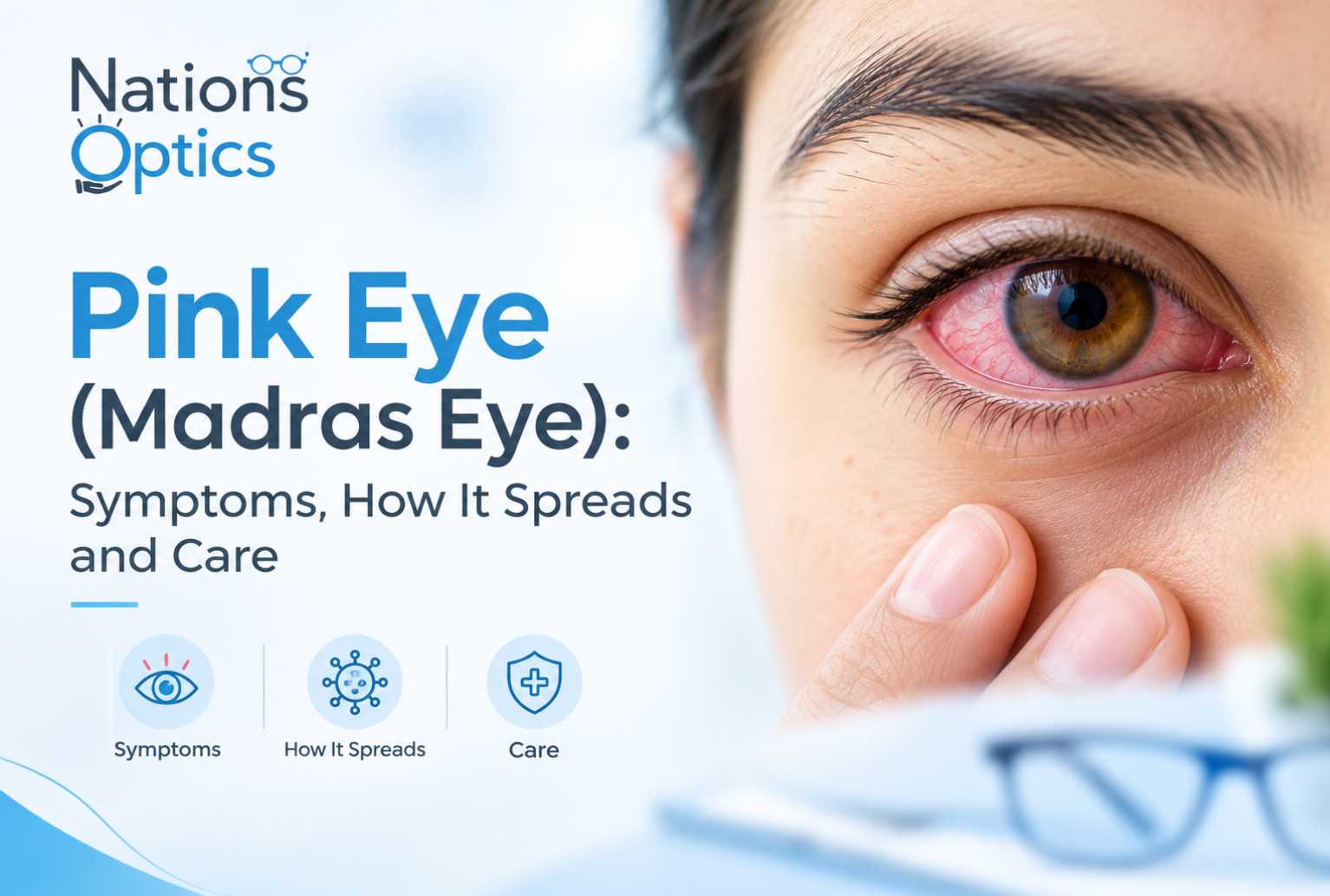
Pink Eye (Madras Eye): Symptoms, How It Spreads and Care
Oct 28, 2026
By Rahul Jain
0 comment(s)
Eye Health
Pink Eye (Madras Eye): Symptoms, How It Spreads and Care
How to spot it, how it spreads, what helps and when to see an eye doctor.
A quick note: This article is for general information and isn't medical advice, diagnosis or treatment. Pink eye can have different causes, and some need prescription treatment. If you have eye pain, vision changes or symptoms that don't settle, please see a qualified eye doctor.
You wake up and one eye is red, gritty and stuck shut. By evening the other one has joined in. If that sounds familiar, it could be pink eye, which a lot of people in India call Madras Eye.
It's common, and it spreads fast in homes, schools and offices. Here's how to spot it, how it spreads, what you can do at home, what to avoid and when to get help. There are tips for glasses and contact lens wearers too.
ConjunctivitisMadras EyeSymptomsPrevention
What Is Pink Eye (Madras Eye)?
Pink eye is the everyday name for conjunctivitis. That means the conjunctiva, the thin clear layer over the white of your eye and inside your eyelids, is inflamed. The tiny blood vessels in it swell up, so your eye looks pink or red.
In India, it's often called Madras Eye. It tends to hit in waves, especially where lots of people live and work close together.
Not every red eye is an infection. Smoke, dust and dryness can irritate your eyes too. If that sounds more like you, read our Navratri and Dussehra eye care guide and our guide to dry eye syndrome.
The Main Types of Pink Eye
Not all pink eye is the same, and treatment depends on the type. That's why it's worth getting it checked.
| Type | Usual cause | Contagious? | Common signs |
|---|---|---|---|
| Viral | A virus, often the same kind that causes colds | Yes, very | Watery discharge and red eyes. Often starts in one eye, then reaches the other |
| Bacterial | Bacteria | Yes | Thick, sticky yellow or green discharge. Lids stuck together after sleep |
| Allergic | Pollen, dust, pet hair or other triggers | No | Strong itching, watery and puffy eyes, usually both, often with sneezing |
| Irritant | Smoke, chlorine, chemicals, dust | No | Redness and watering after exposure. Usually settles once the cause is gone |
Common Symptoms
1
Redness
The white of the eye turns pink or red. It can start in one eye and reach the other within a day or two.
2
Gritty feeling
It feels like sand or dust is stuck in your eye, and blinking doesn't fix it.
3
Watering or discharge
Either watery, or thick and sticky. Your lids may be stuck together when you wake up.
4
Itching and swollen lids
Itching, burning and puffy lids are common. Very strong itching usually points to an allergy.
5
Light sensitivity
Bright light can feel uncomfortable. If it's strong or painful, see a doctor.
6
Slight blurriness
Mucus can blur your vision for a moment, and it clears when you blink or wipe. Blur that stays isn't normal.
How Pink Eye Spreads
Viral and bacterial pink eye are contagious. They spread through the discharge from the eye, which gets on your hands and then on everything you touch.
- Touching an infected eye, then touching a door handle, phone, towel or another person.
- Sharing towels, handkerchiefs, pillows, make-up or eye drops.
- Close contact in crowded places such as schools, offices and hostels.
- Coughs and sneezes, when the infection comes with a cold.
- Rubbing your eyes with unwashed hands, which carries it from one eye to the other.
Myth: You can catch pink eye just by looking at someone who has it. Fact: It spreads through the eye's discharge, usually via hands and shared items. Looking at someone doesn't pass it on, and dark glasses won't protect you.
How Long Does It Last?
It depends on the cause. Viral pink eye often clears in one to two weeks. Bacterial pink eye usually improves with the right treatment. Allergic pink eye lasts as long as the trigger is around. Your doctor can tell you what to expect.
You can usually spread it while your eye is red and discharging, so ask your doctor when you're safe around others.
What You Can Do While You Recover
- Get it checked early. Only a doctor can tell if it's viral, bacterial or allergic, and each needs different treatment.
- Wash your hands often. Use soap and water, especially after touching your face or eyes.
- Don't rub your eyes. It makes irritation worse and spreads it to the other eye.
- Clean the discharge gently. Use a fresh, clean cotton ball or tissue for each wipe, from the inner corner outwards, then throw it away.
- Use a cool, clean compress. A clean, damp cloth over closed eyes can ease swelling and soreness.
- Keep towels and pillowcases separate. Wash them in hot water.
- Use only the drops your doctor prescribes. Don't share them, and finish the full course.
- Stay home while you're contagious. Ask your doctor when you can go back to work or school.
What Not to Do
Please avoid:
- Using leftover antibiotic or steroid eye drops from an earlier illness. Steroid drops can seriously harm the eye if used without advice.
- Asking the chemist for 'any red eye drops' and using them for days.
- Putting home remedies such as rose water, tea bags, breast milk or ghee in your eyes.
- Wearing contact lenses or eye make-up until the doctor says it's fine.
- Sharing drops, towels or glasses.
When to See an Eye Doctor
See an eye doctor without waiting if you have:
- Eye pain, not just irritation.
- Blurry vision that doesn't clear when you blink or wipe the eye.
- Strong sensitivity to light.
- A very red eye that's getting worse, or a lot of thick discharge.
- Symptoms that don't improve within a few days.
- A weak immune system, or an existing eye condition.
- A baby or young child with a red, sticky eye.
- Contact lenses. Take them out and keep them out until a doctor says it's okay.
Want to know about other warning signs? See our guide to common eye diseases and early warning signs.
If You Wear Glasses or Contact Lenses
- Switch to glasses. If you wear contact lenses, take them out as soon as your eye turns red and stay in glasses until a doctor says you can restart.
- Replace what touched the eye. Throw away the lenses you wore and the case. Using them again can bring the infection back.
- Clean your glasses. Wash the lenses, frame, nose pads and arms with mild soap and water, then dry with a clean cloth. Do this every day while you're unwell. Our lens care guide explains safe cleaning.
- Don't share glasses. Frames sit on your face, so a shared pair can pass germs along.
- Consider sunglasses for comfort. Dark lenses can ease light sensitivity and remind you not to touch your eyes. They won't stop the infection from spreading.
- Wash your hands before you put your glasses on or take them off.
For the full contact lens care rules, read our glasses vs contact lenses guide.
How to Stop It Spreading
- Wash your hands often, and use sanitiser when you can't wash.
- Keep your hands away from your eyes.
- Don't share towels, make-up, eye drops or glasses.
- Change pillowcases and towels often if someone at home is infected.
- Skip crowded swimming pools while you have symptoms.
- Wipe phones, keyboards and door handles if someone at home is infected.
Pink Eye and Children
Pink eye spreads fast in classrooms, which makes it a common reason for kids to miss school.
- Keep your child home while the eye is red and discharging, unless the doctor or school says otherwise.
- Teach children not to rub their eyes and to wash their hands.
- Give your child their own towel and tissues.
- Tell the school if there's an outbreak, so other parents can watch for signs.
For more on children's eyes, see our guide on kids first glasses and signs they need an eye test.
Frequently Asked Questions
What is Madras Eye?
Madras Eye is what people in India commonly call conjunctivitis, or pink eye. It's inflammation of the thin clear layer over the white of the eye and inside the lids.
How long does pink eye last?
It depends on the cause. Viral pink eye often clears in one to two weeks, bacterial usually improves faster with the right treatment, and allergic lasts as long as the trigger is around. See a doctor so you know which one you have.
Is pink eye contagious?
Viral and bacterial pink eye are contagious. Allergic and irritant pink eye are not. You can't tell which type you have just by looking, so treat every red, sticky eye as contagious until a doctor says otherwise.
Can I get pink eye by looking at someone who has it?
No. It spreads through contact with the discharge, usually through hands, towels and shared items.
Can I go to work or school with pink eye?
If your eye is red and discharging, it's safest to stay home until a doctor says you're no longer contagious. Many workplaces and schools have their own rules too.
Can I wear glasses with pink eye?
Yes, and it's better than wearing contact lenses. Clean your glasses daily, and don't share them.
Should I wear sunglasses with pink eye?
They can make bright light easier to bear and may stop you touching your eyes. They don't prevent the spread.
Can I use eye drops from the chemist?
Please see a doctor first. Antibiotic or steroid drops used without advice can do harm, and the wrong drops won't help a viral infection.
When can I wear contact lenses again?
Only when a doctor says your eye has fully recovered. Throw away the lenses and case you used during the infection and start with new ones.
How can I stop pink eye from spreading at home?
Use separate towels, wash your hands often, wash pillowcases and towels in hot water, and don't share drops, make-up or glasses.
Keep Reading
Looking After Your Eyes This Season
Browse our eye frames and sunglasses for everyday comfort.
Browse Eye FramesExclusive Offers
Sitewide
33%
OFF
Flat 33% off on all products
Already applied on every price · no coupon needed
Auto-applied
10%
OFF
On orders ₹1,200 – ₹1,799
No coupon needed · saves automatically
Auto-applied
15%
OFF
On orders ₹1,800 – ₹3,199
No coupon needed · saves automatically
Best Deal 🔥
20%
OFF
On orders above ₹3,200
No coupon needed · saves automatically
Pay Advance
₹50
SAVED
Pay advance amount at checkout
Flat ₹50 off · pay balance on delivery
Pay Full ✓
₹100
SAVED
Pay full amount at checkout
Maximum saving · instant confirmation
N
Nations Optics Assistant
● Online
👋 Hi! I'm your Nations Optics assistant. Ask me anything about lenses, frames, or prescriptions!