
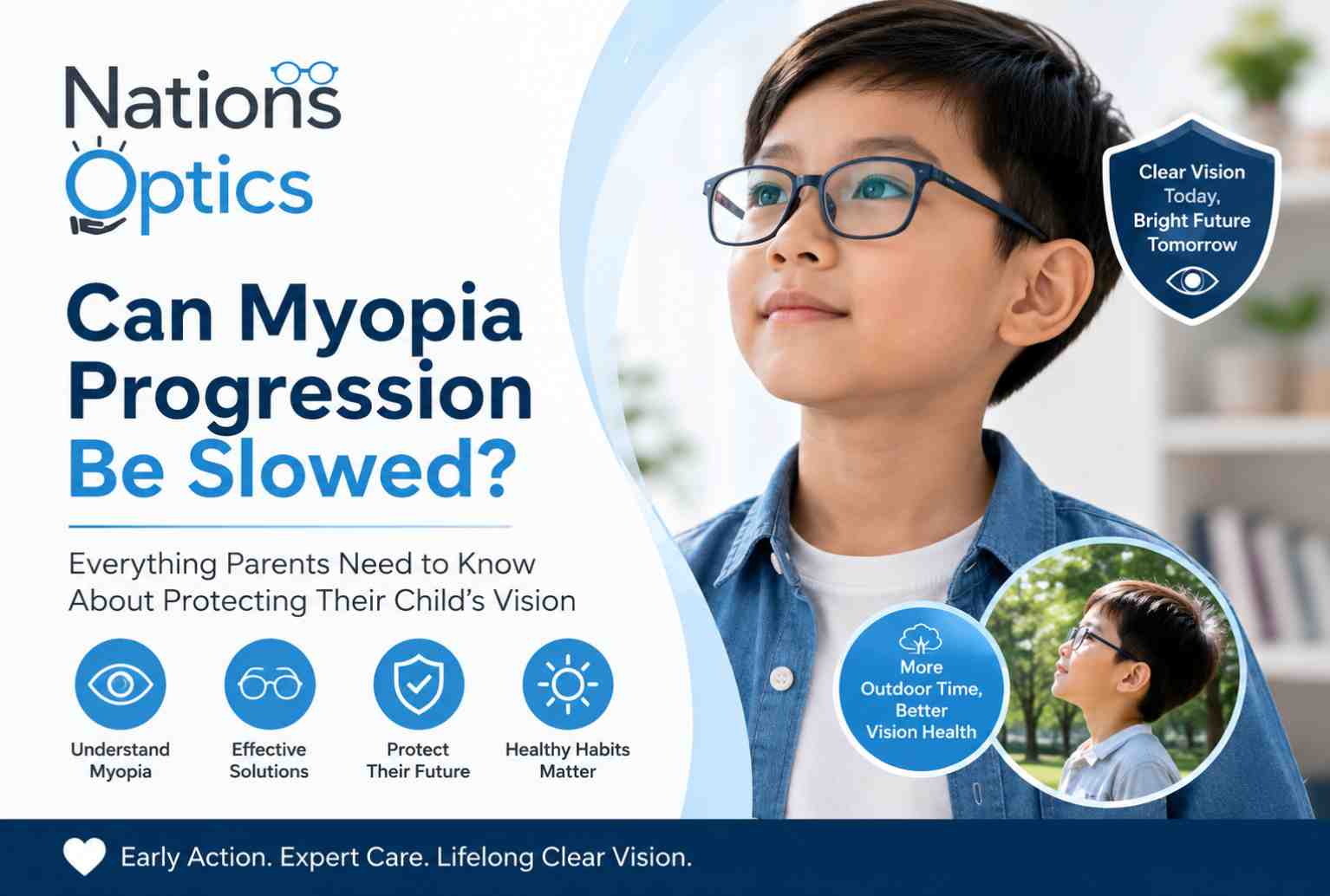
Can Myopia Progression Be Slowed? Parent's Complete Guide
Jul 1, 2026
By Rahul Jain
0 comment(s)
Children's Vision Guide
Can Myopia Progression Be Slowed? What Every Parent Needs to Know
If your child's prescription climbs year after year, there's encouraging news. Myopia can't usually be cured, but modern eye care can meaningfully slow how fast it progresses.
If you've noticed your child's glasses prescription increasing year after year, you're probably asking an important question: can myopia progression be slowed? The answer is encouraging. While myopia (nearsightedness) usually can't be cured, modern eye care has made real progress in slowing its progression in many children.
Childhood myopia is rising worldwide. More children spend hours on screens, study indoors, and play outside far less than before, and eye care professionals are seeing vision worsen at younger ages. The good news: early diagnosis, healthy habits, regular eye exams, and specially designed myopia control lenses can manage the condition effectively, and parents play a vital role.
01What Is Myopia?
Myopia, or nearsightedness, is one of the most common vision conditions in children and young adults. A child with myopia sees nearby objects clearly, but distant objects look blurry. This happens because the eyeball grows too long or the cornea is too curved, so light focuses just in front of the retina instead of on it.
How myopia focuses light
focus point retinaIn a myopic eye, light focuses in front of the retina, so distant objects appear blurred.
Children with myopia may struggle to see the classroom board, road signs, the television, or distant faces. Left unmanaged, the prescription can keep rising each year, which is why understanding progression is the first step to protecting long-term eye health.
02Why Is Childhood Myopia Increasing?
Eye care professionals worldwide have seen a significant rise in childhood myopia over the past decade. Several lifestyle shifts appear to be driving it:
Increased Screen Time
Continuous focus on nearby phones, tablets, and computers puts extra visual demand on growing eyes.
Less Outdoor Play
Time outdoors may reduce rapid progression, but online learning and indoor entertainment cut it short.
Genetics
If one or both parents are myopic, a child is more likely to develop it. Lifestyle then shapes how fast it progresses.
Continuous Near Work
Long stretches of reading, studying without breaks, and device use add visual strain that can accelerate progression.
Children in urban environments often have fewer outdoor opportunities and more near work, raising the likelihood of developing myopia.
03Can Myopia Progression Be Slowed?
Yes. Scientific studies show progression can be slowed in many children through a combination of professional eye care, specialised vision correction, and healthy daily habits. No treatment completely stops eye growth or permanently cures myopia, but early intervention makes a significant difference. The earlier it's detected, the better the opportunity to manage it, waiting until prescriptions are very high may raise the risk of future complications.
04Signs Your Child's Eyesight Is Getting Worse
Watch for these common signs
Squinting at the TV
Sitting very close to the TV
Holding books extremely close
Complaining of blurry distance vision
Frequent headaches
Rubbing the eyes often
Trouble seeing the board
Less interest in outdoor play
Prescription rising every year
If you notice several of these, don't delay an eye examination.
05Myopia Control Lenses: A Modern Approach
One of the most effective advances in modern eye care is the myopia control lens. Unlike ordinary lenses that simply correct blur, these are designed to reduce the rate of progression by influencing how light focuses on different parts of the retina.
- Slower progression of myopia in many children
- Clear vision throughout the day
- Comfortable daily wear
- Reduced need for frequent prescription changes
- Support for long-term eye health
Not every child needs the same lens design, a comprehensive eye examination is essential first. At NationsOptics, our team helps parents understand the available lens technologies and recommends high-quality lenses tailored to each child's needs.
06How to Slow Myopia Naturally
These everyday habits complement professional treatment and support healthy visual development.
1
Spend more time outdoors
Aim for at least two hours a day when possible, cycling, walking, sports, gardening, or family outings. Natural light and distant focusing may help slow progression.
2
Follow the 20-20-20 rule
Every 20 minutes, look at something at least 20 feet away for 20 seconds to relax the focusing muscles.
3
Limit continuous screen time
Encourage breaks, avoid screens at meals and before bed, and make room for offline hobbies and daily outdoor play.
4
Maintain proper reading distance
Hold books and devices roughly 35–40 cm from the eyes, and avoid reading while lying down.
5
Ensure good lighting
Study areas should have enough natural or artificial light, without glare, to reduce strain.
6
Encourage healthy nutrition
No food cures myopia, but a balanced diet supports overall eye health. Focus on Vitamin A, C and E, Omega-3, Zinc, Lutein, and Zeaxanthin.
20·20·20
Every 20 minutes, look 20 feet away for 20 seconds, an easy habit that relaxes the eyes and eases screen strain.
Good food choices include carrots, spinach, kale, eggs, fish, citrus fruits, nuts, sweet potatoes, and bell peppers. Regular physical activity helps too, it improves overall health and gets children outdoors and away from screens.
07Common Myths About Myopia
✕Wearing glasses makes eyes weaker
False. Properly prescribed glasses improve vision and reduce strain, they do not weaken the eyes.
✕Children will outgrow myopia
Unlikely. Most children don't outgrow it, prescriptions often keep increasing until the late teens.
✕Eating carrots can cure myopia
No. Carrots support eye health through Vitamin A, but they can't reverse or cure myopia.
✕Only screen time causes myopia
Not quite. Screens are one factor, genetics, reduced outdoor time, and prolonged near work all play a part.
08When Should Parents Schedule an Eye Exam?
Routine exams matter even when children don't complain about blurry vision. Book one if:
- Your child squints frequently or sits unusually close to the TV
- Vision becomes blurry at school
- Headaches occur regularly
- The prescription increases every year
- Teachers notice difficulty seeing the board
- One or both parents have myopia
Early diagnosis lets professionals recommend the right management plan before myopia progresses significantly.
09Why Managing Myopia Early Matters
Many parents assume rising spectacle power is just part of growing up. But high myopia can increase the risk of future conditions, including retinal problems, glaucoma, cataracts, and myopic macular degeneration. Managing it early isn't only about reducing dependence on stronger glasses, it's about supporting lifelong eye health. Regular monitoring lets professionals adjust the plan as your child grows.
10How NationsOptics Protects Your Child's Vision
Personalised eyewear, expert guidance
Every child's eyes are unique, so we focus on tailored solutions backed by quality products and honest advice.
Premium prescription lenses
High-quality kids' eyeglasses
Lightweight, durable frames
UV protection lens options
Blue light filtering lenses
Comfortable everyday designs
Affordable, quality-first pricing
Support to choose the right eyewear
11Frequently Asked Questions
Can myopia progression be slowed?
Yes. Early diagnosis, regular monitoring, healthy visual habits, and specialised myopia control lenses can slow progression in many children.
At what age does myopia usually begin?
It often develops between ages 6 and 14, though it can appear earlier or later depending on genetics and environment.
Are myopia control lenses effective?
Studies suggest they can reduce the rate of progression in many children when prescribed appropriately by a professional.
How often should children have an eye exam?
Most children should have a comprehensive exam every year, or more often if recommended.
How can parents slow myopia naturally?
Encourage outdoor time, follow the 20-20-20 rule, limit continuous screen use, maintain proper reading distance, ensure good lighting, and provide a balanced diet.
Is my child's eyesight getting worse because of mobile phones?
Phones alone aren't the only cause. Genetics, prolonged near work, lack of outdoor time, and heavy screen use combine to affect vision.
12Conclusion
If you've been asking whether myopia progression can be slowed, the answer is reassuring. Myopia usually can't be reversed, but its progression can often be managed through early detection, regular exams, healthy habits, and modern myopia control lenses. Understanding progression empowers parents to act before changes become significant.
At NationsOptics, we're committed to helping families protect their children's vision with premium eyewear, expert guidance, and quality lens solutions. If you've noticed your child's eyesight getting worse, don't wait for the next prescription change, take proactive steps today.
Protect your child's vision today
Explore lightweight kids' frames and myopia-friendly lens options, or reach out for guidance on the right choice for your child.
Shop Kids' EyewearExclusive Offers
Sitewide
33%
OFF
Flat 33% off on all products
Already applied on every price · no coupon needed
Auto-applied
10%
OFF
On orders ₹1,200 – ₹1,799
No coupon needed · saves automatically
Auto-applied
15%
OFF
On orders ₹1,800 – ₹3,199
No coupon needed · saves automatically
Best Deal 🔥
20%
OFF
On orders above ₹3,200
No coupon needed · saves automatically
Pay Advance
₹50
SAVED
Pay advance amount at checkout
Flat ₹50 off · pay balance on delivery
Pay Full ✓
₹100
SAVED
Pay full amount at checkout
Maximum saving · instant confirmation
N
Nations Optics Assistant
● Online
👋 Hi! I'm your Nations Optics assistant. Ask me anything about lenses, frames, or prescriptions!