Why Do Glasses Prescriptions Expire? What You Need to Know
Aug 20, 2026
By Rahul Jain
0 comment(s)
Prescription & Ordering Guide
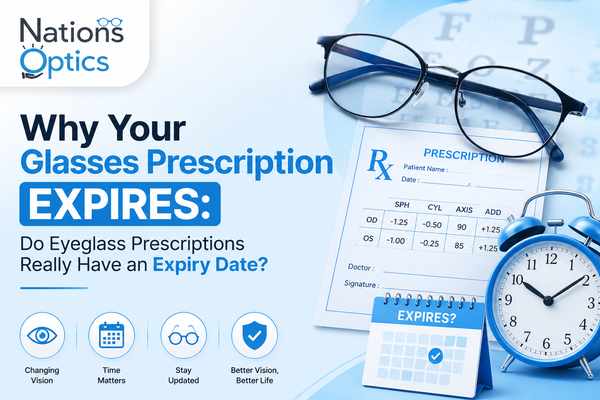
Why Your Glasses Prescription Expires: Do Eyeglass Prescriptions Really Have an Expiry Date?
Trying to reorder glasses and getting stopped by an "expired prescription" message? Here's what that actually means — and why it's there to help, not hinder.
If you've ever tried to reorder glasses online using an old prescription, you may have run into a message saying your prescription has expired. It can be a confusing moment — a prescription is just a set of numbers, so why would it stop being valid?
The short answer: yes, eyeglass prescriptions really do expire, and there's a legitimate reason behind it. This guide explains why prescriptions have a shelf life, how long they typically stay valid, what happens if you order with an expired one, and what to do if yours has lapsed.
Prescription Validity
Eye Health Changes
Ordering Online
Renewal Process
Contacts vs Glasses
Do Glasses Prescriptions Actually Expire?
Yes. A glasses prescription is not meant to be used indefinitely. It reflects your vision and eye health at the specific moment of your eye examination, and both of those things can change — sometimes gradually, sometimes faster than expected. An expiry date is simply a built-in reminder that enough time has passed that your prescription should be reconfirmed before it's used again.
In short: the expiry isn't about the numbers on the paper going "stale" — it's a proxy for how much time has passed since someone actually looked at your eyes and confirmed those numbers are still correct.
Why Do Prescriptions Have an Expiry Date at All?
1
Vision Changes Over Time
Refractive error — the amount of correction your eyes need — can shift gradually, especially in children, young adults whose eyes are still developing, and older adults experiencing age-related changes like presbyopia. A prescription that was accurate a year or two ago may no longer match your current vision.
2
An Expiry Date Encourages Regular Eye Exams
Eye exams check far more than just your prescription. They screen for early signs of conditions like glaucoma, cataracts, and other eye health issues that often develop without obvious symptoms. An expiry date nudges people to keep that screening on a regular schedule rather than skipping it indefinitely.
3
Certain Eye Conditions Need Closer Monitoring
People with diabetes, high myopia, a family history of glaucoma, or other risk factors may need more frequent monitoring than the general population, since some conditions can progress without noticeable symptoms until they've advanced.
4
Regulatory and Professional Standards
Optometry bodies and regulations in many regions set standard validity periods for prescriptions, partly to ensure that eyewear sold to the public reflects a reasonably current assessment of the person's vision and eye health, not one from years earlier.
How Long Is a Glasses Prescription Typically Valid?
Exact validity periods can vary depending on your location, your age, and your eye-care provider's own policy, but general patterns look roughly like this:
Adults, generally healthy eyes
Typically valid for around 1–2 years from the date of the exam
Children & teenagers
Often shorter, since vision changes more quickly during growth years
Adults over 40
May be recommended more frequently due to presbyopia and age-related changes
People with certain eye conditions
Often shorter, based on the specific condition and your eye-care provider's monitoring recommendations
Your prescription slip usually states the exam date and, in many cases, an explicit validity or "expiry" date — check that printed date rather than assuming a generic timeframe applies to you.
Do Glasses and Contact Lens Prescriptions Expire the Same Way?
Glasses Prescriptions
- Typically valid longer than contact lens prescriptions
- Based mainly on refractive correction (SPH, CYL, Axis)
- Less frequent monitoring generally needed
Contact Lens Prescriptions
- Often expire sooner than glasses prescriptions
- Require additional measurements (base curve, diameter) and fitting checks
- Involve direct eye contact, so corneal health needs closer, more frequent monitoring
This is one reason a contact lens prescription and a glasses prescription from the same eye exam can carry different expiry dates, even though they were issued on the same day.
What Happens If You Order Glasses With an Expired Prescription?
Policies vary between opticians and online retailers. Some possibilities include:
- The order may be blocked until an updated prescription is provided
- Some retailers accept slightly expired prescriptions with a warning, at the buyer's discretion
- A retailer may ask you to confirm the prescription is still accurate before proceeding
- In some cases, you may be encouraged to book a new eye exam before ordering
Why Ordering With a Very Old Prescription Is Risky
- Your eyes may have changed since the exam, making the correction inaccurate
- Wearing an incorrect prescription can cause headaches, eye strain, or discomfort
- An outdated prescription could mask an emerging eye health issue that a new exam would catch
- You may end up needing to reorder sooner than expected if the correction turns out to be wrong
What to Do If Your Prescription Has Expired
1
Check the exact expiry date printed on your prescription — some are only a few weeks or months past validity, others much longer.
2
Book a new eye examination with a qualified optometrist — this is the only way to get an accurate, current prescription.
3
Mention any vision changes you've noticed since your last exam, even minor ones — this helps your optometrist assess whether your correction needs adjusting.
4
Get your updated prescription and PD in writing before ordering new glasses, whether in-store or online.
Frequently Asked Questions
Why does my glasses prescription expire?
Because your vision and eye health can change over time. The expiry date encourages a fresh eye exam to confirm your correction is still accurate and to screen for any developing eye conditions.
How long is a glasses prescription usually valid?
Typically around 1–2 years for healthy adults, though this can be shorter for children, people over 40, or those with certain eye conditions. Check the specific date printed on your prescription.
Can I still use an expired prescription to order glasses?
Policies vary by retailer. Some will flag or block the order, others may proceed with a warning. Using a significantly outdated prescription isn't recommended, since your vision may have changed since the exam.
Do contact lens prescriptions expire faster than glasses prescriptions?
Often, yes. Contact lenses require closer monitoring of corneal health, so their prescriptions frequently carry shorter validity periods than glasses prescriptions from the same exam.
What if my vision hasn't changed since my last exam?
Even if your vision feels the same, a fresh exam confirms that's actually the case and checks for any eye health changes that might not affect your prescription but are still worth catching early.
Is it dangerous to wear an old prescription?
Wearing an outdated prescription generally isn't dangerous to your eyes, but it can cause discomfort, headaches, or eye strain, and it means any underlying changes to your eye health go unchecked until your next exam.
Ready to Update Your Prescription?
At Nations Optics, ordering with a current, accurate prescription is the easiest way to get glasses that fit and correct your vision properly.
- Simple, guided prescription upload at checkout
- Support confirming your prescription and PD
- Guidance if your prescription has expired
- A wide range of frames ready for your updated Rx
- Help choosing the right lens options for your needs
An expiry date on your glasses prescription isn't a bureaucratic inconvenience — it's a simple safeguard that keeps your eyewear matched to your actual, current vision and gives your eyes a regular check for anything that might need attention. If your prescription has lapsed, the fix is straightforward: book an eye exam, get an updated prescription, and order with confidence that your next pair of glasses will actually be right for your eyes today.
Exclusive Offers
Sitewide
33%
OFF
Flat 33% off on all products
Already applied on every price · no coupon needed
Auto-applied
10%
OFF
On orders ₹1,200 – ₹1,799
No coupon needed · saves automatically
Auto-applied
15%
OFF
On orders ₹1,800 – ₹3,199
No coupon needed · saves automatically
Best Deal 🔥
20%
OFF
On orders above ₹3,200
No coupon needed · saves automatically
Pay Advance
₹50
SAVED
Pay advance amount at checkout
Flat ₹50 off · pay balance on delivery
Pay Full ✓
₹100
SAVED
Pay full amount at checkout
Maximum saving · instant confirmation
N
Nations Optics Assistant
● Online
👋 Hi! I'm your Nations Optics assistant. Ask me anything about lenses, frames, or prescriptions!