
Different Prescription Each Eye? Is It Normal | Nations Optics
Jul 16, 2026
By Rahul Jain
0 comment(s)
Eye Health & Prescriptions
Different Prescription Each Eye: Is It Normal?
Yes — and it's far more common than most people realize. Here's what anisometropia is, why it happens, and how the right lenses fix it.
Have you ever looked at your eyeglass prescription and noticed your left and right eyes have different numbers? You're not alone. Having a different prescription in each eye is extremely common and, in most cases, completely normal.
Many people are surprised to discover that one eye sees more clearly than the other, or needs a stronger prescription. This condition is medically known as anisometropia, and it affects millions of people worldwide. Mild differences usually don't cause issues — but larger gaps between the two eyes can lead to blurry vision, headaches, eye strain, poor depth perception, or trouble focusing.
In this guide, we'll explain why prescriptions differ between the eyes, what causes it, the symptoms to watch for, treatment options, and how to choose the best lenses for clear, comfortable vision.
Anisometropia Myopia Astigmatism Lens Materials LASIK
What Does "Different Prescription Each Eye" Mean?
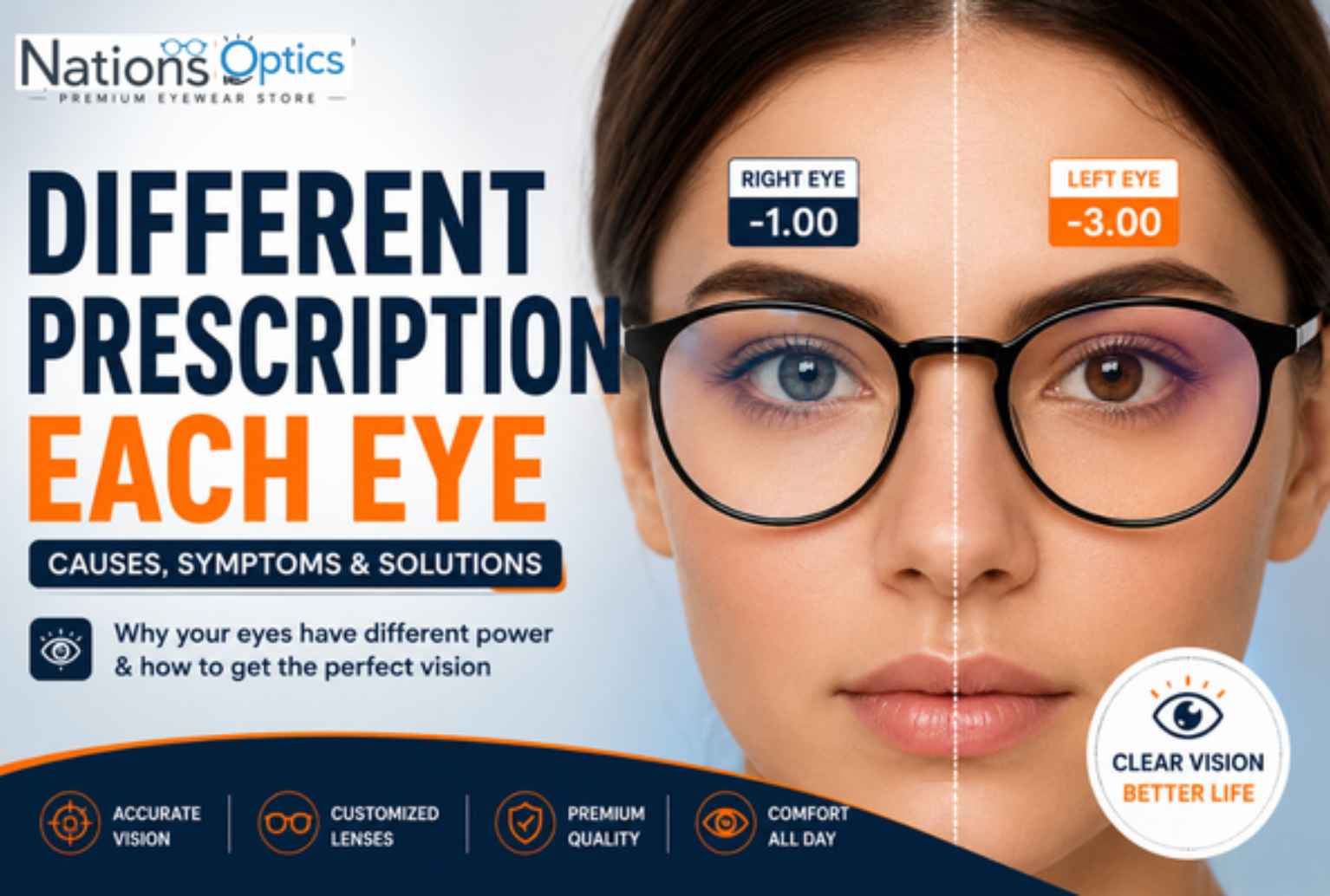
It simply means your left and right eyes require different lens powers to achieve the clearest possible vision. Your optometrist prescribes separate lens powers because each eye has its own refractive error.
Right Eye (OD)
-1.00
Sphere
Left Eye (OS)
-3.00
Sphere — more nearsighted
Different Eye Prescriptions Are More Common Than You Think
Many people assume both eyes should have identical vision — in reality, that's rarely the case. It's very common for one eye to have:
- More myopia (nearsightedness)
- More hyperopia (farsightedness)
- More astigmatism
- A different axis measurement
- A different cylinder value
These differences are perfectly normal as long as they're properly corrected with prescription lenses.
Anisometropia, Explained Simply
Anisometropia is the medical term for unequal refractive power between the two eyes — meaning one eye requires a stronger prescription than the other. The difference can involve sphere (SPH), cylinder (CYL), axis, or a combination of all three. Small differences are extremely common; larger ones may need more specialized correction for comfortable binocular vision.
What Causes Different Prescriptions in Each Eye?
1
Genetics
The most common cause. Eye growth is shaped by inherited traits, so one eye may naturally develop differently than the other.
2
Uneven Eye Growth
During childhood, one eye may grow slightly longer or shorter than the other. Even a tiny variation in eye length changes how light focuses on the retina.
3
Myopia (Nearsightedness)
One eye can become more nearsighted than the other over time, even though both eyes remain otherwise healthy.
4
Hyperopia (Farsightedness)
Similarly, one eye may require more positive lens power than the other.
5
Astigmatism
Many people have different amounts of astigmatism in each eye — one of the most common reasons prescriptions differ.
6
Eye Injury
Trauma can alter the shape of the cornea or lens, changing vision in one eye only.
7
Eye Surgery
Procedures like cataract surgery or LASIK can result in different prescriptions if only one eye has been treated.
8
Certain Eye Conditions
Keratoconus, cataracts, amblyopia (lazy eye), and corneal irregularities can all produce significant prescription differences.
One Eye Stronger Than the Other: Is It Normal?
Yes. Many people naturally have one eye stronger than the other, and this doesn't necessarily mean the weaker eye is unhealthy — it simply focuses light less accurately without correction. Your brain combines the images from both eyes to create one clear picture.
Different Vision in Each Eye: Symptoms to Watch For
- Blurry vision
- Frequent headaches
- Eye strain
- Difficulty focusing
- Double vision
- Trouble reading
- Poor depth perception
- Eye fatigue after screens
- Difficulty driving at night
- Dizziness when switching focus
If any of these symptoms appear suddenly, schedule a comprehensive eye examination immediately.
Can Different Eye Prescriptions Get Worse?
Yes. Prescription differences can increase because of progressive myopia, aging, diabetes, cataracts, corneal disease, or eye injuries. Regular eye exams help catch these changes early.
How Eye Doctors Diagnose Different Eye Prescriptions
- Visual acuity testing
- Refraction test
- Retinoscopy
- Corneal measurements
- Eye pressure test
- Retinal examination
How Are Glasses Made for Different Eye Prescriptions?
Modern prescription glasses are customized individually. Even though both lenses are mounted in the same frame, each one is uniquely crafted according to:
- Sphere power
- Cylinder power
- Axis
- Pupillary Distance (PD)
- Lens material
- Lens coatings
Best Lenses for Different Eye Prescriptions
| Lens Type | Best For |
|---|---|
| CR-39 | Low to moderate prescriptions, everyday wear, excellent clarity, affordable pricing |
| Polycarbonate | Strong prescriptions, active lifestyles, children, rimless frames, better impact resistance, lightweight comfort |
Can Contact Lenses Help?
Yes. For larger prescription differences, contact lenses often reduce the image-size mismatch between the two eyes, improving comfort, depth perception, and overall visual quality. Your eye doctor will determine whether contacts are suitable for you.
Can LASIK Correct Different Eye Prescriptions?
In many cases, yes — LASIK can correct different refractive errors in each eye individually. Eligibility depends on corneal thickness, prescription stability, overall eye health, and age. A comprehensive evaluation is necessary before surgery.
What Happens If You Wear the Wrong Prescription?
- Blurry vision
- Headaches
- Eye fatigue
- Neck pain
- Difficulty concentrating
- Poor night vision
Tips for Living Comfortably with Different Eye Prescriptions
- Wear your prescribed glasses consistently
- Schedule routine eye exams every 12–24 months
- Follow the 20-20-20 rule during long screen sessions
- Keep your prescription up to date
- Choose lenses with anti-reflective coatings
- Wear UV-protective sunglasses outdoors
- Never buy glasses without a verified prescription
When Should You Visit an Eye Doctor?
Seek professional care if you notice sudden vision changes, persistent headaches, double vision, increasing blur, eye pain, light sensitivity, or new floaters or flashes. Prompt evaluation helps catch underlying conditions before they progress.
Frequently Asked Questions
Is it normal to have a different prescription each eye?
Yes. Most people have some difference between their eyes, and it's usually normal when properly corrected with glasses or contact lenses.
What is anisometropia?
Anisometropia is the medical term for a condition where each eye has a different refractive error or prescription.
Can one eye become stronger than the other?
Yes. Genetics, eye growth, refractive errors, and certain eye conditions can cause one eye to require a stronger prescription than the other.
Does having different prescriptions damage my eyes?
No. The difference itself doesn't damage your eyes. Wearing the correct prescription simply helps provide clear, comfortable vision.
Can different prescriptions cause headaches?
Yes. An outdated or incorrect prescription — especially with a significant difference between the eyes — can contribute to headaches, eye strain, and fatigue.
Which lenses are best for different eye prescriptions?
CR-39 lenses work well for low to moderate prescriptions, while polycarbonate lenses are recommended for stronger prescriptions and rimless frames thanks to their lightweight, impact-resistant build.
Why Choose Nations Optics for Prescription Glasses?
Every pair is customized to your exact prescription, ensuring each eye gets the precise correction it needs.
- Individually crafted lenses for each eye
- High-quality CR-39 and Polycarbonate options
- Anti-reflective, blue light, photochromic & UV coatings
- Accurate fitting based on your prescription and PD
- Lightweight, stylish frames for everyday comfort
- Affordable pricing with premium optical quality
Having a different prescription in each eye is far more common than many people realize. Whether it's due to myopia, hyperopia, astigmatism, or anisometropia, each eye can develop differently over time. The key to clear, comfortable vision is wearing accurately customized lenses that match the unique needs of both eyes.
If you've noticed different vision in each eye, one eye stronger than the other, or recently received a new prescription with a gap between the two — don't ignore it. A comprehensive eye exam and properly fitted eyewear can improve visual comfort, reduce eye strain, and protect your long-term eye health.
Exclusive Offers
Sitewide
33%
OFF
Flat 33% off on all products
Already applied on every price · no coupon needed
Auto-applied
10%
OFF
On orders ₹1,200 – ₹1,799
No coupon needed · saves automatically
Auto-applied
15%
OFF
On orders ₹1,800 – ₹3,199
No coupon needed · saves automatically
Best Deal 🔥
20%
OFF
On orders above ₹3,200
No coupon needed · saves automatically
Pay Advance
₹50
SAVED
Pay advance amount at checkout
Flat ₹50 off · pay balance on delivery
Pay Full ✓
₹100
SAVED
Pay full amount at checkout
Maximum saving · instant confirmation
N
Nations Optics Assistant
● Online
👋 Hi! I'm your Nations Optics assistant. Ask me anything about lenses, frames, or prescriptions!