Contact Lens vs Glasses Prescription: Key Differences | Nations Optics
Jul 18, 2026
By Rahul Jain
0 comment(s)
Prescriptions & Vision Correction
Contact Lens Prescription vs Glasses Prescription: What's the Difference?
They might look similar on paper, but the numbers on your glasses prescription rarely translate directly to contact lenses. Here's why.
Many people believe a contact lens prescription and a glasses prescription are the same. They're not. Although both correct vision problems like myopia, hyperopia, astigmatism, and presbyopia, they're calculated differently because glasses and contact lenses sit at completely different distances from your eyes.
If you're planning to switch from glasses to contact lenses, you may be wondering: "Can I use my glasses prescription for contact lenses?" The answer is usually no. A separate eye examination and contact lens fitting are required to determine the correct power, size, and fit.
In this guide, we'll explain the difference between contact lens and glasses prescriptions, why they differ, and how to understand your own vision correction needs.
Vertex Distance Base Curve Toric Lenses Astigmatism Presbyopia
Are Contact Lens and Glasses Prescriptions the Same?
"Are contact lens prescription and glasses prescription the same?"
The simple answer is no. A glasses prescription is designed for lenses sitting roughly 12–14 mm away from your eyes, while contact lenses sit directly on the surface of your eye. Because of this distance difference, the optical power required for contacts can differ from your spectacle prescription.
For lower prescriptions, the difference may be small. For higher powers, the gap between glasses power and contact lens power can become significant.
Example: A person wearing -8.00 power glasses may require a different contact lens power. High-prescription users usually need special calculations before choosing contacts — and astigmatism or multifocal corrections require additional measurements. Never directly copy your glasses prescription when buying contact lenses.
The Core Difference: Lens Position
The biggest difference between the two prescriptions is the distance between the corrective lens and your eye. Because contact lenses move with your eyes, the prescription calculation is different from glasses.
Glasses Prescription
- Lenses sit away from your eyes
- Includes only vision correction power
- Frame measurements influence lens positioning
Contact Lens Prescription
- Lenses sit directly on your cornea
- Requires Base Curve (BC) & Diameter (DIA)
- Accounts for lens material, movement & comfort
Glasses vs Contact Lens Prescription: Key Differences
| Feature | Glasses Prescription | Contact Lens Prescription |
|---|---|---|
| Lens Position | ~12–14 mm away from eyes | Directly on the eye surface |
| Power Calculation | Based on spectacle distance | Adjusted for corneal position |
| Additional Measurements | Usually not required | Base Curve & Diameter required |
| Eye Movement | Lens stays fixed in frame | Lens moves with the eye |
| Fitting Required | Frame fitting | Professional contact lens fitting |
| Comfort Factors | Frame size & weight | Lens material & eye moisture |
Can I Use My Glasses Prescription for Contact Lenses?
"Can I use my glasses prescription for contact lenses?"
This is one of the most searched questions online — and the answer is: it's not recommended. Your glasses prescription provides SPH, CYL, Axis, and ADD values. A contact lens prescription needs additional details such as contact lens power, Base Curve (BC), Diameter (DIA), and lens brand and material. A contact lens specialist needs to evaluate how the lens actually fits on your eye before prescribing it.
Using the Wrong Contact Lens Prescription Can Cause
- Blurry vision
- Eye discomfort
- Dry eyes
- Redness
- Headaches
- Poor lens movement
Why Is a Contact Lens Prescription Different from a Glasses Prescription?
The reason comes down to vertex distance — the space between your eye and your glasses lens. When the prescription power is high, even a few millimeters of distance can change the effective power reaching your eyes.
- Low prescriptions may have nearly identical glasses and contact lens power
- High minus powers may require reduced contact lens power
- High plus powers may require increased contact lens power
Optometrists use special vertex-distance calculations to convert prescriptions accurately.
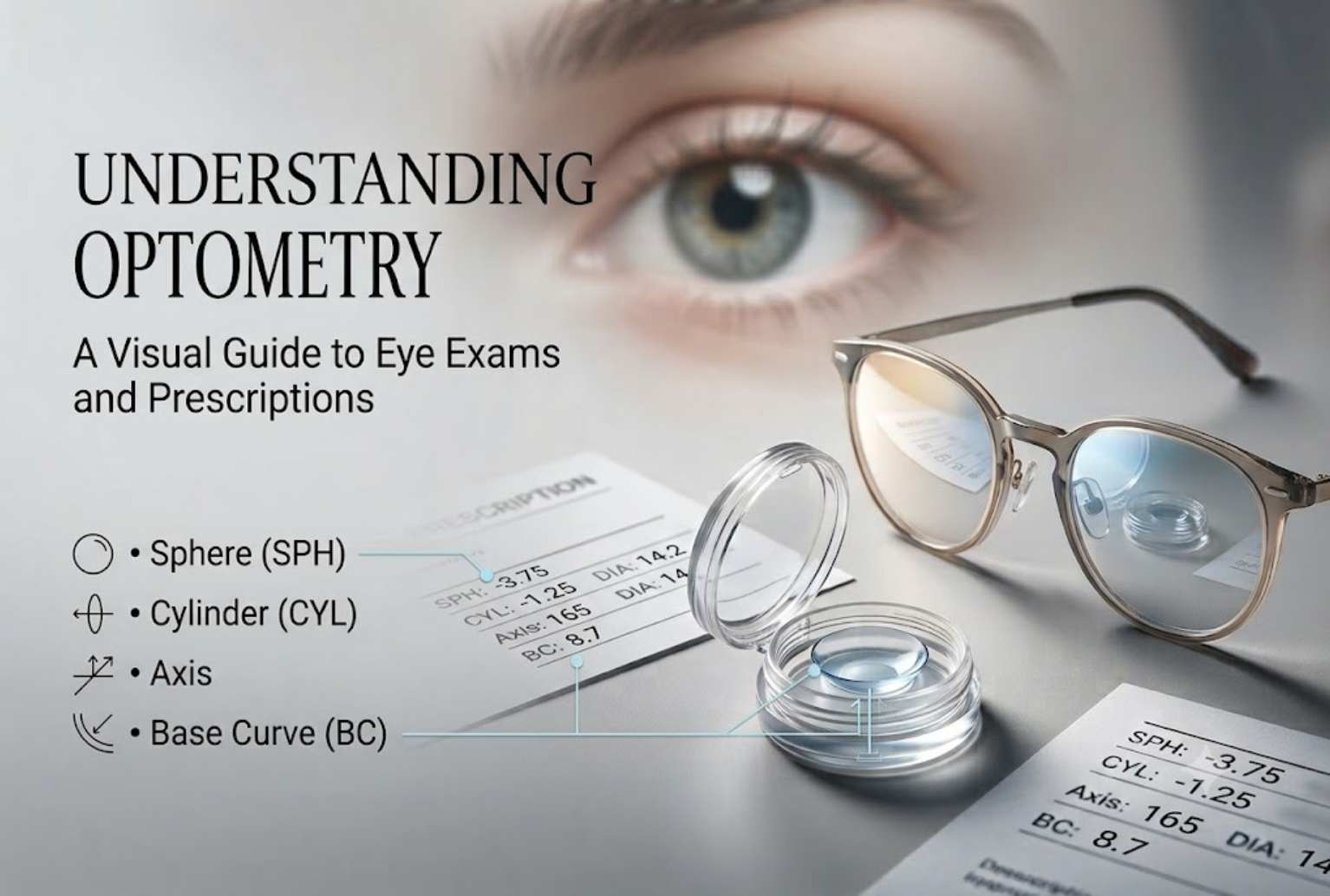
How to Read a Contact Lens Prescription
SPH
Sphere
Indicates the correction needed for near-sightedness (– power) or far-sightedness (+ power). For example, -2.50 SPH means correction for myopia.
CYL
Cylinder
Measures astigmatism correction. A cylinder value may appear in both glasses prescriptions and toric contact lens prescriptions.
AXIS
Axis
Shows the orientation of astigmatism correction, measured between 0° and 180°.
BC
Base Curve
Describes the curvature of the contact lens, ensuring it properly fits the shape of your eye.
DIA
Diameter
Represents the size of the contact lens. The correct diameter helps maintain comfort and stability.
Contact Lens Power vs Glasses Power: Are They Different?
Yes, they can be. The difference depends on prescription strength, type of vision correction, eye shape, and lens design. For small prescriptions, the numbers may look similar. For stronger prescriptions, conversion is often required.
Example: A glasses prescription of -6.00 SPH may not always translate to -6.00 contact lenses. The final contact lens power should always be decided after a proper eye examination.
Contact Lens Prescriptions for Different Vision Problems
Myopia (Near-Sightedness)
People with myopia usually have a negative prescription. Both glasses and contacts can correct it, but the power may vary depending on prescription strength.
Hyperopia (Far-Sightedness)
Hyperopia requires positive power lenses. Contact lens calculations may differ from glasses because of lens position.
Astigmatism
Astigmatism requires cylindrical correction. Special toric contact lenses are designed specifically for this condition.
Presbyopia
People above 40 may need progressive glasses, bifocal lenses, or multifocal contact lenses — the prescription process differs for each option.
Why You Need a Separate Contact Lens Eye Test
A glasses eye test only checks vision clarity. A contact lens examination goes further, evaluating:
- Corneal shape
- Tear film quality
- Eye health
- Lens movement
- Comfort level
- Contact lens fitting
This helps ensure the lens is safe and comfortable for daily use.
Can You Convert a Glasses Prescription to a Contact Lens Prescription?
"Convert glasses prescription to contact lens prescription."
Although conversion formulas exist, they aren't always accurate for every person. A professional optometrist considers prescription strength, eye measurements, contact lens brand, lens material, and wearing schedule. A proper fitting delivers better vision and comfort than any formula alone.
Glasses or Contact Lenses: Which Is Better?
Glasses Benefits
- Easy to maintain
- No eye touching required
- Available in different styles
- Suitable for almost everyone
Contact Lens Benefits
- Natural field of vision
- No frame obstruction
- Better for sports activities
- Cosmetic appearance without glasses
The right choice depends on your lifestyle, prescription, and comfort preferences.
Frequently Asked Questions
Is a contact lens prescription the same as a glasses prescription?
No. Contact lenses sit directly on the eye, so the power calculation, base curve, and diameter differ from a glasses prescription, which is designed for lenses sitting away from the eye.
Can I use my glasses prescription to buy contact lenses?
It's not recommended. A separate contact lens eye exam and fitting are needed to determine the correct power, base curve, and diameter for your eyes.
Why is contact lens power different from glasses power?
Because of vertex distance — the space between your eye and a glasses lens. At higher prescriptions, this distance changes the effective power needed on the eye's surface.
What additional measurements does a contact lens prescription need?
Base Curve (BC) and Diameter (DIA), along with lens material and brand — none of which appear on a standard glasses prescription.
Can astigmatism be corrected with contact lenses?
Yes. Toric contact lenses are specifically designed to correct astigmatism using cylinder and axis measurements.
Do I need a separate eye test for contact lenses?
Yes. A contact lens exam evaluates corneal shape, tear film quality, and lens fit — factors a standard glasses eye test doesn't check.
Get the Right Prescription, the Right Way
At Nations Optics, accurate vision correction starts with the right prescription, quality lenses, and expert guidance — whether you wear glasses or contacts.
- Precise lens power for every prescription strength
- Guidance on glasses vs. contact lens options
- High-quality CR-39 & Polycarbonate lens materials
- Anti-reflective, blue light & UV protective coatings
- Support choosing frames that fit your lifestyle
Understanding the difference between contact lens prescriptions and glasses prescriptions matters before switching between eyewear options. A glasses prescription cannot simply replace a contact lens prescription, because contacts require additional measurements and professional fitting.
If you're asking "Can I use my glasses prescription for contact lenses?" — the safest answer is to consult an optometrist and get a proper contact lens evaluation. Whether you choose glasses or contacts, the correct prescription is what ensures clear vision and a comfortable wearing experience.
Exclusive Offers
Sitewide
33%
OFF
Flat 33% off on all products
Already applied on every price · no coupon needed
Auto-applied
10%
OFF
On orders ₹1,200 – ₹1,799
No coupon needed · saves automatically
Auto-applied
15%
OFF
On orders ₹1,800 – ₹3,199
No coupon needed · saves automatically
Best Deal 🔥
20%
OFF
On orders above ₹3,200
No coupon needed · saves automatically
Pay Advance
₹50
SAVED
Pay advance amount at checkout
Flat ₹50 off · pay balance on delivery
Pay Full ✓
₹100
SAVED
Pay full amount at checkout
Maximum saving · instant confirmation
N
Nations Optics Assistant
● Online
👋 Hi! I'm your Nations Optics assistant. Ask me anything about lenses, frames, or prescriptions!