Back-to-School Kids' Eyeglasses Guide: Fit, Durability & Blue Light | Nations Optics
Jul 30, 2026
By Rahul Jain
0 comment(s)
Back-to-School Series
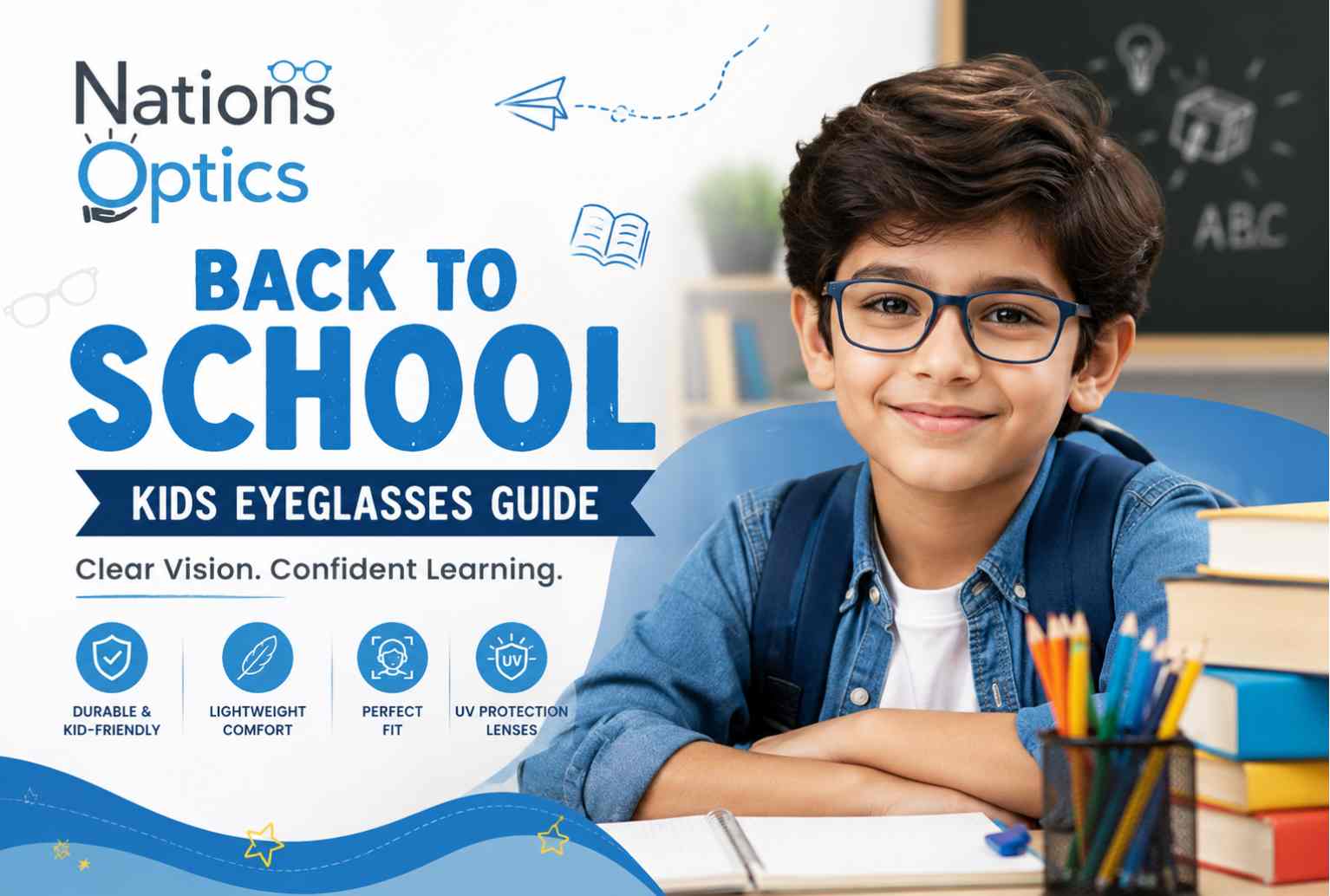
Back-to-School Eyeglasses Guide for Kids: Fit, Durability & Blue Light Protection
School's reopening and your child needs eyewear that survives the school bag, the playground, and hours of screen time — without you guessing at sizes. Here's exactly what to check before you order.
Every school reopening season, parents make the same mistake: they reorder the same frame style their child had last year, without checking whether the fit, lens durability, or lens type still matches what their child actually needs now. Faces change fast between ages 5 and 15. So does screen time. Getting this right at the start of term saves you a mid-semester replacement.
Here's a practical, no-fluff guide covering the four things that actually matter: fit, durability, blue light protection, and how to measure everything correctly from home.
1. Getting the Fit Right — Without a Store Visit
Kids' glasses fail for one main reason: they were bought slightly too big "so they'll grow into them." That doesn't work with eyewear. A frame that's too wide slides down the nose, sits crookedly, and pushes the optical centre of the lens away from the pupil — which means blurrier vision, not better vision.
The two measurements that matter most:
- Face width — determines whether a frame will sit securely without pinching at the temples or sliding on the nose bridge.
- Pupillary Distance (PD) — the exact distance between your child's pupils. This decides where the optical centre of each lens is ground, directly affecting clarity and eye strain.
Skip the guesswork: Use our Face Size & Try Frames AI tool to measure your child's PD and face width instantly from a phone camera — then preview how each frame actually looks on their face before you order. No ruler, no store visit.
Frame shapes that hold up on active kids
- Full-rim, flexible TR90 or acetate — bends without snapping, ideal for younger kids who forget they're wearing glasses.
- Spring hinges — absorb the shock of being yanked off or slept in, instead of the hinge cracking.
- Avoid rimless frames for children under 10 — thin drilled edges are the first thing to chip on a playground fall.
2. Durability: The Lens Matters More Than the Frame
A sturdy frame with the wrong lens is still a liability. For children, lens impact-resistance matters as much as clarity — a cracked lens near the eye is a real injury risk, not just an inconvenience.
| Lens Material | Impact Resistance | Best For |
|---|---|---|
| CR-39 (Standard) | Moderate | Calm indoor use, older teens |
| Polycarbonate | ~10x more impact-resistant than CR-39 | Active kids, sports, playground use, rimless-safe |
At Nations Optics, we already use polycarbonate lenses as the safety standard for rimless frames — for children, we'd recommend it across full-rim and half-rim frames too, purely because it won't shatter or crack from an accidental drop, a dodgeball, or a bag getting sat on.
3. Blue Light Protection for Online Classes & Tablets
Between school-assigned tablets, homework portals, and evening screen time, most kids today clock several hours a day looking at a backlit screen — often more than their parents do. This doesn't cause permanent damage, but it does contribute to digital eye strain: tired eyes, headaches after homework, and difficulty refocusing on the whiteboard afterward.
A blue-light-filtering coating on the lens reduces glare and high-energy blue wavelengths from screens, which most parents notice as fewer end-of-day complaints about tired or itchy eyes — especially useful if your child already has a low prescription and spends an hour or more daily on a tablet or laptop for homework.
4. One Habit Worth Building This Term
Children's eyesight can change every 6–12 months during school years, faster than adults realise. If your child is already complaining about the whiteboard being blurry from the back row, or squinting at their book, it's worth getting the prescription rechecked before ordering new frames rather than reusing an old one — an outdated prescription paired with a new frame still won't give them clear vision.
Do I need to visit a store to get my child's glasses fitted correctly?
No — you can measure PD and face width from home using our AI tool, and our team verifies the fit against your child's existing prescription before we craft the eyewear. We also share photos for your approval before dispatch.
Are polycarbonate lenses more expensive?
They cost a little more than standard CR-39, but for a child who's constantly moving, dropping things, and playing sports, the extra durability is worth it — you avoid a mid-term replacement.
Can blue light lenses be added to any kids' frame?
Yes — the blue-light coating can be added to single vision lenses in any of our kids' frames, whether full-rim or half-rim.
School-Ready Eyewear, Sorted From Home
Measure fit with our AI tool, choose a durable polycarbonate lens, and add blue light protection — all before the first day of term.
Measure My Child's Fit → Shop Kids Frames →Have a specific prescription or fit question? WhatsApp us at 87553-87553 — our team replies the same day.
Exclusive Offers
Sitewide
33%
OFF
Flat 33% off on all products
Already applied on every price · no coupon needed
Auto-applied
10%
OFF
On orders ₹1,200 – ₹1,799
No coupon needed · saves automatically
Auto-applied
15%
OFF
On orders ₹1,800 – ₹3,199
No coupon needed · saves automatically
Best Deal 🔥
20%
OFF
On orders above ₹3,200
No coupon needed · saves automatically
Pay Advance
₹50
SAVED
Pay advance amount at checkout
Flat ₹50 off · pay balance on delivery
Pay Full ✓
₹100
SAVED
Pay full amount at checkout
Maximum saving · instant confirmation
N
Nations Optics Assistant
● Online
👋 Hi! I'm your Nations Optics assistant. Ask me anything about lenses, frames, or prescriptions!