Prescription Sunglasses: Can You Get Sunglasses with Power?
Sep 5, 2026
By Rahul Jain
0 comment(s)
Sunglasses & Prescription Guide
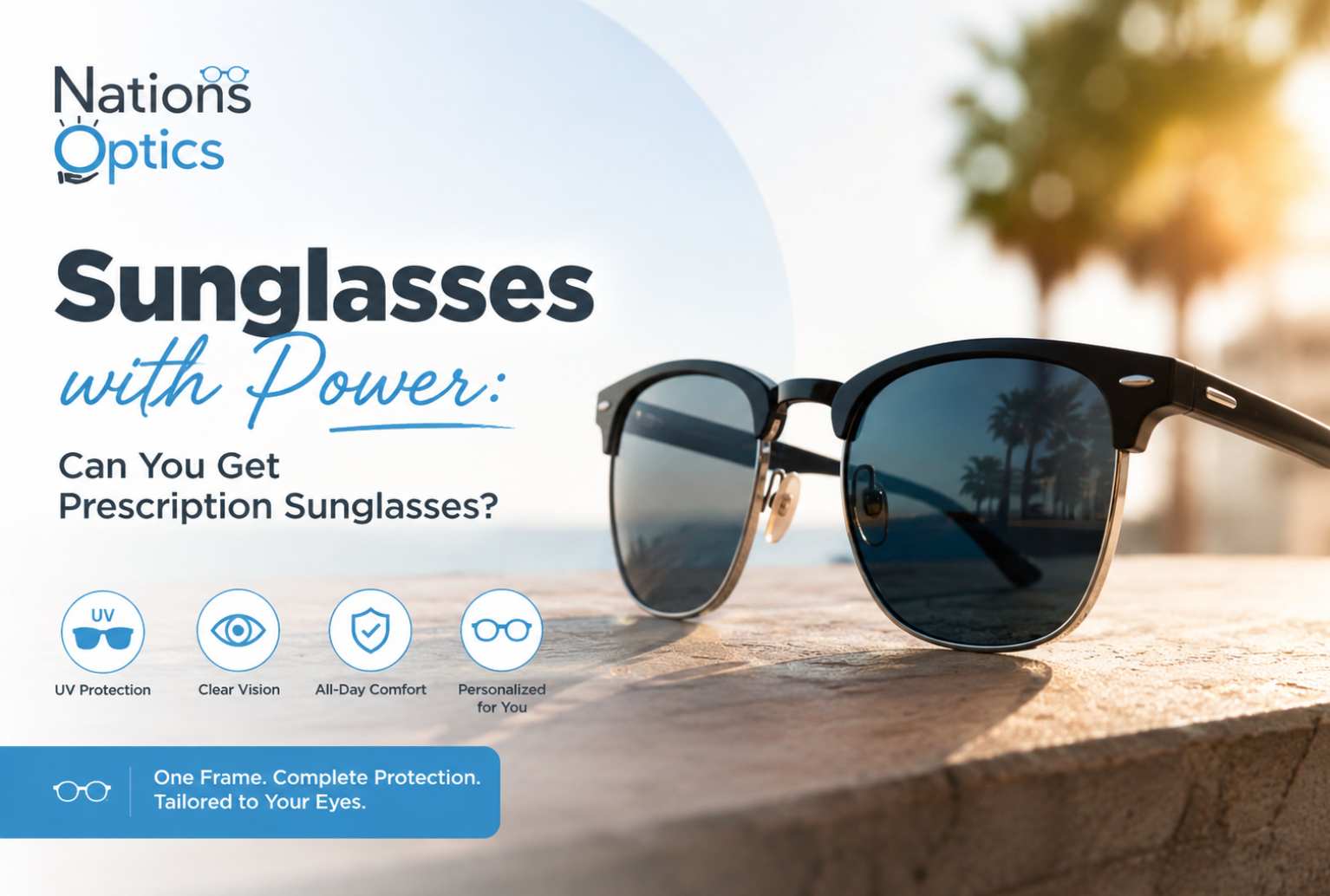
Sunglasses with Power: Can You Get Prescription Sunglasses?
Squinting through your regular sunglasses because you can't see clearly? Yes, prescription sunglasses exist — here's everything you need to know.
If you wear prescription glasses, you've probably run into this problem: your everyday sunglasses look great, but you can barely make out road signs or menus through them because they don't correct your vision. Meanwhile, your prescription glasses do the job indoors but leave you squinting the moment you step into bright sunlight.
The good news is you don't have to choose between clear vision and sun protection. Prescription sunglasses — sunglasses ground with your exact optical power — solve exactly this problem. This guide covers how they work, your options, what to consider before ordering, and how they compare to alternatives like clip-ons and photochromic lenses.
Prescription Power UV Protection Polarized Lenses Photochromic Lenses Clip-On Options
Can You Get Prescription Sunglasses?
Yes. Prescription sunglasses are sunglasses made with lenses ground to your exact eyeglass prescription — SPH, CYL, AXIS, and ADD if needed — combined with a tinted or polarized lens for outdoor light and UV protection. Functionally, they work exactly like your regular prescription glasses, except the lens also blocks glare and bright sunlight instead of staying clear.
In short: if you can get a lens made in your prescription for regular glasses, that same prescription can almost always be made into a tinted or polarized sunglass lens as well — the process is essentially the same, just with a different lens finish.
Why Regular Sunglasses Don't Work If You Need Vision Correction
Off-the-shelf sunglasses are made with plain, non-corrective lenses — they block light, but they don't focus it for your specific eyes. If you have myopia, hyperopia, or astigmatism, wearing non-prescription sunglasses means either squinting to compensate or not being able to see clearly at all, particularly at a distance — which matters a lot for driving, sports, or simply walking around outdoors.
Your Options for Vision Correction in the Sun
What to Consider Beyond the Prescription
UV Protection
Look for lenses offering 100% UVA and UVB protection — this is separate from how dark the tint is. A very dark lens without adequate UV protection is actually worse for your eyes than a lighter lens with full protection, since your pupils dilate more under a dark lens, letting in more unfiltered UV light.
Polarized vs Standard Tinted Lenses
Standard Tinted
- Reduces overall brightness evenly
- Generally more affordable
- Available in a wide range of colors
Polarized
- Cuts glare from flat, reflective surfaces (water, roads, car hoods)
- Particularly useful for driving and water-based activities
- Can make certain digital screens harder to read at some angles
Tint Colour and When It Helps
| Tint | Good For |
|---|---|
| Grey | True color perception, everyday all-purpose use |
| Brown / Amber | Enhanced contrast, useful for variable or overcast light |
| Green | Balanced brightness reduction with good contrast |
| Yellow / Orange | Low-light or hazy conditions, less suited to bright sun |
Frame Considerations for Prescription Sunglasses
Stronger prescriptions can mean thicker lenses, which matters more with sunglass shapes than with regular glasses since sunglass lenses are often larger and more curved.
Wraparound & Curved Frames
Provide excellent side coverage and glare protection, but can be more complex and costly to produce in a strong prescription due to the lens curvature.
Flatter, Traditional Shapes
Generally easier and more affordable to produce with any prescription, including higher powers, since the lens curve is less extreme.
Oversized Frames
Offer great coverage but may increase lens thickness and weight for stronger prescriptions — consider a high-index lens material to offset this.
Smaller, Compact Frames
Can help keep lenses thinner for stronger prescriptions, similar to how smaller frames help with regular high-prescription glasses.
How to Order Prescription Sunglasses
1
Get a Current, Valid Prescription
Make sure your prescription is up to date and includes your full SPH, CYL, AXIS, and ADD values if applicable.
2
Choose Your Lens Type
Decide between standard tinted or polarized lenses based on your main use case — everyday wear, driving, or water activities.
3
Pick a Tint Colour
Choose based on your typical lighting conditions and personal preference — grey and brown are the most versatile all-purpose options.
4
Select a Frame
Keep your prescription strength in mind when choosing frame size and shape, especially for oversized or heavily curved styles.
5
Confirm UV Protection
Verify the lenses offer full UVA/UVB protection, regardless of tint darkness.
A Note on Very Strong Prescriptions
- Higher prescriptions may benefit from high-index lens materials to keep sunglass lenses from becoming too thick or heavy
- Very high astigmatism correction may limit some heavily wrapped or curved frame styles
- A qualified optician can advise on the best lens and frame combination for stronger prescriptions
Frequently Asked Questions
Can I get prescription sunglasses with any eyeglass prescription?
In most cases, yes — the same prescription used for regular glasses can typically be used for sunglasses. Very strong prescriptions may have some frame shape limitations, but a suitable option is usually available.
Are prescription sunglasses more expensive than regular sunglasses?
Generally yes, since they require custom-ground lenses rather than a standard flat lens, similar to the cost difference between prescription and non-prescription regular glasses.
Should I choose polarized or regular tinted lenses?
Polarized lenses are especially useful for driving and activities near water due to their glare reduction. Standard tinted lenses work well for everyday, general-purpose use.
Do photochromic lenses work as well as dedicated prescription sunglasses?
Photochromic lenses are convenient for one pair that handles both indoor and outdoor light, but they typically don't get as dark as dedicated sunglasses and can be slower to adjust, especially in cold weather.
Does a darker tint mean better UV protection?
No — tint darkness and UV protection are separate features. Always confirm your lenses have full UVA/UVB protection regardless of how dark the tint is.
Can I use my contact lenses with regular sunglasses instead?
Yes, if you're a comfortable contact lens wearer — this gives you the widest choice of sunglass styles since prescription isn't a limiting factor.
See Clearly, Even in Bright Sun
At Nations Optics, we can fit your exact prescription into sunglasses that match your style and your vision needs.
- Custom prescription sunglass lenses
- Polarized & standard tint options
- Full UVA/UVB protection on every lens
- High-index options for stronger prescriptions
- Photochromic lenses if you want one pair for everything
You don't have to choose between seeing clearly and protecting your eyes from the sun. Prescription sunglasses, photochromic lenses, and clip-ons all solve the same basic problem in different ways — the right choice depends on how often you're outdoors, whether you want one pair or two, and how strong your prescription is.
Whatever you choose, don't compromise on UV protection or an accurate prescription just to save on a second pair of glasses — clear vision and healthy eyes are worth getting right in every kind of light.
Exclusive Offers
Sitewide
33%
OFF
Flat 33% off on all products
Already applied on every price · no coupon needed
Auto-applied
10%
OFF
On orders ₹1,200 – ₹1,799
No coupon needed · saves automatically
Auto-applied
15%
OFF
On orders ₹1,800 – ₹3,199
No coupon needed · saves automatically
Best Deal 🔥
20%
OFF
On orders above ₹3,200
No coupon needed · saves automatically
Pay Advance
₹50
SAVED
Pay advance amount at checkout
Flat ₹50 off · pay balance on delivery
Pay Full ✓
₹100
SAVED
Pay full amount at checkout
Maximum saving · instant confirmation
N
Nations Optics Assistant
● Online
👋 Hi! I'm your Nations Optics assistant. Ask me anything about lenses, frames, or prescriptions!