
High Index Lens Benefits: Are High Index Lenses Worth It?
Jul 20, 2026
By Rahul Jain
0 comment(s)
Lens Guide
High Index Lens Benefits: Are High Index Lenses Worth It for Your Prescription?
Thick, heavy lenses aren't the only option for a strong prescription. Here's how high-index lenses can make your glasses thinner, lighter, and better looking.
If you have a strong prescription, you may have noticed your eyeglass lenses becoming thick, heavy, or visually noticeable. This is where high index lenses can make a real difference.
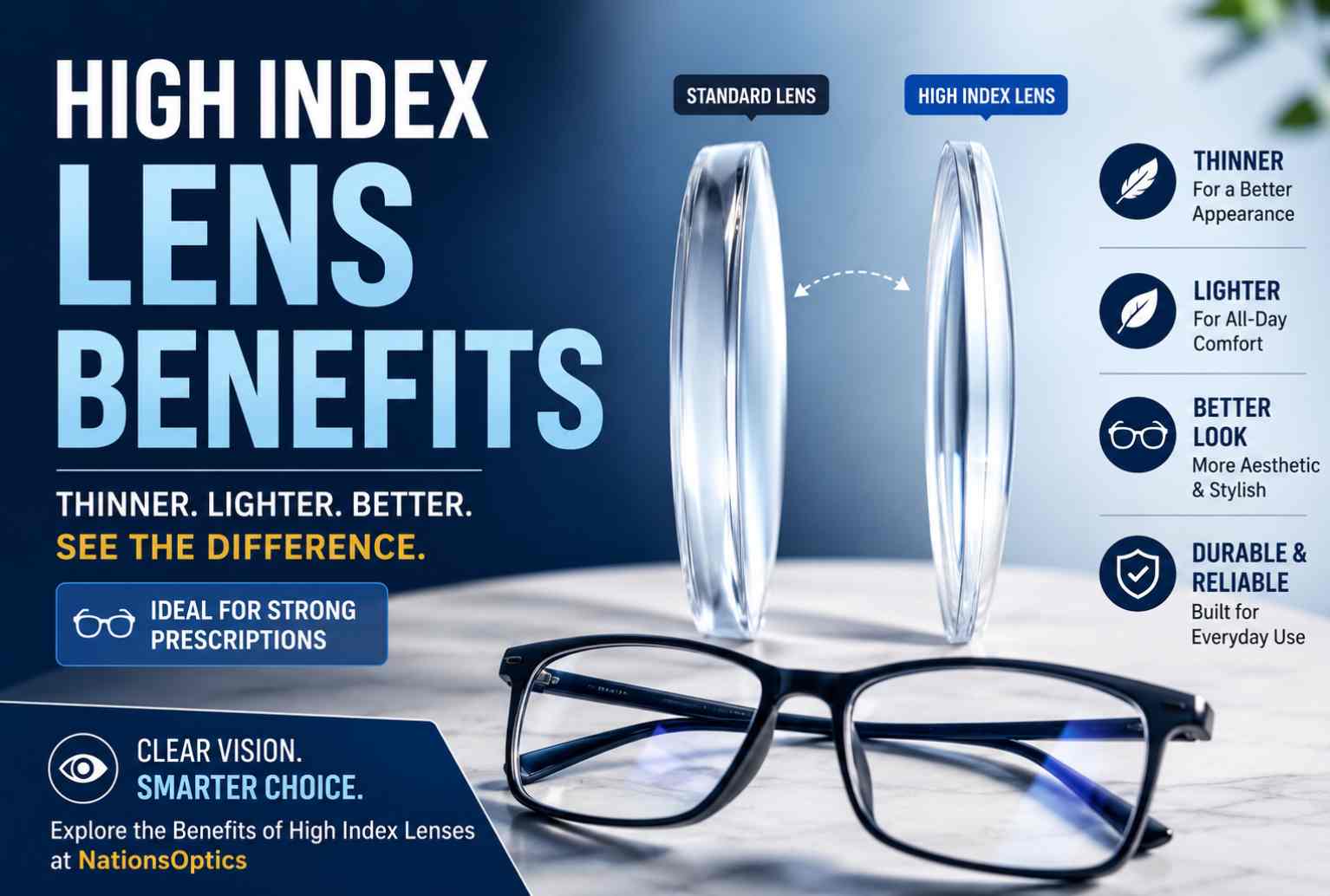
The main high index lens benefits are thinner lenses, reduced weight, improved appearance, and better comfort for moderate to strong prescriptions. Compared with traditional lens materials, high-index lenses bend light more efficiently — letting manufacturers create thinner lenses for the same prescription power.
In this guide, we cover the major benefits of high index lenses, how they work, who should consider them, and whether they're worth the extra cost.
Refractive Index 1.67 Lenses Anti-Reflective Coating Rimless Frames Strong Prescriptions
What Are High Index Lenses?
High index lenses are prescription lenses made from materials with a higher refractive index than standard lens materials. The refractive index describes how efficiently a material bends light — a higher index means the lens can bend light more effectively using less material, so it can often be made thinner for the same prescription power.
1.56
Standard Index
A good balance of cost and thickness for mild to moderate prescriptions.
1.59
Polycarbonate
Lightweight and highly impact-resistant; commonly used for this index level.
1.60–1.61
Mid-High Index
Popular for moderate to stronger prescriptions where thinner lenses are desired.
1.67
High Index
Built for stronger prescriptions needing additional thickness reduction.
1.74
Ultra-High Index
Among the thinnest materials available, typically for very strong prescriptions.
Good to know: The highest index is not automatically the best choice. A higher index costs more and may not provide a meaningful benefit for a low prescription. The right lens index should match your prescription and eyewear needs — not just chase the highest number.
High Index Lens Benefits at a Glance
Thinner lenses for stronger prescriptions
Reduced lens thickness
Lighter, more comfortable eyewear
Improved cosmetic appearance
Better fit with modern, smaller frames
Reduced edge thickness (myopia)
Reduced center thickness (hyperopia)
Greater flexibility in frame styles
The actual result depends on your prescription and the lens index selected.
The Benefits, Explained
1
Makes Strong Prescription Lenses Thinner
For people with myopia, stronger prescriptions can create noticeably thick lens edges. High index lenses reduce this edge thickness because the material bends light more efficiently — useful for moderate to high myopia and strong astigmatism. Thickness is also influenced by frame size, frame shape, optical center placement, and lens design.
2
Reduces the Appearance of Thick Edges
Strong minus prescriptions often show thick edges in traditional lenses. A high-index material needs less material at the edges, creating a more streamlined look — especially when paired with an appropriately sized frame.
3
Can Be More Comfortable
Thinner lenses generally need less material, which can mean a lighter pair of glasses overall — helpful for full-time wearers, large frames, and anyone who feels pressure around the nose or ears. Total weight still depends on the frame material too.
4
Improves the Appearance of Prescription Glasses
High-index lenses help create a more balanced, streamlined look — particularly valuable for thin metal frames, rimless, semi-rimless, and smaller fashion frames where more of the lens is visible. Note: polycarbonate is often required for rimless designs due to impact resistance and drilling needs.
5
Helpful for Strong Prescriptions
There's no single prescription number that "requires" high index — but the benefits grow as prescription strength increases, for both higher minus and higher plus powers. For mild prescriptions, a standard lens may already look and perform great.
6
Offers More Frame Flexibility
Strong prescriptions are sometimes paired with smaller frames to reduce thickness — but high-index lenses can open up more options, including rectangular, square, round, cat-eye, browline, rimless, and semi-rimless styles, depending on the prescription.
7
A Better Choice for High Myopia
High myopia often results in significantly thicker lens edges. High-index materials can reduce this compared to lower-index options — though frame size, pupillary distance, optical center placement, lens design, and coatings all still matter.
8
Beneficial for High Hyperopia Too
High-index lenses aren't just for minus prescriptions. Strong plus prescriptions can create thick lens centers — high-index materials reduce the material needed, creating a more streamlined, lighter result.
High Index Lenses vs Regular Lenses
The main difference is how efficiently each material bends light. Standard materials need more material to reach a given prescription power; high-index materials achieve the same power with a thinner profile.
High Index Lenses
- Thinner for stronger prescriptions
- Potentially lighter
- Improved cosmetic appearance
- Greater frame flexibility
Standard Lenses
- Usually lower cost
- Suitable for low–moderate prescriptions
- Good optical performance when well selected
High Index vs CR-39 Lenses
CR-39 offers good clarity at an affordable price. High-index lenses can be thinner than CR-39 for the same prescription power. For low prescriptions, CR-39 is often completely suitable; for stronger prescriptions, high-index may offer better thickness and appearance.
High Index vs Polycarbonate Lenses
Polycarbonate is lightweight and impact-resistant — a common choice for safety eyewear, kids' glasses, and certain rimless designs. High-index lenses may give a thinner profile for certain prescriptions. The right pick depends on prescription strength, frame type, impact-resistance needs, and thickness preferences. For rimless frames, polycarbonate may be mandatory depending on the construction.
Are High Index Lenses Worth It?
For many people with moderate to strong prescriptions, yes — they offer a thinner, more attractive lens profile. They're especially worth considering if:
- Your prescription is strong
- You dislike thick lens edges
- You want a lighter pair of glasses
- You prefer modern, smaller frames
- You're choosing rimless or semi-rimless eyewear
- Appearance matters to you
For low prescriptions, the difference between standard and high-index lenses may be less noticeable — so the decision comes down to balancing prescription, desired thickness, comfort, frame choice, and budget.
Do High Index Lenses Need Anti-Reflective Coating?
Yes, it's commonly recommended. Some high-index materials reflect more light than traditional lenses, which can affect appearance and visual comfort. An AR coating helps reduce visible reflections, improve clarity, let more light pass through, and cut down on distracting reflections from screens and artificial lighting.
What Is the Best High Index Lens for Your Prescription?
There's no single best high-index lens for everyone. The ideal index depends on:
- Prescription power — stronger prescriptions usually benefit more from higher-index materials
- Frame size — larger frames need more lens material and may increase thickness
- Frame shape — shape and dimensions influence the final lens profile
- Pupillary distance — accurate PD helps position the optical center correctly
- Lens design — aspheric and other advanced designs can improve appearance and performance
- Personal preference — some prioritize the thinnest lens possible, others balance price and performance
Frequently Asked Questions
What are high index lenses?
Prescription lenses made from materials that bend light more efficiently than standard materials, allowing them to be made thinner for certain prescriptions.
What are the main high index lens benefits?
Reduced lens thickness, a potentially lighter design, improved appearance, and better suitability for moderate to strong prescriptions.
Are high index lenses good for strong prescriptions?
Yes. They're often particularly beneficial for stronger prescriptions because they help reduce lens thickness compared with lower-index materials.
Are high index lenses thinner than regular lenses?
For the same prescription power, generally yes. Final thickness also depends on the frame and lens design chosen.
Are high index lenses worth the extra cost?
They can be worth it for moderate to strong prescriptions where thinner, more cosmetically attractive lenses matter. For low prescriptions, the benefit may be less noticeable.
What is the best lens index for a strong prescription?
It depends on the exact prescription, frame size, lens design, and individual needs. Higher indexes such as 1.61, 1.67, or 1.74 may be considered for stronger prescriptions.
Are high index lenses better than polycarbonate?
Neither is universally better. Polycarbonate offers excellent impact resistance; high-index materials may offer a thinner profile. The best choice depends on prescription and frame requirements.
Do high index lenses need anti-reflective coating?
It's commonly recommended, since it helps reduce reflections and improves lens appearance and clarity.
Find the Right Lens for Your Prescription
At Nations Optics, we match your lens material to your prescription and lifestyle — not just the highest index number.
- 1.56 to 1.74 high-index lens options
- CR-39 & Polycarbonate alternatives available
- Anti-reflective, blue light & UV coatings
- Guidance based on your exact prescription
- Frame recommendations to minimize thickness
The major benefits of high index lenses are thinner lenses, reduced thickness, improved appearance, and potentially greater comfort for people with stronger prescriptions. The best lens index depends on your individual prescription, frame size, frame style, lens design, and personal preferences.
A thinner lens isn't always about choosing the highest number — it's about choosing the right lens material and design for your prescription. If you're unsure whether high-index lenses are right for you, your prescription should be evaluated before selecting the lens material.
Exclusive Offers
Sitewide
33%
OFF
Flat 33% off on all products
Already applied on every price · no coupon needed
Auto-applied
10%
OFF
On orders ₹1,200 – ₹1,799
No coupon needed · saves automatically
Auto-applied
15%
OFF
On orders ₹1,800 – ₹3,199
No coupon needed · saves automatically
Best Deal 🔥
20%
OFF
On orders above ₹3,200
No coupon needed · saves automatically
Pay Advance
₹50
SAVED
Pay advance amount at checkout
Flat ₹50 off · pay balance on delivery
Pay Full ✓
₹100
SAVED
Pay full amount at checkout
Maximum saving · instant confirmation
N
Nations Optics Assistant
● Online
👋 Hi! I'm your Nations Optics assistant. Ask me anything about lenses, frames, or prescriptions!