
Incorrect PD Measurement: How Wrong PD Affects Glasses
Jul 11, 2026
By Rahul Jain
0 comment(s)
Prescription Accuracy Guide
Incorrect PD Measurement: How Wrong Pupillary Distance Affects Your Glasses
Blurry vision, headaches, or dizziness with a correct prescription? The culprit is often one overlooked number, your Pupillary Distance.
When ordering prescription glasses online, most people focus on the frame, lens material, and coatings. But one measurement directly affects your comfort and clarity, Pupillary Distance (PD). An incorrect PD is one of the most common reasons people experience blurry vision, eye strain, headaches, dizziness, or discomfort even when their prescription power is correct.
Your PD determines exactly where your eyes look through the optical centre of your lenses. If it's inaccurate, your lenses may not align with your eyes, changing how you see. This guide explains what PD is, why a wrong measurement causes problems, common mistakes, and how to measure PD correctly.
01What Is PD Measurement in Glasses?
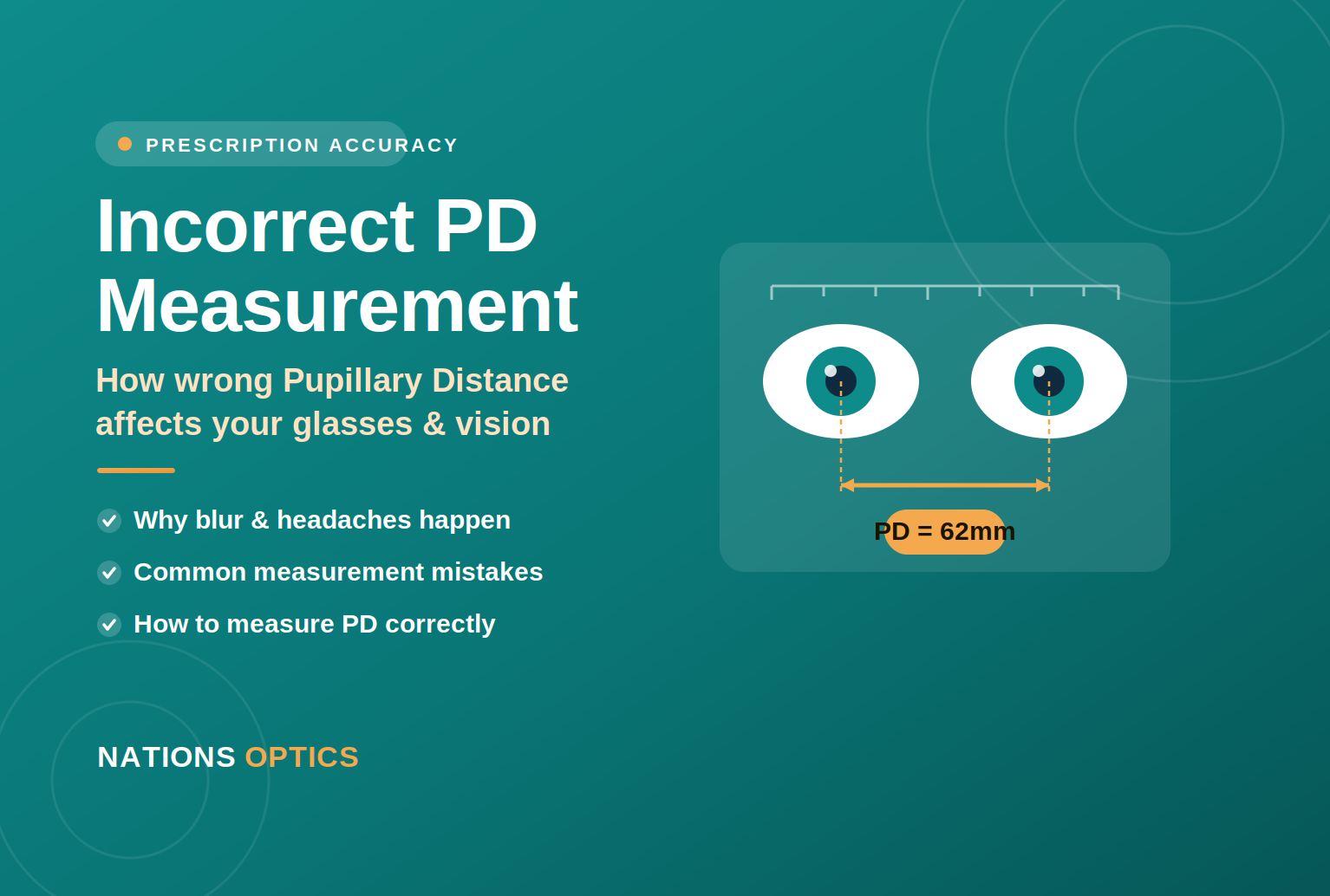
PD stands for Pupillary Distance, the distance between the centres of your pupils (the black circles in the middle of your eyes). It's given in millimetres and helps optical professionals position your lenses correctly.
- A common adult PD ranges between 54 mm and 74 mm
- Some prescriptions include a single PD value
- Others include separate measurements per eye, known as dual or monocular PD
When your lenses are made, your PD places the optical centre of each lens exactly in front of your pupils. A small error may not always be noticeable, but a significant mistake can affect vision quality.
02Why Correct PD Matters
Your prescription tells the lens power you need; your PD tells the manufacturer where to position that power. Even a perfectly accurate prescription can leave your eyes looking through the wrong part of the lens if PD is off.
Optical centre alignment
CORRECT PD eyes look through lens centre INCORRECT PD centre sits off to the sideWhen the optical centre doesn't match your pupils, your eyes strain to compensate.
A wrong PD can cause
Blurry or distorted vision
Difficulty focusing
Eye fatigue
Headaches
Dizziness
Trouble adjusting to glasses
Uncomfortable wear
This matters most for progressive lenses, high-power prescriptions, bifocals, rimless frames, and customised eyewear, the more advanced the lens design, the more critical accurate PD becomes.
03Common Problems From Incorrect PD
Blurry vision despite a correct prescriptionMany assume the lens power is wrong, but the real issue is often lens alignment. When the optical centre misses your pupil, your eyes work harder to compensate.
Headaches and eye strainA wrong PD forces constant adjustment, leading to forehead pressure, discomfort, frequent headaches, and tired eyes. If new glasses feel wrong after days, check the PD.
Difficulty adjusting to new glassesSome adjustment is normal, but lasting discomfort points to measurement error, objects looking tilted, uneven vision, or feeling your eyes aren't aligned with the lenses.
04Why Does Wrong PD Happen?
1. Measuring PD incorrectly at home
Many people measure with a mirror or phone camera without following proper steps, measuring from the wrong point, holding the ruler crooked, looking away mid-measurement, using poor lighting, or rushing.
2. Using an old or incorrect prescription
Reusing a PD taken years ago is risky, your PD can change slightly over time, especially in children and teenagers. Always use the latest measurement.
3. Confusing frame measurements with PD
Frame width and PD are different. Frame figures (lens width, bridge width, temple length) don't tell you your PD, which specifically measures the distance between your pupils.
05Measurement Mistakes to Avoid
- Measuring without looking straight — your eyes should look directly forward; looking sideways skews the result.
- Measuring from the edge of the eye — PD is centre-pupil to centre-pupil, not from eyelids, iris edges, or corners.
- Using a flexible measuring tape — a rigid millimetre ruler is best; flexible tapes bend and misread.
- Taking only one measurement — a single reading can contain errors. Measure several times and use the average.
06How to Measure PD Correctly
1
Stand in front of a mirror
Keep your face straight and maintain a natural posture.
2
Look straight ahead
Focus on a point in front of you, not on the ruler or tool.
3
Place the ruler correctly
Hold a millimetre ruler above your eyes and measure between the centres of both pupils.
4
Repeat the measurement
Take several readings to confirm consistency.
5
Record your PD
Write it down and provide it with your prescription when ordering. For best accuracy, have an optician measure it professionally.
07Single PD vs Dual PD
Single PD
PD = 62 mm
Measures the total distance between both pupils, one combined number.
Dual PD
R 31 / L 31 mm
Measures each eye separately. More accurate, since faces aren't perfectly symmetrical.
Dual PD is especially useful for progressive lenses, high prescriptions, and customised lenses.
08How to Fix Wrong PD on Glasses
- Verify your PD measurement — check your prescription and compare it against your glasses order details.
- Get your glasses checked — an optician can measure your lenses and confirm whether the optical centres match your PD.
- Replace or remake the lenses — if made with the wrong PD, they may need remaking with the correct value.
- Adjust the frame properly — sometimes discomfort is frame fit, not PD. An optician can adjust nose bridge, temple alignment, and frame height.
09Can Wrong PD Damage Your Eyes?
A wrong PD usually doesn't cause permanent damage. But wearing misaligned glasses for a long time can bring continuous eye strain, headaches, reduced comfort, and difficulty focusing. Correct PD helps your eyes work naturally and improves the overall wearing experience.
10Why PD Accuracy Matters More Online
When buying glasses online, you provide the measurements yourself, which makes PD accuracy even more important. Online orders rely on accurate prescription power, PD, frame size, and lens type, and a small measurement slip can affect the final result. At NationsOptics, we focus on accurate prescription processing and professional lens fitting so customers receive clear, comfortable vision.
Tips for the most accurate PD
Measure in good lighting
Keep your head straight
Look directly forward
Take multiple measurements
Use a recent prescription
Confirm PD before ordering
11Final Thoughts
An incorrect PD can significantly affect your glasses experience, even when your prescription is correct. Understanding how a wrong PD causes problems, avoiding common measurement mistakes, and learning to measure correctly all help you achieve better clarity and comfort. If your glasses feel uncomfortable, blurry, or hard to adjust to, checking your PD should be one of the first steps.
Accurate measurements create better-fitting glasses, clearer vision, and a more comfortable experience. Choose accurate measurements, quality lenses, and expert optical guidance for glasses that truly fit your vision.
Not sure of your PD?
Use the Nations Optics AI face-measurement tool to capture your PD accurately from your phone, no ruler required.
Measure My PDExclusive Offers
Sitewide
33%
OFF
Flat 33% off on all products
Already applied on every price · no coupon needed
Auto-applied
10%
OFF
On orders ₹1,200 – ₹1,799
No coupon needed · saves automatically
Auto-applied
15%
OFF
On orders ₹1,800 – ₹3,199
No coupon needed · saves automatically
Best Deal 🔥
20%
OFF
On orders above ₹3,200
No coupon needed · saves automatically
Pay Advance
₹50
SAVED
Pay advance amount at checkout
Flat ₹50 off · pay balance on delivery
Pay Full ✓
₹100
SAVED
Pay full amount at checkout
Maximum saving · instant confirmation
N
Nations Optics Assistant
● Online
👋 Hi! I'm your Nations Optics assistant. Ask me anything about lenses, frames, or prescriptions!