
Single Vision vs. Progressive vs. Bifocal Lenses Explained | Nations Optics
Sep 25, 2026
By Rahul Jain
0 comment(s)
Lens Education
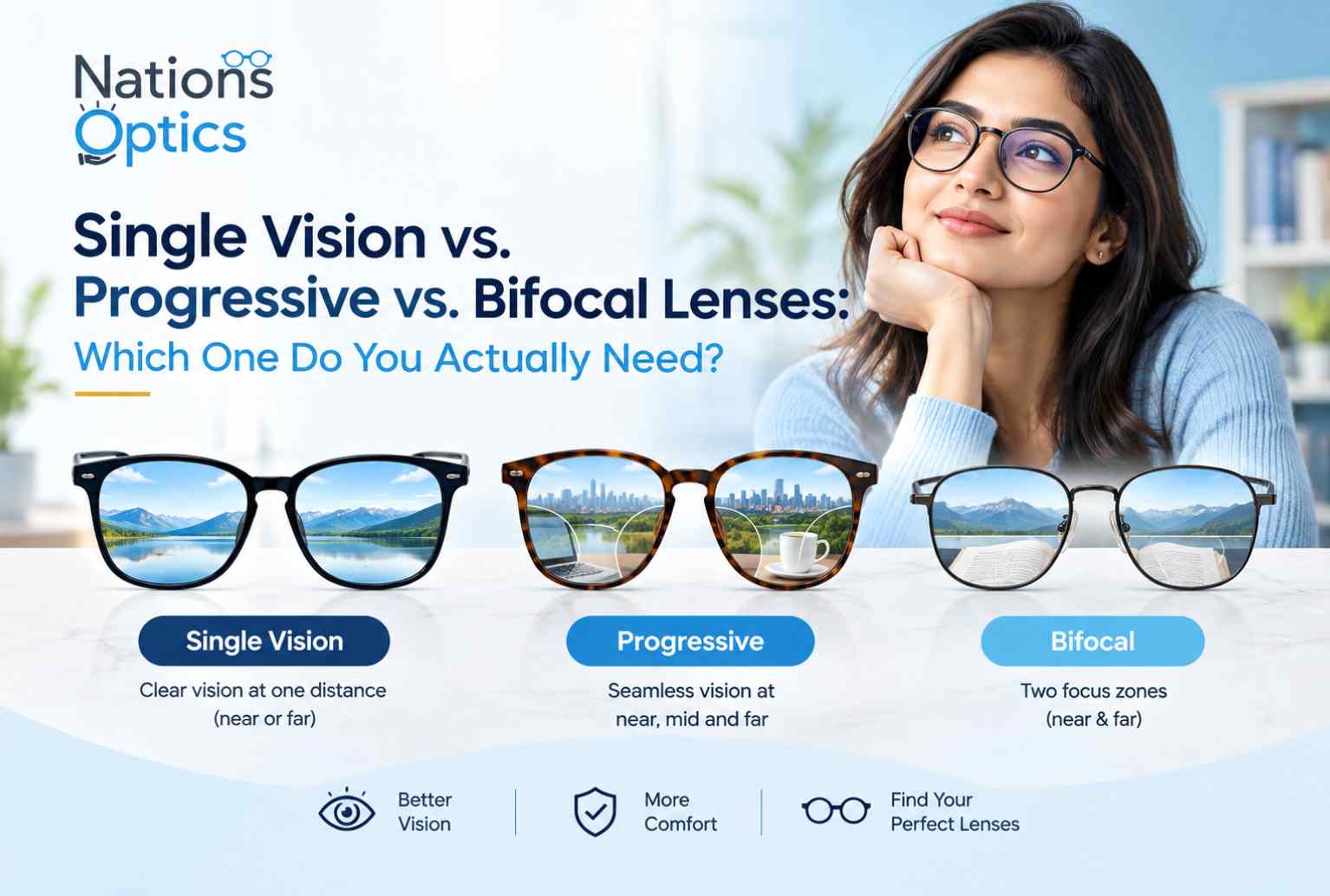
Single Vision vs. Progressive vs. Bifocal Lenses: Which One Do You Actually Need?
Your prescription tells you the power you need — but not which lens design is right for you. Here's a clear, no-jargon breakdown of the three most common lens types.
When most people think about buying glasses, they focus almost entirely on the frame — the shape, the color, the brand. But the lens design inside that frame is just as important, and it's the part that decides how comfortably you'll actually see through your glasses every day.
If you've ever seen terms like "single vision," "progressive," or "bifocal" on a prescription or an order form and weren't sure which one applied to you, you're not alone. This guide breaks down what each lens type actually does, who typically needs it, and how to tell which one fits your situation.
Single Vision Bifocal Progressive Lens Basics
The Core Idea: One Focal Point vs. Multiple
Every lens type exists to solve one basic problem: your eyes may need different amounts of correction for seeing things at different distances — far away, up close, or in between. The three lens types differ in how many "zones" of correction they build into a single lens.
In short: single vision corrects one distance, bifocals correct two distinct distances with a visible line, and progressives correct a full range of distances with no visible line at all.
Single Vision Lenses
Most Common
Single Vision
One consistent power across the entire lens, correcting a single distance.
- Best for distance-only, near-only, or single-focus needs
- Used for myopia, hyperopia, and most astigmatism corrections
- Also used for dedicated reading or computer glasses
- No visible lines or transition zones
- Generally the most affordable and easiest to adapt to
Single vision is the lens type most people are already wearing. It's typically prescribed when only one type of correction is needed — for example, correcting nearsightedness for driving and daily activities, or correcting farsightedness for general use. Some people also use a separate pair of single-vision lenses specifically for reading or screen work, even if their primary glasses correct a different distance.
Bifocal Lenses
Two Zones, Visible Line
Bifocal
Two distinct correction zones in one lens, separated by a visible line.
- Upper portion corrects distance vision
- Lower segment corrects near vision (reading, close work)
- Clear, defined boundary between the two zones
- Common for presbyopia — the age-related loss of near focus
- No "in-between" correction for intermediate distances like a computer screen
Bifocals are typically recommended once someone develops presbyopia — the natural, age-related change (usually starting in the 40s) where the eye's ability to focus on close objects declines. A bifocal lens lets a person look through the top for everyday distance vision and glance down through the lower segment for reading or close-up tasks, without needing to switch glasses.
The trade-off is the visible dividing line and the lack of a smooth zone for intermediate distances, such as a computer monitor or a car dashboard, which can require some head-tilting to find the right focus.
Progressive Lenses
No Line, Full Range
Progressive
A gradual, seamless change in power from top to bottom — often called "no-line bifocals."
- Smooth transition through distance, intermediate, and near zones
- No visible line anywhere on the lens
- Covers computer-distance vision in addition to far and near
- More natural-looking for those who prefer not to show an age-related lens
- Slightly wider price range and a short adjustment period is common
Progressive lenses work like bifocals in concept — correcting more than one distance in a single lens — but instead of a hard line, the power gradually changes from the top of the lens (distance) through the middle (intermediate, such as a computer screen) down to the bottom (near, such as reading). This makes them a popular choice for people who spend time moving between distances throughout the day, and for anyone who prefers the more seamless, line-free appearance.
Because the correction zones blend gradually, many people need a short adjustment period — usually a few days to a couple of weeks — to get used to finding the right area of the lens for each task.
Side-by-Side Comparison
| Feature | Single Vision | Bifocal | Progressive |
|---|---|---|---|
| Number of correction zones | 1 | 2 | 3+ (seamless) |
| Visible dividing line | No | Yes | No |
| Covers intermediate distance (e.g., computer) | No | No | Yes |
| Typical adjustment period | Minimal | Short | Days to a couple weeks |
| Best suited for | Single-distance correction at any age | Presbyopia, budget-conscious multi-distance need | Presbyopia with an active, multi-distance lifestyle |
| Relative cost | Lowest | Moderate | Higher |
How to Know Which One You Need
- If you only need correction for one distance (like nearsightedness for everyday use), single vision is almost always the right — and most economical — choice.
- If your optometrist has noted presbyopia alongside your regular prescription, you'll likely be guided toward a bifocal or progressive option.
- If you frequently shift between your phone, a computer screen, and the road or a room, a progressive lens is generally more comfortable since it removes the need to switch focus abruptly.
- If you'd prefer a simpler, more affordable multi-distance option and don't mind a visible line, a bifocal remains a solid, reliable choice.
Important: The right lens type depends on your specific prescription, your eye examination results, and how you use your vision day to day. This guide is meant to help you understand the options — always confirm the best fit with a qualified optometrist before ordering.
Frequently Asked Questions
Can I switch from single vision to progressives at any time?
You can switch once your eye examination indicates you'd benefit from multi-distance correction, typically once presbyopia develops. Your optometrist can confirm whether progressives are appropriate for your current prescription.
Do progressive lenses take long to get used to?
Many people adapt within a few days, though it can take a couple of weeks for some. Moving your head slightly rather than just your eyes when looking through different zones can help speed up the adjustment.
Are bifocals only for older adults?
Bifocals are most commonly prescribed for age-related presbyopia, but the specific need is determined by an eye examination rather than age alone. Your optometrist will recommend a lens type based on your actual vision needs.
Can I use single-vision computer glasses instead of progressives?
Yes — some people prefer a dedicated single-vision pair set specifically for computer-distance viewing, especially if they don't need correction for distance or near tasks throughout the rest of the day. This is a matter of personal preference and daily routine.
Not Sure Which Lens Type Is Right for You?
Share your prescription with our team, and we'll help you choose the right lens type for your frame and your lifestyle.
Get Lens Guidance from Nations OpticsRelated Reading
Exclusive Offers
Sitewide
33%
OFF
Flat 33% off on all products
Already applied on every price · no coupon needed
Auto-applied
10%
OFF
On orders ₹1,200 – ₹1,799
No coupon needed · saves automatically
Auto-applied
15%
OFF
On orders ₹1,800 – ₹3,199
No coupon needed · saves automatically
Best Deal 🔥
20%
OFF
On orders above ₹3,200
No coupon needed · saves automatically
Pay Advance
₹50
SAVED
Pay advance amount at checkout
Flat ₹50 off · pay balance on delivery
Pay Full ✓
₹100
SAVED
Pay full amount at checkout
Maximum saving · instant confirmation
N
Nations Optics Assistant
● Online
👋 Hi! I'm your Nations Optics assistant. Ask me anything about lenses, frames, or prescriptions!