
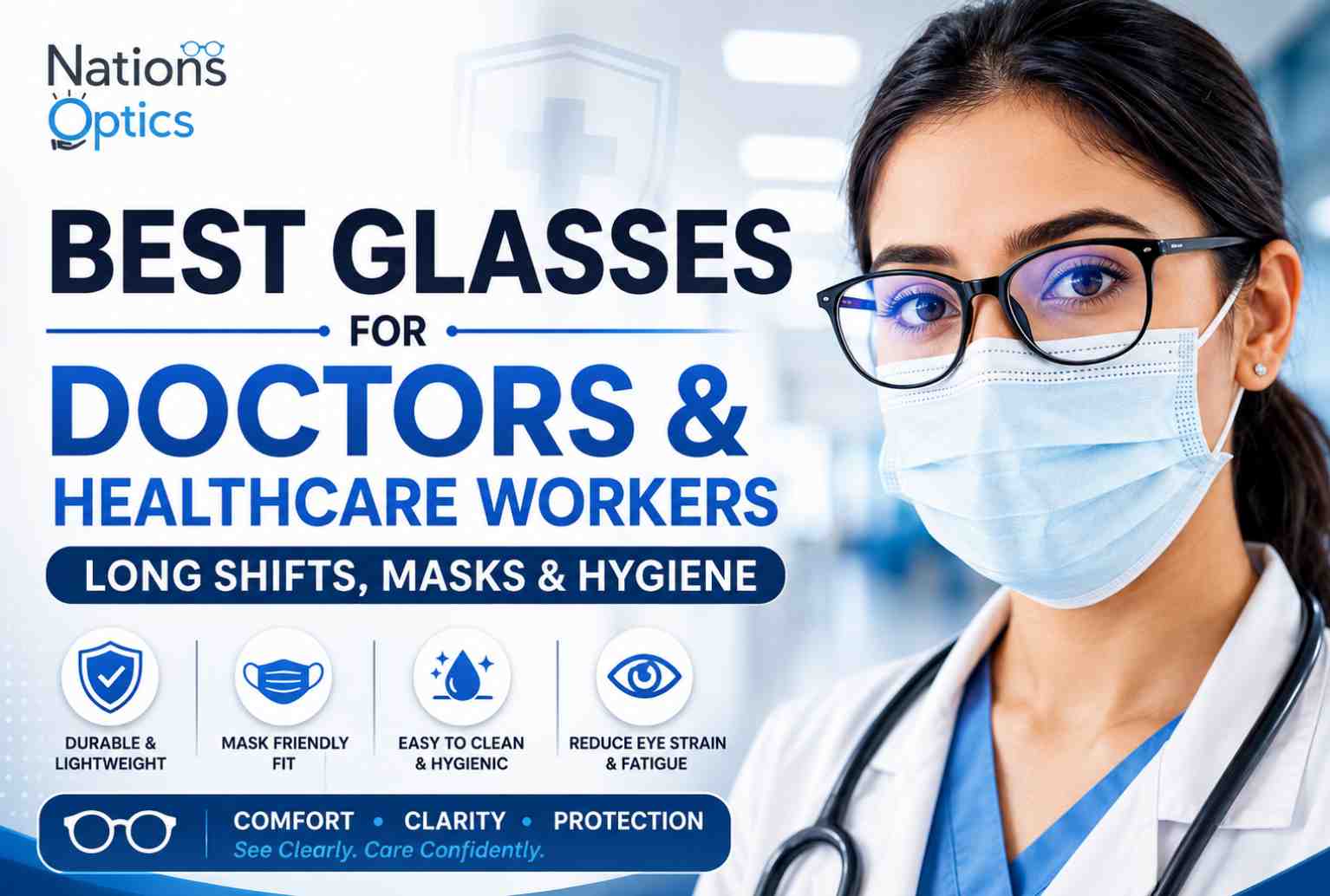
Best Glasses for Doctors & Healthcare Workers: Mask-Proof Guide
Sep 1, 2026
By Rahul Jain
0 comment(s)
Eyewear for Healthcare Professionals
Best Glasses for Doctors & Healthcare Workers: Long Shifts, Masks & Hygiene
Twelve-hour shifts, a mask fogging your lenses, and hands you can't touch your face with — regular glasses weren't built for this. Here's what actually helps.
Few professions put as much daily strain on a pair of glasses as healthcare work. Long shifts, constant mask wear, frequent handwashing and sanitizing, close patient contact, and the need for absolute clarity during procedures all place real demands on eyewear that everyday frames simply aren't designed for.
This guide covers what actually matters when choosing glasses for doctors, nurses, and other healthcare workers — from stopping mask fog in its tracks to hygiene-friendly materials and frame features that hold up through a 12-hour shift.
Mask Fogging
Hygiene & Sanitizing
Long Shift Comfort
Anti-Reflective Coating
Durable Frames
Why Healthcare Work Is So Hard on Regular Glasses
A typical office worker's glasses deal with screen glare and long hours. A healthcare worker's glasses deal with all of that, plus a mask pushing warm breath upward all day, repeated alcohol-based sanitizer exposure, being pushed up and down constantly during procedures, and the simple wear of a 10-to-12-hour shift on your feet.
Common Problems Healthcare Workers Face
- Lenses fogging up constantly under a mask
- Glasses sliding down during procedures
- Sanitizer residue clouding lenses over time
- Pressure marks after long shifts
- Difficulty wearing glasses under face shields or loupes
- Smudges from repeated mask adjustments
- Frame discoloration from frequent disinfecting
- Discomfort from glasses plus mask straps together
Solving Mask Fog: The #1 Complaint
Warm breath escaping upward from a mask hitting cooler lenses is the single most common eyewear complaint among healthcare workers, and it has several practical fixes:
Anti-Fog Lens Coating
A dedicated anti-fog treatment spreads moisture evenly across the lens instead of letting it condense into a visible fog layer — the most effective fix if fogging is a daily issue.
Improve Mask Fit at the Nose
A mask with a snug nose wire, or reinforced with medical tape along the top edge, redirects breath downward and outward instead of up into your lenses.
Position Glasses Over the Mask
Resting glasses on top of a well-fitted mask, rather than under a loose edge, helps create a barrier against upward-escaping air.
Anti-Fog Wipes or Spray
A quick anti-fog spray or wipe at the start of a shift provides several hours of fog resistance — useful as a backup even with a coated lens.
Key Features to Look For
1
Anti-Fog Coating
Given how much of a daily issue mask fogging is, this is arguably the single most valuable lens feature for anyone working in a mask for extended periods.
2
Anti-Reflective Coating
Reduces glare from overhead surgical or exam-room lighting, monitors, and screens — helpful for both visual comfort and clarity during close, detail-focused work.
3
Lightweight, Durable Frames
TR90 or titanium frames hold up to a 12-hour shift without pressure points, and resist the wear that comes from being handled, adjusted, and cleaned repeatedly throughout the day.
4
Secure, Non-Slip Fit
Rubberized nose pads and temple tips keep glasses in place during procedures, bending over patients, or fast-paced movement — no constant pushing them back up mid-task.
5
Scratch-Resistant & Sanitizer-Safe Coating
Frequent cleaning with alcohol-based sanitizers or wipes can degrade lower-quality coatings over time — a durable, sanitizer-tolerant coating holds up better to this repeated exposure.
6
Compatibility With Face Shields and Loupes
A slim, close-fitting frame profile sits more comfortably under additional protective equipment or magnification loupes than a bulky or oversized frame.
Keeping Glasses Hygienic During a Shift
1
Clean lenses with a lens-safe solution — not straight alcohol wipes on the lens surface, which can degrade coatings over repeated use.
2
Wipe frames separately with an appropriate disinfectant wipe, focusing on nose pads and temple tips where skin contact is highest.
3
Avoid touching lenses with sanitized hands immediately after using hand sanitizer — residual alcohol can smear or slowly degrade certain coatings.
4
Store in a clean case during breaks rather than leaving them on a shared surface.
5
Deep clean at the end of each shift using a proper lens-safe cleaner and microfiber cloth, rather than relying only on quick wipes during the day.
Best Frame Materials for Healthcare Settings
TR90
Flexible, lightweight, and holds up well to repeated handling, cleaning, and long wear without losing shape.
Titanium
Highly durable and corrosion-resistant, standing up well to frequent sanitizing without discoloring or weakening over time.
Stainless Steel
Strong and rust-resistant, a solid mid-weight option for daily clinical wear.
Silicone-Tipped Temples
Grip well even with sweat or humidity under a mask, reducing the need to constantly readjust glasses during procedures.
Considerations by Role
Surgeons
A secure, slim-profile frame that sits comfortably under loupes or a face shield, with strong anti-fog performance for long procedures.
Nurses
Lightweight and secure for fast-paced movement throughout long shifts, with durable, easy-to-clean materials.
General Physicians
Anti-reflective coating for comfortable screen use during patient documentation, paired with a professional, approachable frame style.
Dentists & Hygienists
Strong anti-fog performance is especially important given close-range mask wear and frequent leaning over patients.
Lab & Pharmacy Staff
Durable, chemical-resistant coatings and frames that tolerate frequent cleaning in a lab or dispensing environment.
If you wear safety eyewear over prescription glasses: make sure your everyday frame is slim and lightweight enough to fit comfortably underneath — a bulky frame under protective eyewear adds pressure and discomfort over a long shift.
Frequently Asked Questions
What's the best way to stop glasses fogging up under a mask?
An anti-fog lens coating is the most effective long-term fix. Improving mask fit at the nose and positioning glasses over the mask edge also help reduce fogging.
What frame material is best for frequent sanitizing?
Titanium and stainless steel hold up particularly well to repeated alcohol-based cleaning without discoloring or degrading.
Can I clean my glasses with hand sanitizer?
It's better to use a dedicated lens-safe cleaning solution on the lenses. Sanitizer residue on hands or direct alcohol contact can degrade certain lens coatings over repeated use.
Do healthcare workers need special lenses?
Not a special prescription, but anti-fog and anti-reflective coatings are particularly valuable given the combination of mask wear and long hours under clinical lighting.
What frames work best under a face shield or loupes?
A slim, close-fitting, lightweight frame profile is more comfortable under additional protective equipment than a bulky or oversized frame.
Eyewear Built for a Long Shift
At Nations Optics, we help healthcare professionals find frames and lenses that handle masks, sanitizing, and long hours without compromise.
- Anti-fog lens coating options
- Anti-reflective & scratch-resistant coatings
- TR90 & titanium frame options
- Slim profiles compatible with loupes and face shields
- Secure, non-slip fit for active shifts
Healthcare work asks a lot of a pair of glasses — clarity through a long shift, resistance to constant cleaning, and a fit that holds up under a mask, a face shield, or loupes without becoming a daily annoyance. The right combination of anti-fog and anti-reflective coatings, a durable frame material, and a secure, lightweight fit can make a real difference to how comfortable your eyewear feels by hour ten of a shift.
None of this requires compromising on style or professionalism — it's simply about matching the frame and lens features to the very specific demands of clinical work.
Exclusive Offers
Sitewide
33%
OFF
Flat 33% off on all products
Already applied on every price · no coupon needed
Auto-applied
10%
OFF
On orders ₹1,200 – ₹1,799
No coupon needed · saves automatically
Auto-applied
15%
OFF
On orders ₹1,800 – ₹3,199
No coupon needed · saves automatically
Best Deal 🔥
20%
OFF
On orders above ₹3,200
No coupon needed · saves automatically
Pay Advance
₹50
SAVED
Pay advance amount at checkout
Flat ₹50 off · pay balance on delivery
Pay Full ✓
₹100
SAVED
Pay full amount at checkout
Maximum saving · instant confirmation
N
Nations Optics Assistant
● Online
👋 Hi! I'm your Nations Optics assistant. Ask me anything about lenses, frames, or prescriptions!