How to Read Your Eyeglass Prescription: OD, SPH, CYL & More
Sep 2, 2026
By Rahul Jain
0 comment(s)
Prescription Guide
How to Read Your Eyeglass Prescription Like a Pro: A Complete Visual Breakdown
OD, OS, SPH, CYL, AXIS, ADD, PD — decode every abbreviation on your prescription in under five minutes.
You've just received your eye prescription, looked at the numbers, and thought: what does all of this actually mean? Terms like OD, OS, SPH, CYL, AXIS, ADD, and PD can make an eyeglass prescription look complicated. But once you understand what each abbreviation means, reading your prescription becomes surprisingly simple.
Your prescription is essentially a set of precise measurements that tells an optical professional how your lenses should be made to correct your vision. By the end of this guide, you'll be able to look at your prescription and understand exactly what every number means.
OD / OS
SPH
CYL & AXIS
ADD Power
Pupillary Distance
The Quick Answer: What a Prescription Looks Like
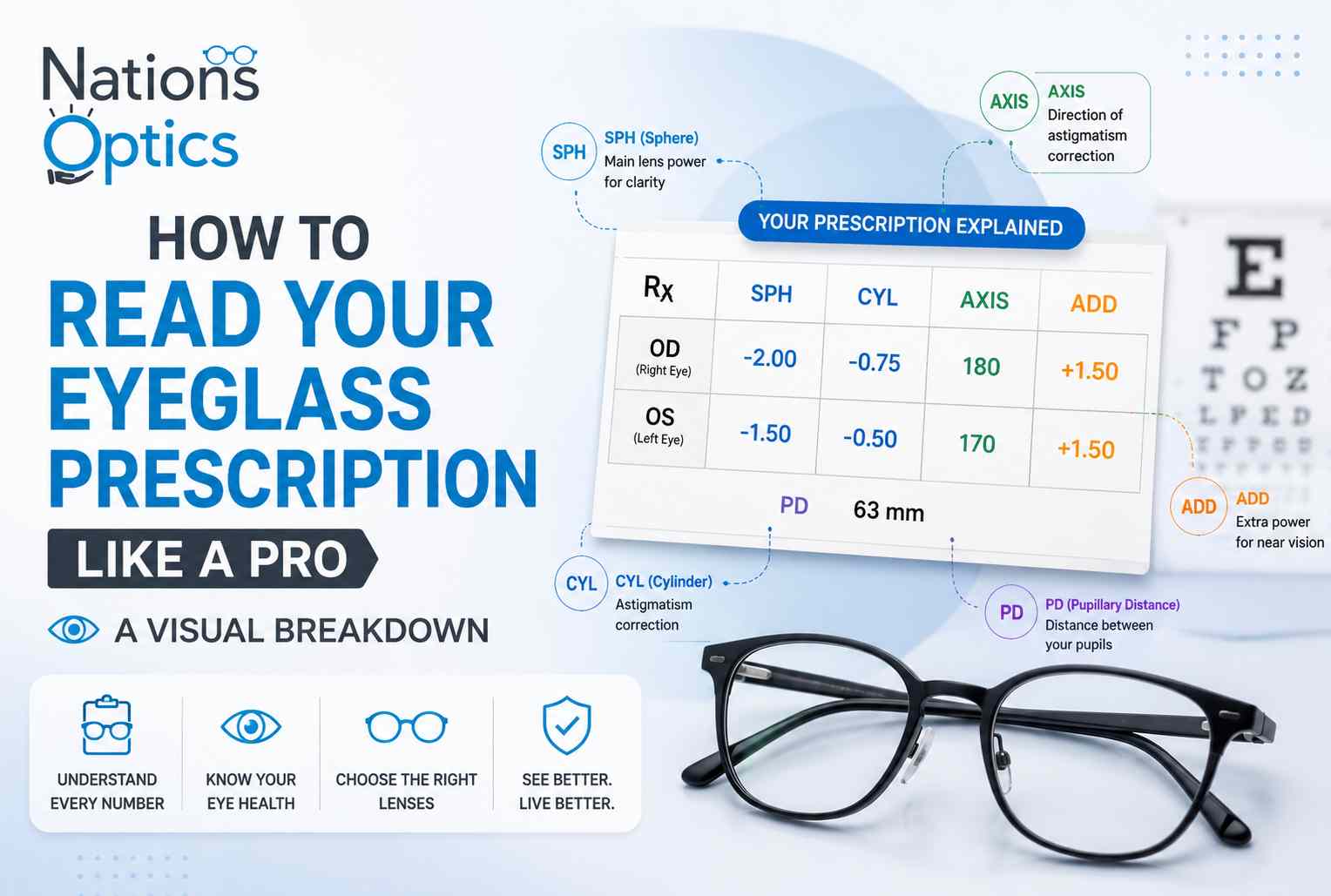
A typical eyeglass prescription may look something like this:
| Eye | SPH | CYL | Axis | ADD |
|---|---|---|---|---|
| OD | -2.00 | -0.75 | 180 | +1.50 |
| OS | -1.50 | -0.50 | 170 | +1.50 |
PD: 63 mm
At first glance, this may look confusing. But each part has a specific meaning:
- OD = Right eye
- OS = Left eye
- SPH = Main lens power
- CYL = Astigmatism correction
- AXIS = Direction of astigmatism correction
- ADD = Extra power for reading
- PD = Pupillary distance
The key to understanding an eye prescription is to read each column one at a time.
Step 1: What Do OD and OS Mean?
OD
Oculus Dexter
Right eye. Everything on the OD row applies specifically to your right eye.
OS
Oculus Sinister
Left eye. Everything on the OS row applies to your left eye.
Some prescriptions use simpler abbreviations instead: RE / R/E for right eye, LE / L/E for left eye. You may also occasionally see OU, meaning both eyes.
Important: Your right and left eyes may have completely different prescription numbers — this is normal. It's extremely important to enter the correct values for each eye when ordering prescription glasses, and never switch them.
Step 2: What Is SPH in an Eye Prescription?
SPH, or Sphere, is the main lens power in your prescription — it tells you the basic amount of vision correction your lens needs, measured in diopters (D). The number may have either a minus sign (–) or a plus sign (+).
− Minus
Usually indicates myopia (short-sightedness/nearsightedness) — nearby objects are clearer than distant ones. The farther from zero, the stronger the correction: -4.00 is stronger than -1.00.
+ Plus
Usually indicates hyperopia (long-sightedness/farsightedness). Again, the farther from zero, the stronger the correction: +3.00 is stronger than +1.00.
What Does Plano or PL Mean?
Sometimes instead of a regular SPH number, you'll see PL, Plano, or 0.00. This generally means no spherical correction is required — but a person can still have other prescription values, such as CYL and AXIS, even with a Plano SPH.
Step 3: What Is CYL in an Eye Prescription?
CYL stands for Cylinder and represents the amount of correction needed for astigmatism — a refractive error related to the way light focuses in the eye. A CYL value may look like -0.50, -0.75, -1.25, or +1.00. Not everyone has a CYL value; if the box is blank, zero, or marked differently, it may indicate no significant cylindrical correction has been prescribed.
Think of CYL as an additional correction that works alongside the main SPH power. Your prescription may include SPH only, SPH + CYL + AXIS, or Plano + CYL + AXIS. If CYL appears, you'll usually also see an AXIS value, since the two work together.
Step 4: What Is AXIS in an Eye Prescription?
AXIS tells the optical lab the direction in which the CYL correction should be positioned. It's written as a number between 1 and 180 degrees — for example, 10, 45, 90, 135, or 180.
Common mistake: A higher AXIS number does NOT mean a stronger prescription. AXIS is a direction, not a power. In "CYL -1.00 × AXIS 180," the -1.00 is the cylinder power, and the 180 is simply the direction that correction is positioned.
SPH, CYL, and AXIS — Explained Simply
SPH = How much main correction you need
CYL = How much astigmatism correction you need
AXIS = Where that astigmatism correction goes
Step 5: What Is ADD Power in an Eye Prescription?
ADD, sometimes called Addition, is extra plus power used for near vision — commonly relating to reading and close-up tasks. ADD values may look like +1.00, +1.50, +2.00, or +2.50, and are commonly used in progressive lenses, bifocal lenses, and other multifocal designs.
As people get older, many experience presbyopia, an age-related change that makes focusing on close objects more difficult. The ADD value provides the additional power needed for near vision.
Reading a Progressive Prescription
| Eye | SPH | CYL | Axis | ADD |
|---|---|---|---|---|
| OD | -2.00 | -0.50 | 180 | +2.00 |
| OS | -1.75 | -0.75 | 170 | +2.00 |
The SPH, CYL, and AXIS values describe the distance prescription and astigmatism correction. The ADD +2.00 provides the additional power for near vision within a multifocal lens design. If your prescription includes ADD, make sure the lens type you select is appropriate for it.
Step 6: What Is PD in Glasses?
PD stands for Pupillary Distance — the distance between the centers of your pupils, generally measured in millimeters (e.g., 60mm, 62mm, 63mm, 64mm). PD matters because the optical center of your lenses needs to be positioned correctly in front of your eyes, which becomes especially important when ordering glasses online and for certain multifocal lenses.
Your PD may be written as a single number (63mm) or as two separate monocular measurements (31.5 / 31.5) representing each eye individually. Never guess your PD when precise measurements are required.
Step 7: What Is Prism in an Eye Prescription?
Some prescriptions include Prism correction, which is less common than SPH, CYL, and AXIS. If Prism appears, it's usually accompanied by a Base direction, such as Base In, Base Out, Base Up, or Base Down. Prism is used for specific visual and eye-alignment requirements — if your prescription includes it, make sure your glasses are made exactly according to the prescription and measurements your eye-care professional provided.
A Complete Worked Example
| Eye | SPH | CYL | Axis | ADD |
|---|---|---|---|---|
| OD | -2.50 | -0.75 | 180 | +1.50 |
| OS | -1.75 | -0.50 | 170 | +1.50 |
PD: 63 mm
Right Eye (OD)
SPH -2.50 — the right eye requires minus spherical correction.
CYL -0.75 — cylindrical correction for astigmatism.
AXIS 180 — the CYL correction is positioned at 180 degrees.
ADD +1.50 — additional plus power for near vision.
Left Eye (OS)
SPH -1.75 — the left eye requires minus spherical correction.
CYL -0.50 — cylindrical correction for astigmatism.
AXIS 170 — the cylindrical correction is positioned at 170 degrees.
ADD +1.50 — additional near-vision power.
Eyeglass Prescription Chart: Quick Reference
| Term | Meaning |
|---|---|
| OD | Right Eye |
| OS | Left Eye |
| OU | Both Eyes |
| SPH | Main spherical lens power |
| CYL | Astigmatism correction |
| AXIS | Direction of cylinder correction |
| ADD | Additional power for near vision |
| PD | Pupillary distance |
| Prism | Special correction for certain eye-alignment needs |
| PL / Plano | No spherical correction |
A Few Common Questions About Reading Your Prescription
How Do You Know If Your Prescription Is Strong?
In general, the number farther from zero represents a stronger amount of correction — -1.00 is less powerful than -5.00, and +1.00 is less powerful than +4.00. But there's more to a prescription than just the SPH number: CYL, AXIS, ADD, and Prism all factor in too. A higher number doesn't automatically mean something is wrong with your eyes — it simply indicates the amount and type of optical correction prescribed.
Can Your Right and Left Eye Have Different Prescriptions?
Yes — very commonly. For example, OD might be -3.00 while OS is -1.50. This means the two eyes require different amounts of correction. Always enter the OD and OS values exactly as they appear, and never switch them.
Can You Have CYL Without SPH?
Yes. A person may have little or no spherical correction (Plano) but still require astigmatism correction, such as Plano SPH with CYL -1.00 at AXIS 180.
Can You Have CYL Without AXIS?
Generally, no — CYL correction needs an AXIS value to specify its orientation. CYL tells the amount of astigmatism correction; AXIS tells the direction. Both values matter when reading and entering a prescription.
Common Mistakes People Make When Reading a Prescription
1
Confusing OD and OS
Remember: OD = right eye, OS = left eye.
2
Ignoring the Plus or Minus Sign
The sign is extremely important — -2.00 and +2.00 are not the same prescription. Always enter the sign exactly as written.
3
Thinking AXIS Is Lens Strength
AXIS is not a strength measurement — it's the direction of the CYL correction.
4
Guessing Your PD
PD should be measured accurately rather than guessed.
5
Leaving Out ADD
If you need progressive or bifocal lenses, the ADD value is an essential part of your prescription.
6
Assuming Both Eyes Match
Your right and left eyes can have completely different values — always check each eye separately.
How to Check Your Prescription Before Ordering Online
Before You Place Your Order
1
Confirm the right eye (OD) and left eye (OS) values are entered correctly.
2
Check the SPH sign — a missing plus or minus sign can completely change the prescription.
3
Check CYL carefully — enter it exactly as written, if present.
4
Do not change the AXIS — enter it exactly as provided.
5
Check ADD for progressive or bifocal lenses, and select the correct lens type.
6
Use an accurate PD to help ensure proper lens positioning.
7
Never guess prescription values — ask a qualified optical professional if anything is unclear.
Eyeglass Prescription vs Contact Lens Prescription
Not always the same. An eyeglass prescription and a contact lens prescription aren't automatically interchangeable — contact lenses sit directly on the eye, while eyeglass lenses sit at a distance in front of the eyes. Contact lens prescriptions may also include additional measurements and specifications. Always use the appropriate prescription for the type of vision correction you're ordering.
The easiest way to remember it all: Which eye (OD/OS)? → Main power (SPH) → Astigmatism (CYL) → Direction (AXIS) → Reading power (ADD) → Lens positioning (PD). Follow this order and even a complicated prescription becomes much easier to read.
Frequently Asked Questions
What does SPH, CYL, and AXIS mean?
SPH is the main spherical correction, CYL is the amount of astigmatism correction, and AXIS is the direction in which the CYL correction is positioned.
What does OD mean on a glasses prescription?
OD means right eye (from the Latin Oculus Dexter).
What does OS mean on a glasses prescription?
OS means left eye (from the Latin Oculus Sinister).
What does PD mean in glasses?
PD means Pupillary Distance, used to help position the lenses correctly in front of your eyes.
What is ADD power in an eye prescription?
ADD is additional plus power for near vision, commonly used in progressive and bifocal prescriptions.
What does Plano mean in an eye prescription?
Plano, PL, or 0.00 generally indicates no spherical correction is prescribed.
Can I order glasses using my eye prescription?
Yes — an eyeglass prescription provides the optical values needed for prescription lenses, but accurate measurements and the appropriate lens selection also matter.
Order Prescription Glasses With Confidence
Now that you can read your prescription, let Nations Optics help you turn it into the right lenses and frame.
- Simple, guided prescription entry at checkout
- Support for SPH, CYL, AXIS, ADD & Prism values
- Accurate PD verification
- Single vision, bifocal & progressive lens options
- Guidance if anything on your prescription is unclear
Your eye prescription may look like a complicated combination of numbers and abbreviations, but every value has a specific purpose. The most important terms to remember are OD (right eye), OS (left eye), SPH (main lens power), CYL (astigmatism correction), AXIS (direction of that correction), ADD (extra near-vision power), and PD (pupillary distance).
Your prescription is not just a collection of random numbers — it's a precise map designed to help your lenses provide the clearest, most comfortable vision possible.
Exclusive Offers
Sitewide
33%
OFF
Flat 33% off on all products
Already applied on every price · no coupon needed
Auto-applied
10%
OFF
On orders ₹1,200 – ₹1,799
No coupon needed · saves automatically
Auto-applied
15%
OFF
On orders ₹1,800 – ₹3,199
No coupon needed · saves automatically
Best Deal 🔥
20%
OFF
On orders above ₹3,200
No coupon needed · saves automatically
Pay Advance
₹50
SAVED
Pay advance amount at checkout
Flat ₹50 off · pay balance on delivery
Pay Full ✓
₹100
SAVED
Pay full amount at checkout
Maximum saving · instant confirmation
N
Nations Optics Assistant
● Online
👋 Hi! I'm your Nations Optics assistant. Ask me anything about lenses, frames, or prescriptions!