
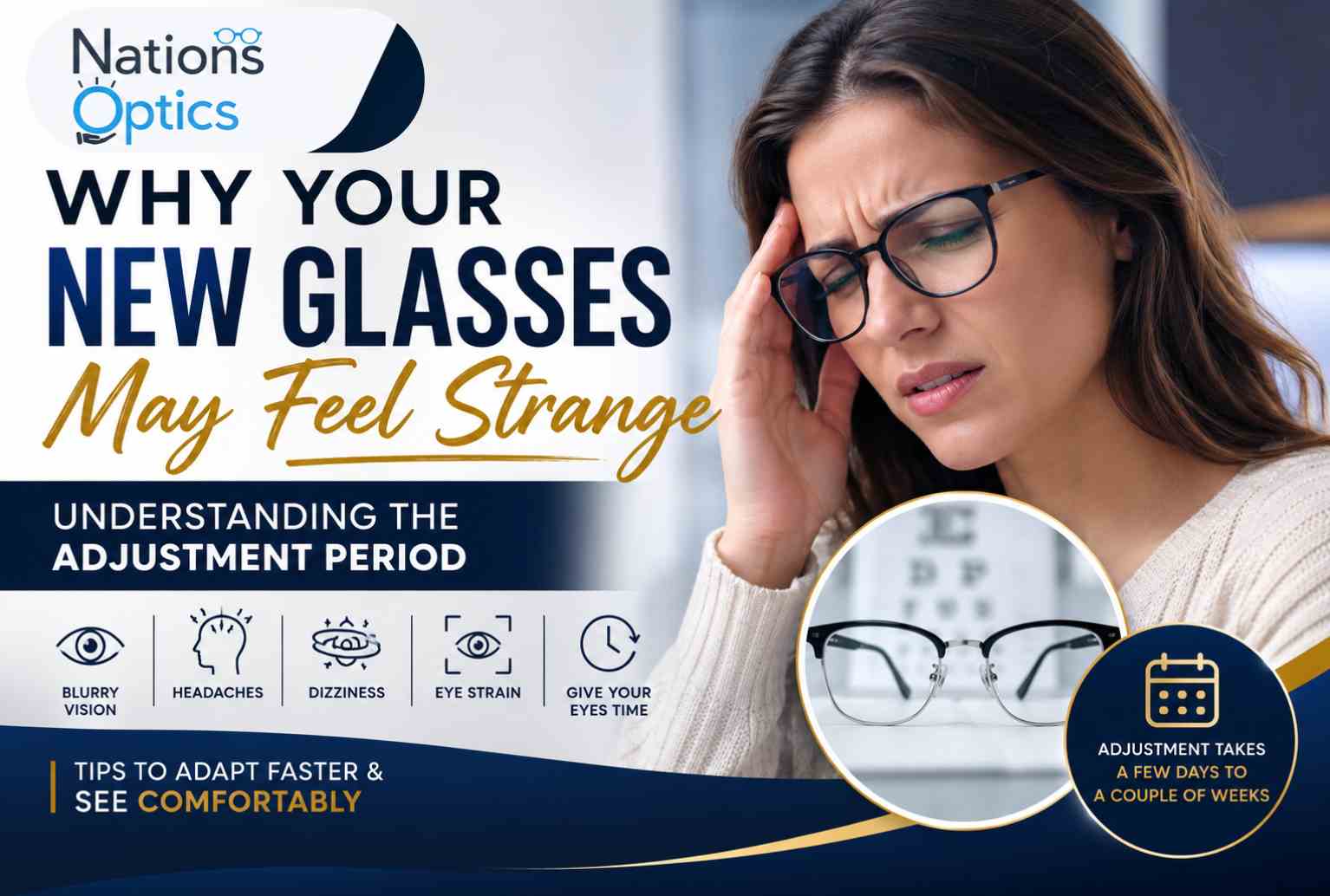
Why New Glasses Feel Strange: The Adjustment Period Explained
Aug 27, 2026
By Rahul Jain
0 comment(s)
Prescription & Comfort Guide
Why Your New Glasses May Feel Strange: Understanding the Adjustment Period
Mild headaches, slight dizziness, a "fishbowl" feeling — new glasses can feel off at first, and that's usually your brain adjusting, not a sign something's wrong.
Getting a new pair of glasses should make your vision clearer and more comfortable. Yet many people experience the opposite at first. Your new glasses may feel weird, your vision may seem slightly different, or you may notice mild headaches, dizziness, eye strain, or distortion.
If this is happening to you, don't immediately assume something is wrong with your glasses. In many cases, your eyes and brain simply need time to adapt to the new lenses and prescription. Most people adjust within a few days, although some may need a couple of weeks, particularly after a significant prescription change or when starting progressive lenses.
Adjustment Period
Progressive Lenses
New Glasses Headache
Frame Fit
When to Get Checked
Why Do My New Glasses Feel Weird?
Your brain has become accustomed to the way you see through your previous glasses — or without glasses. A new prescription changes the way light enters your eyes and how visual information reaches your brain. Even when the new prescription is correct, your visual system may need time to adapt.
You May Temporarily Notice:
- Mild headaches
- Eye strain
- Slight blurry vision
- Dizziness or feeling off-balance
- Distorted vision
- Changes in depth perception
- A "fishbowl" or swimming sensation
- Mild nausea in some cases
These new glasses symptoms are generally temporary and tend to improve as you continue wearing your new eyewear.
How Long Does It Take to Adjust to New Glasses?
For many people, the adjustment period lasts only a few days. Some may need a week or two, especially with a substantial prescription change or when switching to multifocal or progressive lenses. There isn't one exact adjustment time that applies to everyone — it can depend on:
- How much your prescription changed
- Whether you're wearing glasses for the first time
- Whether you have astigmatism
- Whether you switched from single-vision to progressive lenses
- Your age and visual needs
- The lens design and material
- The size and shape of your new frame
- How accurately the lenses are positioned in front of your eyes
The good news is that mild discomfort generally becomes less noticeable as your visual system becomes accustomed to the new prescription.
Why Do New Glasses Feel Strange at First?
1
Your Prescription Has Changed
A change in lens power can make the world look noticeably different. If your prescription has become stronger, your eyes and brain need to adapt to the new level of correction — objects may initially appear slightly different in size, distance, or position. This is particularly noticeable with a significant prescription change.
2
You're Wearing Glasses for the First Time
Almost everything about the experience is new — you're adapting not only to the prescription but to the feeling of a frame on your face and seeing lens edges in your peripheral vision. The frame itself can feel unfamiliar around your nose, ears, and temples.
3
You've Switched to Progressive Lenses
Progressive lenses provide multiple viewing zones for distance, intermediate, and near vision. Because the power changes gradually across the lens, there can be areas of peripheral distortion while you learn how to use them.
- Blurry peripheral vision
- A swimming sensation
- Dizziness
- Headaches
- Depth-perception changes
- Difficulty finding the correct viewing area
4
Your Frame Is Different
Sometimes the prescription hasn't changed at all, but your new glasses feel weird because you've changed frames. A larger, smaller, deeper, or differently curved frame can change how the lenses sit in front of your eyes — frame position and lens alignment can affect visual comfort just as much as the prescription itself.
5
Your Eyes Need to Adapt to Astigmatism Correction
If your new prescription includes a change in cylinder or axis for astigmatism, the visual difference can be noticeable. Some people temporarily experience distortion, eye strain, or headaches while adjusting. If these symptoms don't improve, your eye-care professional should check the prescription and lens positioning.
Common Symptoms When Adjusting to New Glasses
New Glasses Headache
Mild headaches can occur during the first few days, particularly after a prescription change, as your visual system adapts to the new correction. Persistent or worsening headaches shouldn't simply be ignored.
Dizziness From New Glasses
Can occur when your brain is adapting to changes in visual information and depth perception — more noticeable with significant prescription changes or multifocal lenses. If dizziness is severe, persistent, or interfering with normal activities, have your glasses and prescription checked.
Blurry Vision With New Glasses
A small amount of temporary blur can occur during adaptation. But your new prescription should ultimately provide clearer vision — if it remains significantly blurry after enough time to adjust, incorrect lens positioning, prescription, or pupillary distance measurement could be the cause, and your optician should check the lenses.
Eye Strain From New Glasses
Tired eyes, difficulty focusing, mild headaches, and discomfort during prolonged reading or screen use can appear in the first few days and should generally improve as you become accustomed to your glasses.
Distorted or "Fishbowl" Vision
Straight lines may appear slightly curved, or floors may look unusual, particularly with certain prescription changes, higher prescriptions, or progressive lenses. Your brain needs time to reinterpret the visual information — if distortion continues rather than improving, have the glasses checked.
Can a New Frame Cause Problems Even With the Same Prescription?
Yes. You can experience an adjustment period even if your prescription hasn't changed. A different frame shape, lens size, curvature, or position can change the way you look through the lenses. Poor frame fit can also create pressure around the nose, temples, or ears and may contribute to discomfort or headaches — which is exactly why professional frame fitting matters just as much as the prescription itself.
How to Get Used to New Glasses Faster
1
Wear Your New Glasses Consistently
Your visual system generally adapts more efficiently with consistent use — put them on in the morning and wear them regularly.
2
Avoid Switching Between Old and New Glasses
Going back and forth between prescriptions can make the transition feel more difficult — give your new glasses a consistent trial period if possible.
3
Give Yourself Time
Don't expect your vision to feel completely natural immediately — a few days of adjustment is normal, and progressive-lens wearers or those with substantial prescription changes may need longer.
4
Check the Frame Fit
If your glasses are sliding, pressing behind your ears, tight around the temples, sitting crooked, or pressuring your nose, visit an optician for a professional adjustment.
5
Make Sure Your Prescription and Measurements Are Correct
If your glasses continue to feel wrong, don't assume you just need more time — your optician can check whether the lenses were manufactured correctly and whether measurements like pupillary distance are appropriate.
When Should You Be Concerned?
- Vision remains significantly blurry
- Headaches continue or worsen
- Dizziness doesn't improve
- Persistent double vision
- Distortion remains severe
- Glasses feel incorrectly positioned
- Can't comfortably do everyday activities
- Can't see safely while driving
Don't force yourself to tolerate persistent visual problems simply because the glasses are new — if symptoms persist beyond the expected adjustment period, your prescription, lens positioning, and frame fit may need to be checked.
Should You Go Back to Your Old Glasses?
Stick With the New Pair If:
- Symptoms are mild
- You notice gradual improvement day to day
- Discomfort is manageable during daily activities
Get Them Checked Instead If:
- Symptoms are severe
- Nothing is improving after a reasonable period
- Discomfort is getting worse, not better
Constantly switching between prescriptions can make the adjustment process more difficult — but if symptoms are severe or not improving, have the new glasses checked rather than simply continuing to push through the discomfort.
What About Progressive Glasses Specifically?
Progressive lenses can require a longer adaptation period because one lens provides different zones for different viewing distances. At first, you may need to learn to:
- Look through the appropriate area of the lens
- Move your head toward the object you're viewing
- Use the upper portion for distance
- Use the lower portion for reading
- Become comfortable with peripheral distortion
Consistent use can help you become more comfortable with progressive lenses over time. If you're still struggling after the adjustment period, your optician can check the frame position and lens fitting.
Correctly prescribed glasses do not damage your eyes or make your vision worse. Glasses correct refractive errors and help you see more clearly — the adjustment period is your visual system adapting, not a sign of harm.
Frequently Asked Questions
Is it normal for new glasses to feel weird?
Yes — particularly if your prescription has changed, you're wearing glasses for the first time, or you've switched to a different lens type.
How long does it take to get used to new glasses?
Many people become comfortable within a few days, while some may take a week or two. Progressive lenses and significant prescription changes can require a longer adjustment period.
Why do my new glasses make me dizzy?
Changes in prescription, lens type, and depth perception can temporarily cause dizziness. If it persists or is severe, have your glasses and prescription checked.
Why do my new glasses give me a headache?
A new prescription can temporarily require your visual system to adapt. Frame pressure, incorrect measurements, or an unsuitable prescription can also contribute to headaches.
Why are my new glasses blurry?
Temporary blurry vision can occur during adjustment, but persistent blur may indicate an issue with the prescription, lens positioning, frame fit, or measurements.
Can new glasses make your eyes worse?
Correctly prescribed glasses do not make your eyes weaker or damage your vision — they correct refractive errors and help you see more clearly.
Should I wear my new glasses all day?
For most people, consistent wear helps the visual system adapt. If they cause significant or worsening symptoms, speak with your eye-care professional.
Adjusting Isn't Going Smoothly?
At Nations Optics, we can check your prescription, lens positioning, and frame fit to make sure your new glasses are set up correctly from the start.
- Prescription and pupillary distance verification
- Professional frame fitting and adjustment
- Guidance for progressive lens adaptation
- Support if symptoms aren't improving
- A comfortable frame fit built around your face
If your new glasses feel strange, don't panic. A temporary adjustment period is common, especially when you've received a new prescription, changed frame styles, started wearing glasses for the first time, or switched to progressive lenses. Mild headaches, eye strain, slight dizziness, temporary blur, or distortion can occur while your eyes and brain adapt — and for many people, these symptoms improve within a few days.
The important thing is to pay attention to the direction of your symptoms. If your vision and comfort are steadily improving, you're likely adapting. If symptoms remain severe, worsen, or don't improve, have your glasses and prescription professionally checked. Clear vision should feel comfortable — not confusing.
Exclusive Offers
Sitewide
33%
OFF
Flat 33% off on all products
Already applied on every price · no coupon needed
Auto-applied
10%
OFF
On orders ₹1,200 – ₹1,799
No coupon needed · saves automatically
Auto-applied
15%
OFF
On orders ₹1,800 – ₹3,199
No coupon needed · saves automatically
Best Deal 🔥
20%
OFF
On orders above ₹3,200
No coupon needed · saves automatically
Pay Advance
₹50
SAVED
Pay advance amount at checkout
Flat ₹50 off · pay balance on delivery
Pay Full ✓
₹100
SAVED
Pay full amount at checkout
Maximum saving · instant confirmation
N
Nations Optics Assistant
● Online
👋 Hi! I'm your Nations Optics assistant. Ask me anything about lenses, frames, or prescriptions!