
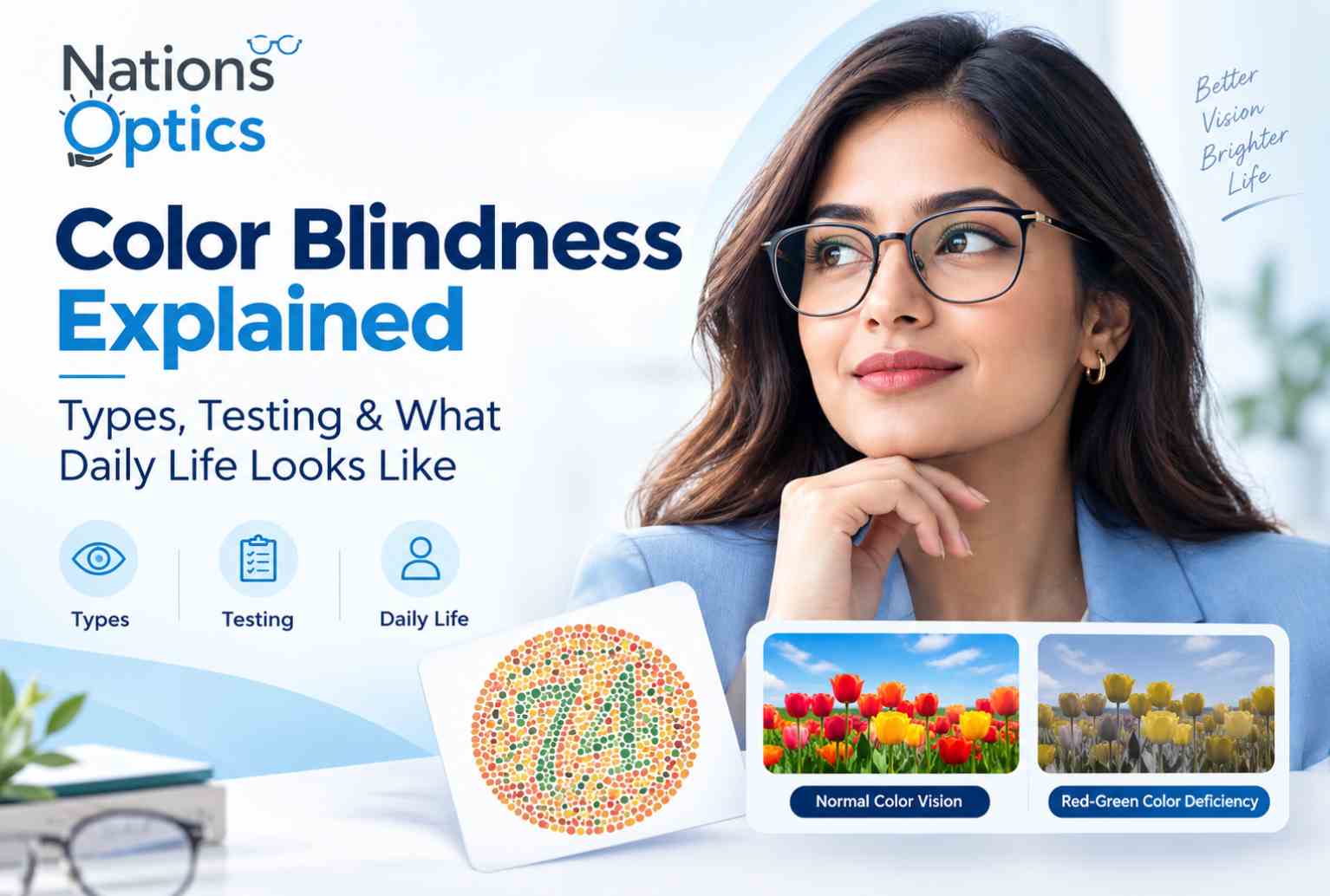
Color Blindness Explained: Types, Testing & What Daily Life Looks Like
Oct 1, 2026
By Rahul Jain
0 comment(s)
Vision Science
Color Blindness Explained: Types, Testing & What Daily Life Looks Like
It rarely means seeing the world in black and white. Here's what color vision deficiency actually is, how it's tested, and what day-to-day life looks like for people who have it.
A quick note: This article provides general information about color vision deficiency and is not a substitute for professional medical advice. If you have concerns about your color vision, consult an eye-care professional for proper testing and evaluation.
Seeing the world in color is something most of us take for granted. But what happens when certain colors look similar, appear less bright, or are difficult to distinguish? This is where color blindness, medically known as color vision deficiency, comes in.
Color blindness does not usually mean that a person sees the world entirely in black and white. In most cases, people with color vision deficiency can see colors but have difficulty telling certain colors or shades apart. The most common form affects the ability to distinguish between red and green, while less common forms affect blue and yellow. Complete color vision deficiency, in which a person sees little or no color, is rare.
Color Vision Deficiency Red-Green Blue-Yellow Ishihara Test
What Is Color Blindness?
Color blindness is a condition in which a person has difficulty seeing or distinguishing certain colors in the same way that people with typical color vision do. The medical term commonly used is color vision deficiency. The term "color blind" can be misleading, because most affected people are not completely unable to see colors — instead, they may have difficulty distinguishing particular colors, shades, or levels of brightness.
Color vision deficiency can be inherited and present from birth, but it can also develop later in life because of certain eye or neurological conditions, injuries, medicines, or age-related changes.
Is color blindness the same as poor eyesight? No. A person can have normal visual sharpness and still have a color vision deficiency — and someone who needs glasses for nearsightedness, farsightedness, or astigmatism may have perfectly normal color vision. Color vision testing evaluates something entirely different from a standard visual-acuity test.
What Causes Color Blindness?
The most common forms of color vision deficiency are genetic and passed from parents to children. Red-green color vision deficiency is particularly associated with genes carried on the X chromosome, which is one reason it's more common in males — though it can affect people of any sex.
Color vision deficiency can also be acquired later in life, with possible causes including:
- Certain eye diseases
- Damage to the retina or optic nerve
- Certain brain or nervous-system conditions
- Eye or head injuries
- Some medicines
- Age-related eye changes, including cataracts
If someone notices a new or sudden change in color perception, particularly when they previously had normal color vision, it's worth discussing the change with an eye-care professional.
The Main Types of Color Blindness
1
Red-Green Color Blindness
The most common type. Includes deuteranomaly (most common form — green appears more reddish or hard to distinguish, often mild), protanomaly (red appears more greenish or less bright), deuteranopia and protanopia (more pronounced difficulty distinguishing red and green).
2
Blue-Yellow Color Blindness
Less common than red-green deficiency. Includes tritanomaly (difficulty distinguishing blue from green, yellow from red) and tritanopia (difficulty with blue-green and yellow-related combinations; some colors may appear less bright).
3
Complete Color Blindness
Rare, sometimes called monochromacy or achromatopsia. A person may see little or no color, and may also experience reduced visual sharpness or increased light sensitivity, depending on the specific condition.
Common Symptoms
A person with color vision deficiency may have trouble telling certain colors apart, identifying subtle differences between shades, recognizing how bright a color is, distinguishing similar-looking colors, or identifying color-coded information. Symptoms can be mild enough that a person doesn't realize they have a color vision deficiency — many people gradually develop strategies for identifying colors using context, position, labels, brightness, or surrounding objects.
What Do Color Blind People Actually See?
There's no single answer, because color blindness has different types. A person with red-green color vision deficiency does not necessarily see everything as red and green — instead, certain colors and shades may appear more similar than they would to someone with typical color vision. For example, combinations like red and green, brown and green, purple and blue, or red and brown may be harder to distinguish, depending on the individual's specific type.
Someone with blue-yellow deficiency may struggle with different combinations involving blue, green, yellow, and pink. Someone with complete color vision deficiency may see very little or no color. There is no single "color blind view" — the experience depends entirely on the type and severity involved.
How Is Color Blindness Tested?
A color blindness test checks how well a person can distinguish different colors. If you think you or your child may have a color vision deficiency, an eye-care professional can perform appropriate testing.
| Test | How It Works |
|---|---|
| Color Plate Test | Person identifies a hidden number, letter, or shape within a circle of differently colored dots. |
| Ishihara Test | A well-known color plate test, particularly effective at assessing red-green deficiencies; simple and quick to administer. |
| Anomaloscope Test | A more detailed instrument-based test where the person matches brightness or appearance of different lights. |
| Hue Test | Arranging colored objects or blocks in sequence — useful for occupational assessments requiring precise color discrimination. |
Can you test for color blindness online? Yes, online tests are available, but they shouldn't be treated as a medical diagnosis — screen size, display settings, lighting, and image quality can all affect how colors appear. If you have ongoing concerns, a proper evaluation by an eye-care professional is the reliable next step.
Color Blindness in Children
Color blindness in children may not always be obvious — kids often simply assume everyone sees colors the way they do. Parents or teachers may notice signs such as using unusual colors when drawing, difficulty sorting objects by color, confusion between particular colors, or difficulty with classroom activities that rely heavily on color. An Ishihara test can be used to assess color vision in children when a problem is suspected. If a child has a family history of color vision deficiency or repeatedly struggles to identify colors, discussing it with an eye-care professional can help.
How Color Blindness Affects Daily Life
For many people, color vision deficiency is manageable day to day. The brain can use other cues — position, shape, brightness, labels, patterns, context, and memory — to identify objects. Most people with color vision deficiency do not have major problems with everyday activities.
Traffic Lights
A person who has difficulty distinguishing red and green may rely on the light's position in the sequence rather than its color alone. Note that color-vision requirements can vary for specific driving, transport, or occupational situations.
Clothing
Some people organize clothing by labels, ask someone to confirm a color, use smartphone color-identification apps, or choose clothing based on pattern rather than color alone.
School
Color-coded classroom materials (markers, charts, maps) can create friction. Labels, patterns, symbols, and text alongside color can make activities more accessible for students with a deficiency.
Work
Most people work normally, though some occupations — aviation, railways, emergency services, electrical work, design — may have specific color-vision requirements worth checking before pursuing that career path.
Can Color Blindness Be Cured?
For inherited color vision deficiency, there is currently no established cure. Many people adapt using practical strategies for everyday tasks. If color vision deficiency develops because of an underlying medical condition or medication, addressing that underlying cause may sometimes improve the problem — this should be evaluated by an appropriate healthcare professional.
Do color-blind glasses work? Special glasses and contact lenses may help some people distinguish certain colors more easily by increasing contrast between them — but they do not restore normal color vision or cure inherited color blindness, and results vary from person to person. Discuss realistic expectations with an eye-care professional before trying them.
Color Blindness vs. Color Vision Deficiency
The terms are often used interchangeably. "Color vision deficiency" is generally more precise, since most affected people aren't completely unable to see color — for many, the issue is difficulty distinguishing specific colors or shades rather than seeing the world entirely without color.
When Should You See an Eye-Care Professional?
Consider getting your color vision checked if you frequently confuse certain colors, have difficulty identifying colors others easily distinguish, notice your child consistently struggling to identify colors, have a family history of color vision deficiency, have recently experienced a change in color perception, have an eye condition or injury associated with vision changes, or need accurate color vision for your occupation. A new, sudden change in color perception is particularly worth discussing promptly, since acquired color vision deficiency can sometimes be associated with eye disease, injury, medication, or other health conditions.
Frequently Asked Questions
What is the most common type of color blindness?
Red-green color vision deficiency is the most common type, with deuteranomaly being the most common specific form.
How do you know if you are color blind?
If you regularly have difficulty distinguishing certain colors, you may have a color vision deficiency. A formal color vision test performed by an eye-care professional can confirm whether you have a color vision problem.
Can children have color blindness?
Yes. It can be present from childhood, particularly when inherited. Children may not realize they see colors differently, so parents and teachers may notice difficulties first.
Can you suddenly become color blind?
Color vision changes can develop later in life and may be associated with certain eye diseases, neurological conditions, injuries, medications, or age-related changes. A new change should be evaluated by an eye-care professional.
Do glasses help color blindness?
Special color-enhancing glasses may help some people distinguish certain colors by increasing contrast, but they do not restore normal color vision.
Final Thoughts
Color blindness is more accurately described as color vision deficiency, because most people with the condition can see colors but have difficulty distinguishing certain colors or shades. The most common form is red-green color blindness, while blue-yellow deficiency is less common and complete color vision deficiency is rare. A color blindness test, including color plate testing such as the Ishihara test, can help identify color vision differences — and for many people, simple adaptations, technology, labels, patterns, and context make color-dependent tasks easier.
If you or your child regularly struggle to distinguish colors, or your color perception has changed, consider speaking with an eye-care professional for an appropriate evaluation.
Better Eye Care Starts With Understanding Your Vision
Whether you need prescription glasses or everyday eyewear, choosing eyewear based on your individual vision needs is part of seeing comfortably and clearly.
Explore Eyewear at Nations OpticsExclusive Offers
Sitewide
33%
OFF
Flat 33% off on all products
Already applied on every price · no coupon needed
Auto-applied
10%
OFF
On orders ₹1,200 – ₹1,799
No coupon needed · saves automatically
Auto-applied
15%
OFF
On orders ₹1,800 – ₹3,199
No coupon needed · saves automatically
Best Deal 🔥
20%
OFF
On orders above ₹3,200
No coupon needed · saves automatically
Pay Advance
₹50
SAVED
Pay advance amount at checkout
Flat ₹50 off · pay balance on delivery
Pay Full ✓
₹100
SAVED
Pay full amount at checkout
Maximum saving · instant confirmation
N
Nations Optics Assistant
● Online
👋 Hi! I'm your Nations Optics assistant. Ask me anything about lenses, frames, or prescriptions!