
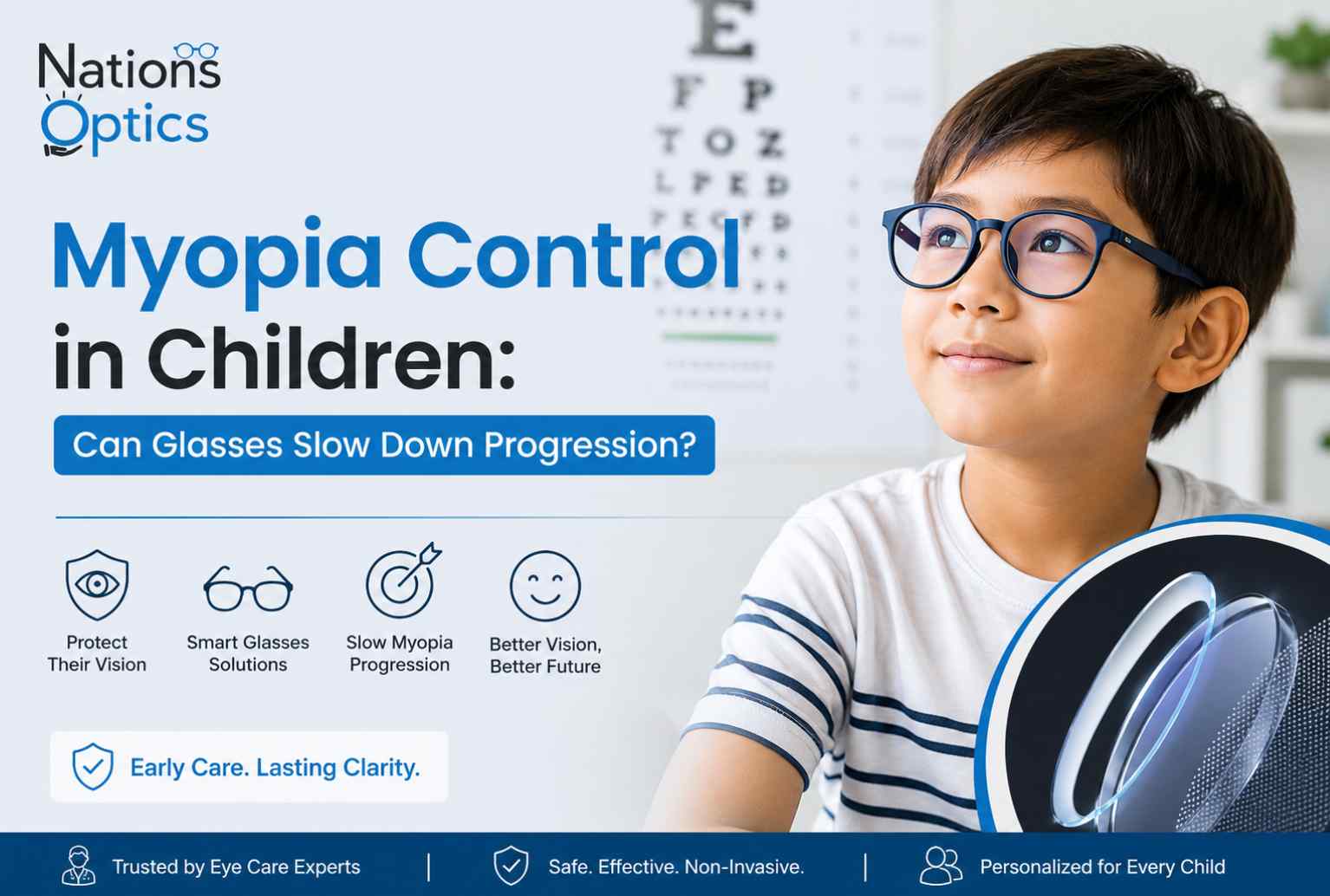
Myopia Control in Children: Can Progression Be Slowed?
Aug 25, 2026
By Rahul Jain
0 comment(s)
Children's Eye Health
Myopia Control in Children: Can Glasses Slow Down Progression?
Not all glasses are the same when it comes to a child's worsening prescription. Here's what myopia control actually means, and what the options really do.
If your child's myopia (nearsightedness) seems to worsen every time you visit the optometrist, you're not imagining it — and you're also not alone. Childhood myopia has been increasing globally for years, and a growing number of parents are asking the same question: is there anything that can slow this down, or are stronger glasses every year just something we have to accept?
The answer is more encouraging than many parents expect. A specific field called myopia control now exists specifically to address this, using specialized lenses, eye drops, and contact lens options designed to slow the rate at which a child's myopia progresses — not just correct the vision they currently have. This guide explains what myopia control actually is, which options exist, and what parents should realistically expect.
Myopia Progression
Specialized Lenses
Outdoor Time
Regular Eye Exams
Pediatric Eye Care
Can Regular Glasses Slow Down Myopia?
Standard single-vision glasses — the kind most children have worn for decades — are designed to correct current vision, not to influence how quickly the prescription changes over time. Wearing the correct standard prescription is still essential for a child to see clearly and function well day to day, but on its own, it isn't designed to slow progression.
What's different: Myopia control uses specially designed lenses — not just any glasses — that alter how light focuses at the edges of the retina, which is believed to be one of the signals that drives eye elongation and worsening myopia. This is a distinct category from standard corrective lenses, and it needs to be specifically discussed with an eye-care professional rather than assumed to come with any glasses purchase.
Why Slowing Myopia Progression Matters
It's not just about avoiding a stronger prescription for convenience. Higher levels of myopia are associated with an increased long-term risk of certain eye conditions later in life, including retinal detachment, myopic maculopathy, and other complications — which is why eye-care professionals increasingly view myopia progression as something worth actively managing in childhood, not just correcting year to year as it happens.
What Increases a Child's Risk of Myopia Progression?
Family history of myopia
Early onset (before age 8)
Limited outdoor time
Extensive near-work (reading, screens)
Certain ethnic backgrounds
Rapid prescription changes year to year
Children who develop myopia at a younger age generally have more years of potential progression ahead of them, which is one reason early identification and discussion of myopia control options matters — the earlier a rapidly progressing case is caught, the more benefit management options may offer.
Signs Your Child May Have Myopia
- Sitting close to the TV or screen
- Holding books very close to the face
- Squinting at distant objects
- Difficulty reading the classroom board
- Frequent headaches after school
- Complaining of blurry distance vision
- Avoiding activities that need distance vision (sports, board games)
- Rubbing eyes frequently
What Are the Main Myopia Control Options?
Several approaches exist, and an eye-care professional will typically consider a child's age, prescription, rate of progression, and lifestyle before recommending one. It's important to note these require professional fitting and monitoring — they aren't something to select independently.
Glasses
Specialized Myopia Control Spectacle Lenses
Purpose-built lens designs (distinct from standard single-vision lenses) that create a specific optical effect at the peripheral retina, intended to send a different growth signal to the eye. These look like ordinary glasses lenses but use a different underlying design.
- Non-invasive, worn like regular glasses
- No daily insertion/removal like contact lenses
- Requires an accurate, professionally fitted prescription
Contact Lenses
Myopia Control Soft Contact Lenses
Specially designed soft daily contact lenses that work on a similar optical principle to control lenses, worn during waking hours.
- Requires a child comfortable with daily contact lens wear and care
- Needs proper hygiene practices to reduce infection risk
- Fitted and monitored by an eye-care professional
Contact Lenses
Orthokeratology (Ortho-K)
Rigid contact lenses worn overnight that gently and temporarily reshape the cornea, providing clear vision during the day without needing glasses or lenses.
- Requires careful nightly wear and strict hygiene
- Needs regular professional monitoring for fit and eye health
- Effect is temporary and reverses if lens wear stops
Medication
Low-Dose Atropine Eye Drops
A prescription eye drop used off-label or as part of a supervised myopia management program in some regions, typically used nightly.
- Administered under an eye-care professional's supervision
- May be combined with other approaches like specialized lenses
- Availability and regulatory approval vary by region
Lifestyle
Increased Outdoor Time
A consistently observed association between more time spent outdoors and a reduced risk of myopia onset and progression in children, independent of near-work habits.
- Simple, low-cost, and safe to encourage regardless of other treatment
- Often recommended alongside — not instead of — clinical interventions for children with active progression
Quick Comparison of Approaches
| Option | Daily Involvement | Reversible |
|---|---|---|
| Myopia control glasses | Low — worn like normal glasses | Yes |
| Myopia control contacts | Moderate — daily insertion/removal & care | Yes |
| Orthokeratology | Moderate — nightly wear & care | Yes (effect stops if wear stops) |
| Atropine drops | Low — nightly drop | Yes |
| Increased outdoor time | Ongoing lifestyle habit | N/A |
This table is a general orientation, not medical guidance — suitability for any option depends on your child's specific eyes, age, and an eye-care professional's assessment.
What Should Parents Realistically Expect?
What Myopia Control Aims to Do
Slow the rate at which a child's myopia worsens over time compared to standard correction alone — reducing how much prescription strength they may eventually reach.
What It Doesn't Do
It doesn't reverse existing myopia, guarantee progression stops entirely, or replace the need for regular eye exams and monitoring throughout treatment.
Results and the degree of effect can vary between children, which is exactly why ongoing professional monitoring — not a one-time fitting — is a core part of any myopia control approach.
How to Get Started
1
Schedule a comprehensive eye exam for your child, including a discussion of their current prescription and rate of change over recent visits.
2
Ask specifically about myopia control — it's a distinct conversation from a routine prescription update, so bring it up directly with your eye-care professional.
3
Discuss which option fits your child — age, comfort with contact lenses, daily routine, and family history all factor into what's realistic and appropriate.
4
Commit to regular follow-up visits — myopia control requires ongoing monitoring to track how well it's working and adjust the approach if needed.
5
Encourage outdoor time and healthy screen habits alongside any clinical approach, since lifestyle factors work in support of — not instead of — professional treatment.
Frequently Asked Questions
Do regular glasses slow down myopia progression?
Standard single-vision glasses correct current vision but aren't designed to influence how quickly a child's prescription changes. Myopia control uses specifically designed lenses or other clinical approaches for that purpose.
At what age does myopia control usually start?
It varies by child, but earlier onset generally means more years of potential progression, so eye-care professionals often discuss options as soon as progression is identified — your child's optometrist can advise on timing specific to their case.
Is myopia control safe for children?
The available options are used under professional supervision and monitoring. As with any treatment involving lenses, contacts, or medication, suitability and safety should be assessed individually by an eye-care professional.
Can outdoor time alone prevent myopia?
Increased outdoor time is associated with a reduced risk of myopia onset and progression, but it's generally recommended alongside — not as a replacement for — clinical management in children with active, progressing myopia.
Does myopia control cost more than regular glasses?
Specialized lenses, contact lens options, and monitoring visits are typically priced differently from standard single-vision glasses — ask your eye-care provider for specific costs relevant to the option being considered.
Will my child need myopia control forever?
Myopia control is generally used during the years when a child's eyes are still growing and progression is most active. Your eye-care professional will guide when it's appropriate to reassess or adjust the approach as your child gets older.
Talk to Us About Your Child's Vision
At Nations Optics, we help parents understand their child's prescription and connect them with the right guidance for ongoing eye care.
- Accurate pediatric prescription fitting
- Guidance on discussing myopia control with an eye-care professional
- Durable, comfortable frames built for kids
- Support for regular prescription updates
- A wide range of lightweight, kid-friendly frame styles
Watching a child's prescription climb every year can feel discouraging, but it's not something parents simply have to accept as inevitable. Myopia control is a real, actively researched field, with several approaches — specialized lenses, contact lens options, orthokeratology, low-dose atropine, and lifestyle changes like outdoor time — that eye-care professionals can tailor to a child's specific situation.
The most important first step is simple: bring up myopia progression directly at your child's next eye exam, rather than assuming a stronger prescription every year is just how it has to go.
Exclusive Offers
Sitewide
33%
OFF
Flat 33% off on all products
Already applied on every price · no coupon needed
Auto-applied
10%
OFF
On orders ₹1,200 – ₹1,799
No coupon needed · saves automatically
Auto-applied
15%
OFF
On orders ₹1,800 – ₹3,199
No coupon needed · saves automatically
Best Deal 🔥
20%
OFF
On orders above ₹3,200
No coupon needed · saves automatically
Pay Advance
₹50
SAVED
Pay advance amount at checkout
Flat ₹50 off · pay balance on delivery
Pay Full ✓
₹100
SAVED
Pay full amount at checkout
Maximum saving · instant confirmation
N
Nations Optics Assistant
● Online
👋 Hi! I'm your Nations Optics assistant. Ask me anything about lenses, frames, or prescriptions!