
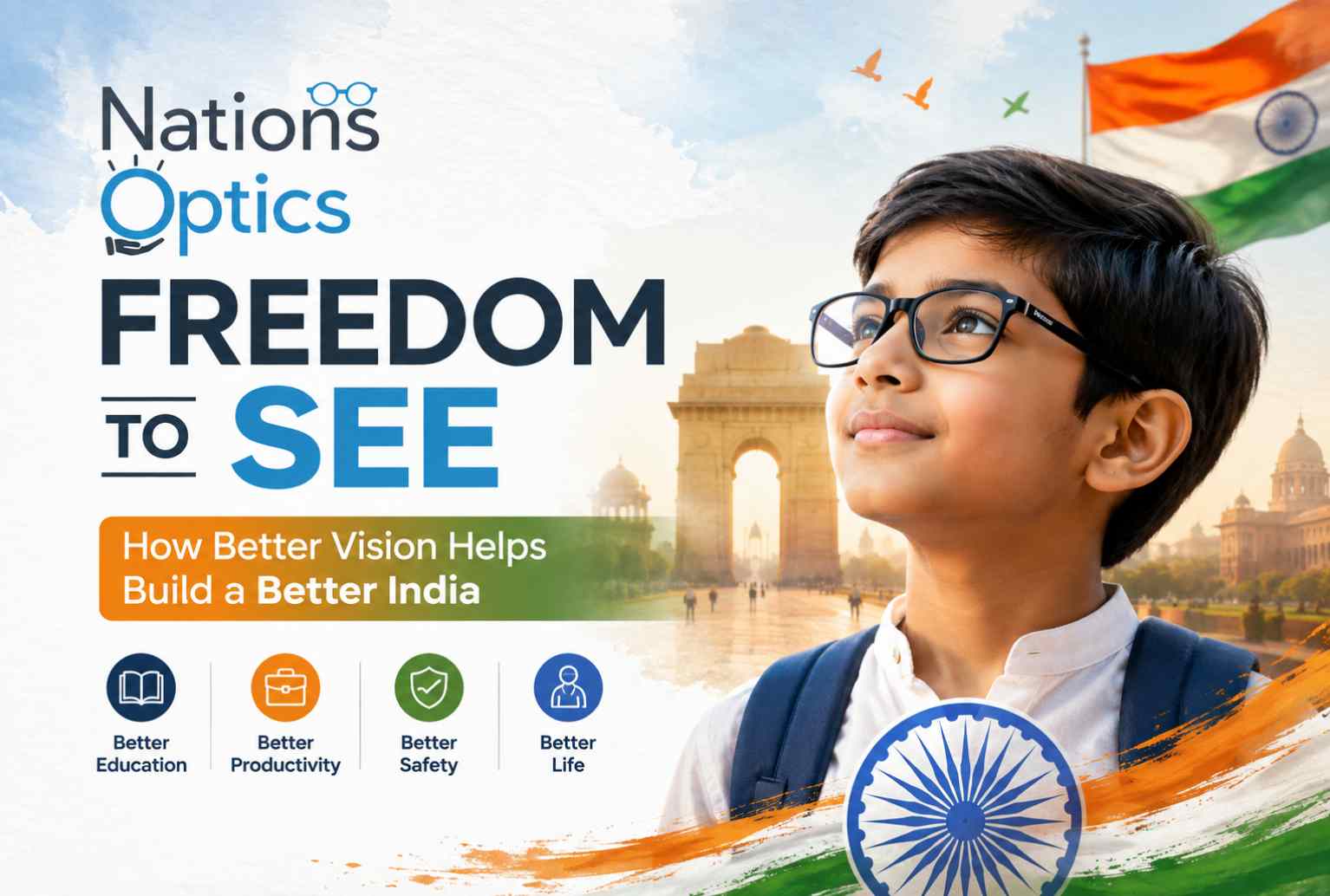
Freedom to See: How Better Vision Helps Build a Better India
Aug 14, 2026
By Rahul Jain
0 comment(s)
This Independence Day
Freedom to See: How Better Vision Helps Build a Better India
Clear vision is more than the ability to see — it's the foundation for learning, working, staying independent, and living confidently.
As India celebrates its Independence Day, there is another kind of freedom worth recognizing: the freedom to see clearly.
From a child reading in a classroom to a professional working on a computer, from a driver navigating busy roads to a senior staying independent at home, healthy eyesight affects almost every part of everyday life. Yet many people continue to live with uncorrected or poorly managed vision problems.
This makes eye health an important part of building a healthier, more productive, and more inclusive society. At Nations Optics, we believe that better vision can contribute to a better quality of life — and that access to proper vision care should be an important part of India's future.
Eye Health Awareness Children's Vision Workplace Vision Road Safety Digital India
What Does "Freedom to See" Really Mean?
Freedom to see means having the visual clarity needed to participate fully in everyday life. Good vision allows us to read and learn comfortably, work more efficiently, recognize people and surroundings, move around safely, use digital devices with ease, take part in sports and outdoor activities, maintain independence as we grow older, and enjoy everyday experiences with greater confidence.
The importance of good vision is often underestimated because people gradually adapt to blurry or uncomfortable vision. Someone who's been struggling to read road signs or see a classroom board may simply assume their eyesight is "getting weaker" — when in reality, many common vision problems can be identified and corrected with the right professional care and prescription eyewear.
"If you cannot see clearly, don't simply learn to live with it. Get your vision checked."
Why Good Vision Matters for a Better India
A country's development is closely connected to the health, education, productivity, and well-being of its people. That's why better vision can contribute to a better India — when people can see clearly, they're better able to learn, work, communicate, travel, and perform everyday activities safely. Vision care isn't only an individual concern; it's an important component of public health and human development.
1
Better Vision Supports Education
Children depend heavily on their eyesight for learning — reading textbooks, seeing the classroom board, writing, and using computers all require adequate vision. An undetected refractive error can make a capable student struggle without anyone realizing why.
- Sitting unusually close to the TV or screen
- Holding books very close
- Squinting at distant objects
- Frequent headaches after studying
- Difficulty reading the classroom board
- Avoiding reading or visually demanding activities
2
Clear Vision Supports Workplace Productivity
Whether someone works in an office, operates machinery, drives professionally, manages a shop, designs products, works in construction, or uses screens for hours a day, good eyesight plays an important role. When people see their work clearly and comfortably, they can perform visually demanding tasks with far greater confidence — increasingly relevant as India's workforce adapts to digital workplaces.
3
Vision and Safety Go Hand in Hand
Drivers need to see road signs, vehicles, pedestrians, traffic signals, lane markings, and changing road conditions clearly. If road signs appear blurry, headlights feel unusually uncomfortable, or distant objects are hard to identify, it's worth getting vision checked by a professional — the importance of good eyesight extends beyond convenience into safer everyday participation.
4
Better Vision Helps People Stay Independent
Vision becomes especially important with age. Difficulty seeing clearly can make reading, walking around unfamiliar places, recognizing faces, using phones, or managing household activities more challenging. Regular professional eye examinations become increasingly important as some eye conditions develop gradually without obvious early symptoms.
5
Vision Plays a Role in Digital India
India's digital transformation has changed how people study, work, communicate, shop, and access services. Extended screen time can contribute to temporary eye strain, dryness, blurred vision, and discomfort — reminders to build healthier screen habits, not necessarily signs of permanent damage.
- Follow the 20-20-20 rule
- Take regular breaks from screens
- Keep screens at a comfortable distance
- Adjust screen brightness
- Maintain appropriate lighting
- Blink regularly
- Seek professional advice for persistent symptoms
Signs Parents and Teachers Should Watch For
- Sitting close to the TV or screen
- Holding books very close
- Squinting at distant objects
- Frequent headaches after studying
- Trouble reading the classroom board
- Avoiding reading or visual activities
The Importance of Regular Eye Checkups
One of the simplest ways to support eye health in India is to make professional eye examinations a regular part of healthcare. Many people only think about an eye exam once their vision becomes noticeably blurry — but the value of regular checkups goes beyond just determining whether someone needs glasses. An eye-care professional can evaluate vision and identify changes that may require further attention.
Regular examinations are particularly important for:
- Children
- Adults experiencing changes in vision
- People who spend long hours on screens
- Older adults
- People with existing eye concerns
- Anyone experiencing persistent visual discomfort
The appropriate frequency of an eye exam can vary depending on age, health, symptoms, and individual risk factors — professional guidance is always recommended.
Why Correct Eyeglasses Matter
Eyeglasses are one of the simplest and most widely used tools for correcting refractive errors. If someone has myopia, hyperopia, astigmatism, or another refractive error, the correct prescription can bring visual clarity into focus.
A prescription should never be guessed, copied from someone else, or chosen simply because a particular pair of glasses feels comfortable. Different eyes can have different prescriptions, and even small differences can matter. Proper measurement and accurate lens fitting are essential parts of getting effective prescription eyewear.
Better Vision Is About More Than Glasses
Although eyeglasses provide essential vision correction, good eye care should involve a broader approach:
- Getting regular professional eye examinations
- Wearing the correct prescription
- Protecting eyes from excessive UV exposure
- Taking breaks during prolonged screen use
- Maintaining a balanced lifestyle
- Following professional advice for existing eye conditions
- Avoiding self-diagnosis when vision changes occur
Remember: Not every vision problem can be solved by simply changing glasses. Sudden or significant changes in vision should be evaluated promptly by an appropriate eye-care professional.
The Growing Need for Eye Health Awareness in India
India is home to a large and diverse population with different levels of access to healthcare and vision services, making eye health awareness especially important. People may ignore blurred vision because they consider it a normal part of aging. Children may not realize their vision differs from their classmates'. Adults may postpone an eye exam because their vision problems don't seem serious.
Creating greater awareness can encourage people to take their vision seriously — a simple message can make a real difference.
Freedom to See: A Vision for Every Generation
Freedom means having opportunities to learn, work, travel, communicate, participate, and make independent choices — and vision can influence all of these experiences.
A student needs clear vision to learn.
A worker needs clear vision to perform many tasks.
A driver needs adequate vision for safe navigation.
A senior may depend on good vision to maintain independence.
A child needs healthy visual development to explore the world.
This is why clear vision deserves to be recognized as an important part of everyday well-being.
How Families Can Protect Their Vision
Creating better vision habits can start at home. Parents can encourage children to report difficulties seeing the board or reading. Adults can avoid ignoring persistent changes in vision. Families can make regular eye examinations part of their healthcare routine.
- Schedule appropriate eye examinations
- Use the correct prescription eyewear
- Take regular breaks from screens
- Protect eyes from excessive sunlight with suitable eyewear
- Maintain healthy daily habits
- Pay attention to changes in vision
- Seek professional advice instead of self-prescribing glasses
Small steps taken consistently can contribute to better long-term vision care.
Building a Better India Through Better Vision
India's future depends on its people being able to learn, innovate, work, and participate fully in society — and vision is part of that foundation. From classrooms and offices to factories, farms, roads, laboratories, and homes, people rely on their eyesight every day.
Improving awareness around vision problems, encouraging regular eye examinations, promoting appropriate vision correction, and making quality eyewear more accessible can all contribute to a stronger culture of eye care. Better vision doesn't build a nation by itself — but it can help people make the most of their ability to learn, work, create, and contribute. That is the deeper meaning behind "Freedom to See."
Frequently Asked Questions
How does vision affect a child's education?
Reading, writing, seeing the classroom board, and using computers all depend on adequate vision. An undetected refractive error can make learning harder even when a child is otherwise fully capable.
How often should I get an eye checkup?
The right frequency varies by age, health, symptoms, and individual risk factors — an eye-care professional can recommend an appropriate schedule for you or your family.
Can screen time permanently damage my eyes?
Extended screen use can cause temporary eye strain, dryness, and discomfort, but this doesn't necessarily mean permanent damage. It's a reminder to build healthier screen habits like the 20-20-20 rule.
Why does an accurate prescription matter so much?
Different eyes can have different prescriptions, and even small differences can affect comfort and clarity. A prescription should never be guessed or copied — proper measurement and fitting matter.
What signs suggest a child may have a vision problem?
Sitting close to screens, holding books very close, squinting, frequent headaches after studying, and difficulty reading the classroom board are all worth mentioning to an eye-care professional.
This Independence Day, Choose the Freedom to See Clearly
At Nations Optics, our goal is to make quality eyewear and vision correction more accessible while encouraging everyone to take their eye health seriously.
- Accurate prescription eyewear for every generation
- Guidance for children, adults, and seniors alike
- UV protection & screen-comfort lens options
- Support choosing the right frame and fit
- A commitment to accessible, quality vision care
The freedom to read a child's first schoolbook. The freedom to recognize a familiar face across the room. The freedom to work comfortably. The freedom to travel with confidence. The freedom to enjoy the world around us. And, wherever vision correction is needed, the freedom to see clearly.
Freedom to See is more than a slogan — it's a reminder that healthy vision deserves attention at every stage of life. Because when people can see better, they can experience more, learn more, work with greater confidence, and participate more fully in the world around them. Better vision. Better opportunities. Better quality of life. A better India.
Nations Optics — See Clearly. Live Confidently.
Exclusive Offers
Sitewide
33%
OFF
Flat 33% off on all products
Already applied on every price · no coupon needed
Auto-applied
10%
OFF
On orders ₹1,200 – ₹1,799
No coupon needed · saves automatically
Auto-applied
15%
OFF
On orders ₹1,800 – ₹3,199
No coupon needed · saves automatically
Best Deal 🔥
20%
OFF
On orders above ₹3,200
No coupon needed · saves automatically
Pay Advance
₹50
SAVED
Pay advance amount at checkout
Flat ₹50 off · pay balance on delivery
Pay Full ✓
₹100
SAVED
Pay full amount at checkout
Maximum saving · instant confirmation
N
Nations Optics Assistant
● Online
👋 Hi! I'm your Nations Optics assistant. Ask me anything about lenses, frames, or prescriptions!