High Myopia Glasses: Best Lenses & Frames for Strong Prescriptions
Jul 24, 2026
By Rahul Jain
0 comment(s)
High Prescription Eyewear
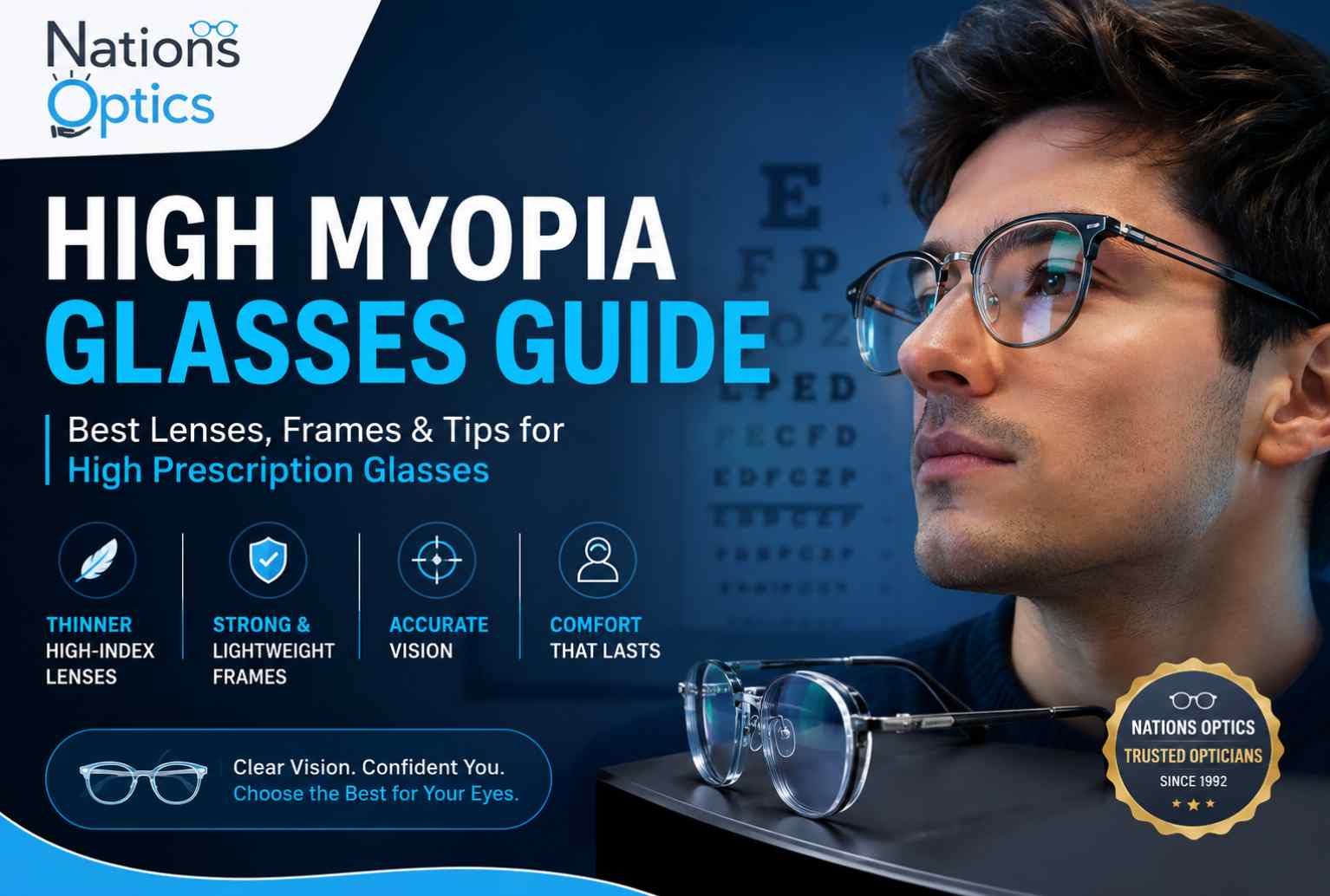
High Myopia Glasses Guide: Best Lenses, Frames & High Prescription Glasses
Thick lenses, heavy frames, and shrunken-eye reflections don't have to come with a strong prescription. Here's how to get thinner, lighter, better-looking glasses.
Finding the right glasses for a strong prescription can be challenging. Many people with high myopia worry about thick lenses, heavy frames, uncomfortable glasses, and the appearance of their eyes through the lenses. The good news: modern optical technology offers several ways to make glasses for high myopia thinner, lighter, more comfortable, and more attractive.
This guide covers what high myopia is, how high prescription glasses work, which lenses reduce thickness, which frame styles suit strong prescriptions, and how accurate measurements improve vision and comfort.
High-Index Lenses Aspheric Design Compact Frames Pupillary Distance Full-Rim Frames
What Is High Myopia?
Myopia, commonly called nearsightedness, is a refractive error where distant objects appear blurry while nearby objects stay clearer. Light entering the eye focuses in front of the retina instead of directly on it. Minus-powered prescription lenses move the focus back onto the retina, so distant objects appear clear again.
The stronger the minus prescription, the more powerful the lens needs to be — and as the prescription becomes significantly high, choosing the right lens material, index, frame size, and measurements matters more and more. What counts as "high" myopia varies by clinical and optical context, so your eye-care professional should always evaluate your prescription and eye health.
What Are the Best Glasses for High Myopia?
The best glasses for high myopia depend on your prescription strength, lens material, frame size, frame shape, pupillary distance, and personal preferences. In general, the best combination usually includes:
- A suitable high-index or high-performance lens material
- A frame that isn't excessively large
- Accurate pupillary distance measurement
- Proper optical center placement
- A well-fitting frame
- A lens design appropriate for your prescription
The goal isn't simply choosing the thinnest lens available — it's balancing optical clarity, thickness, weight, durability, comfort, and appearance.
Why Do High Myopia Glasses Look Thick?
Minus lenses for myopia are generally thinner in the center and thicker toward the edges. As the prescription strengthens, that center-to-edge difference becomes more noticeable. Several factors affect final thickness:
1
Prescription Strength
A stronger minus prescription generally requires more lens power — and higher powers mean thicker lens edges.
2
Lens Material
Different materials have different refractive indices. A higher-index material bends light more efficiently, potentially allowing a thinner lens for the same prescription.
3
Frame Size
Large frames require larger lenses — and larger lens diameters increase the visible edge thickness of strong minus lenses.
4
Frame Shape
The frame's shape influences how much lens material is required. Smaller, more compact shapes are often easier to optimize for strong prescriptions.
5
Pupillary Distance
Accurate PD measurement matters even more for high prescriptions — incorrect optical center placement can affect visual comfort and lens performance.
How Can You Make High Myopia Glasses Thinner?
Choose a Suitable High-Index Lens
High-index lenses bend light more efficiently than standard materials, potentially reducing thickness. The ideal index depends on your individual prescription — an optical professional can help determine what's appropriate.
Choose a Smaller Frame
Frame size plays a major role in final appearance. A smaller frame reduces overall lens diameter and can help reduce visible thick edges around the frame.
Choose a Full-Rim Frame
Full-rim frames completely surround the lens edge, offering a more visually balanced appearance and a practical way to conceal some of the lens edge.
Consider Aspheric Lens Designs
Aspheric lenses use a more advanced surface design that can improve aesthetics and optical performance in suitable prescriptions, often with a flatter profile.
Get an Accurate PD Measurement
Pupillary distance is the distance between the centers of your pupils. For high prescription glasses, correct optical center placement is especially important — an inaccurate measurement can affect lens alignment and visual comfort.
Which Lenses Are Best for High Myopia?
The best lens depends on your prescription, lifestyle, frame choice, and optical requirements.
Remember: The right lens isn't simply the one with the highest index. A professional lens recommendation considers the complete prescription and your individual needs.
What Frame Shape Is Best for High Myopia?
Frame shape is more than a fashion decision here — it directly influences lens size, thickness, weight, and appearance.
Smaller Frames
Often practical for strong prescriptions since they reduce overall lens diameter, helping manage visible edge thickness.
Round Frames
Round and smaller rounded shapes can suit some high prescriptions by offering a compact lens area — results depend on exact dimensions.
Oval Frames
Provide a balanced appearance while keeping a relatively compact lens shape.
Compact Rectangular
A smaller rectangular frame can work well for a modern or professional style without excess lens area.
The key is avoiding a frame that's unnecessarily large for your prescription.
Are Smaller Frames Always Better?
In many cases, yes — smaller frames require less lens area, and reduced lens diameter can make edge thickness easier to manage. But smaller doesn't always mean better. A frame must still provide adequate coverage, a comfortable fit, correct pupil positioning, suitable bridge fit, appropriate eye size, and proper optical center alignment. The best frame combines compact dimensions with a comfortable, accurate fit.
Why Is Accurate PD Important for High Prescription Glasses?
Accurate pupillary distance matters for all prescription glasses, but it becomes particularly important for stronger prescriptions. The optical center of each lens should align properly with your pupils — incorrect measurements can mean the lenses aren't positioned optimally in front of your eyes.
Accurate measurements contribute to:
- Better visual comfort
- More accurate lens positioning
- Improved adaptation
- A better overall wearing experience
When ordering glasses online, always provide the correct prescription and measurement information requested by the optical provider.
Can High Myopia Be Corrected With Glasses?
Yes — glasses correct the refractive error associated with myopia using the appropriate prescription lenses. However, glasses correct the optical effect of myopia; they don't necessarily change the underlying shape or length of the eye.
People with high myopia should follow their eye-care professional's advice and attend recommended eye examinations, since high myopia can be associated with increased risk of certain eye conditions.
Seek Urgent Care If You Notice:
Sudden changes in vision, flashes of light, a sudden increase in floaters, or a curtain-like shadow in your vision — these need urgent professional eye care.
How to Choose the Best High Myopia Glasses
Choosing the right eyewear involves more than selecting the strongest lens power.
1
Start With an Accurate Prescription
Your prescription should be current and accurately measured. Never guess or reuse an old prescription if your vision has changed.
2
Consider the Lens Material
Discuss available materials and index options to find the right combination of optical performance, thickness, weight, durability, and cost.
3
Choose a Suitable Frame Size
Avoid oversized frames unless specifically recommended for your prescription — a more compact frame helps manage lens thickness.
4
Consider the Frame Construction
Full-rim frames can be practical for strong prescriptions, offering complete support around the lens; material and construction affect comfort and weight too.
5
Confirm Your PD Measurement
Accurate PD is essential for proper lens positioning.
6
Consider Additional Lens Features
Depending on your lifestyle: anti-reflective coating, blue-light filtering, scratch-resistant coatings, photochromic lenses, and UV protection.
Common Mistakes to Avoid
Choosing an Oversized Frame
Large frames increase lens diameter and can make thick edges more noticeable.
Selecting a Lens Only Based on Price
The cheapest lens may not be the best solution for a strong prescription — consider the complete combination of material, thickness, optical performance, and durability.
Ignoring PD Accuracy
Incorrect PD can affect lens positioning and comfort.
Choosing the Highest Index Automatically
A higher index isn't automatically the best lens for every prescription — the right choice depends on your specific Rx and optical design.
Buying Without a Valid Prescription
Prescription glasses should always be made according to an accurate prescription from a qualified eye-care professional.
High Myopia Glasses vs Regular Glasses
The main difference is the strength of the prescription and the optical considerations involved. Regular prescriptions offer more flexibility in frame size and lens material. High myopia glasses require more careful attention to lens thickness, lens index, frame size, frame shape, optical center placement, PD accuracy, and lens design.
This doesn't mean limited style options — modern eyewear offers many attractive frame designs suitable for strong prescriptions.
Can High Myopia Glasses Be Thin?
Yes — high myopia glasses can often be made thinner by carefully combining the right lens material, lens design, frame size, and measurements. The amount of reduction depends on the prescription and the specific lens options available. The most important factors:
- The strength of the prescription
- The lens index
- The frame size
- The frame shape
- The optical center position
- The lens design
A professional optical recommendation can help you select the most suitable combination.
Frequently Asked Questions
What are the best glasses for high myopia?
Usually a combination of an appropriate lens material, suitable lens design, accurate measurements, and a well-fitting, compact frame.
What lenses are best for high prescription glasses?
Depends on the prescription and individual requirements — high-index lenses are often considered when reducing thickness is a priority.
How can I make high myopia glasses thinner?
Choose an appropriate high-index lens, select a compact frame, consider aspheric lens designs, and ensure accurate PD measurements.
Are smaller frames better for high myopia?
They can help reduce lens diameter and manage edge thickness, but the frame must still fit comfortably and provide proper optical alignment.
Are high-index lenses better for high myopia?
They're a useful option for many stronger prescriptions since they may provide a thinner profile — the best material still depends on your specific Rx.
Why are my high myopia glasses thick?
Strong minus prescriptions result in thicker lens edges. Lens material, frame size, frame shape, and prescription strength all influence final thickness.
Can I wear stylish glasses with high myopia?
Yes — many modern frame styles work well. The key is choosing a frame that combines your personal style with appropriate dimensions for your prescription.
Is PD important for high myopia glasses?
Yes. Accurate pupillary distance helps position the optical centers correctly and is an essential part of prescription eyewear fitting.
Get Thinner, Lighter High Prescription Glasses
At Nations Optics, we help you choose the right lens material, frame size, and measurements — not just the highest index number.
- High-index & aspheric lens options
- Compact frame recommendations
- Accurate PD measurement support
- Full-rim frame options for strong Rx
- Anti-reflective & UV coatings available
Choosing high myopia glasses doesn't have to mean compromising between vision, comfort, and style. The best approach considers the entire eyewear system — prescription, lens material, lens index, frame size, frame shape, optical design, and measurements.
The best high myopia glasses aren't determined by prescription power alone. If you have a strong prescription, choose your high prescription glasses carefully and consult a qualified optical professional to find the most suitable lens and frame combination for your vision.
Exclusive Offers
Sitewide
33%
OFF
Flat 33% off on all products
Already applied on every price · no coupon needed
Auto-applied
10%
OFF
On orders ₹1,200 – ₹1,799
No coupon needed · saves automatically
Auto-applied
15%
OFF
On orders ₹1,800 – ₹3,199
No coupon needed · saves automatically
Best Deal 🔥
20%
OFF
On orders above ₹3,200
No coupon needed · saves automatically
Pay Advance
₹50
SAVED
Pay advance amount at checkout
Flat ₹50 off · pay balance on delivery
Pay Full ✓
₹100
SAVED
Pay full amount at checkout
Maximum saving · instant confirmation
N
Nations Optics Assistant
● Online
👋 Hi! I'm your Nations Optics assistant. Ask me anything about lenses, frames, or prescriptions!