
Lens Decentration Explained: Why Lens Alignment Affects Your Vision
Jul 14, 2026
By Rahul Jain
0 comment(s)
Lens Fitting Guide
Lens Decentration Explained: Why Lens Alignment Affects Your Vision
Blurry vision, headaches, or dizziness with a correct prescription? The lenses may simply be positioned wrong. Here's what lens decentration means and how to fix it.
Have you ever picked up new prescription glasses only to notice blurry vision, headaches, dizziness, or eye strain, even though your prescription is correct? The problem may not be your prescription at all. It could be lens decentration.
Understanding what lens decentration means is essential, because even a perfectly accurate prescription can deliver poor vision if the lenses aren't positioned correctly. Whether you wear single vision, bifocal, or progressive lenses, proper alignment is crucial for comfortable, crystal-clear vision. This guide explains what it is, its symptoms and causes, how it affects vision, and how professional fitting keeps your glasses performing as intended.
01What Is Lens Decentration?
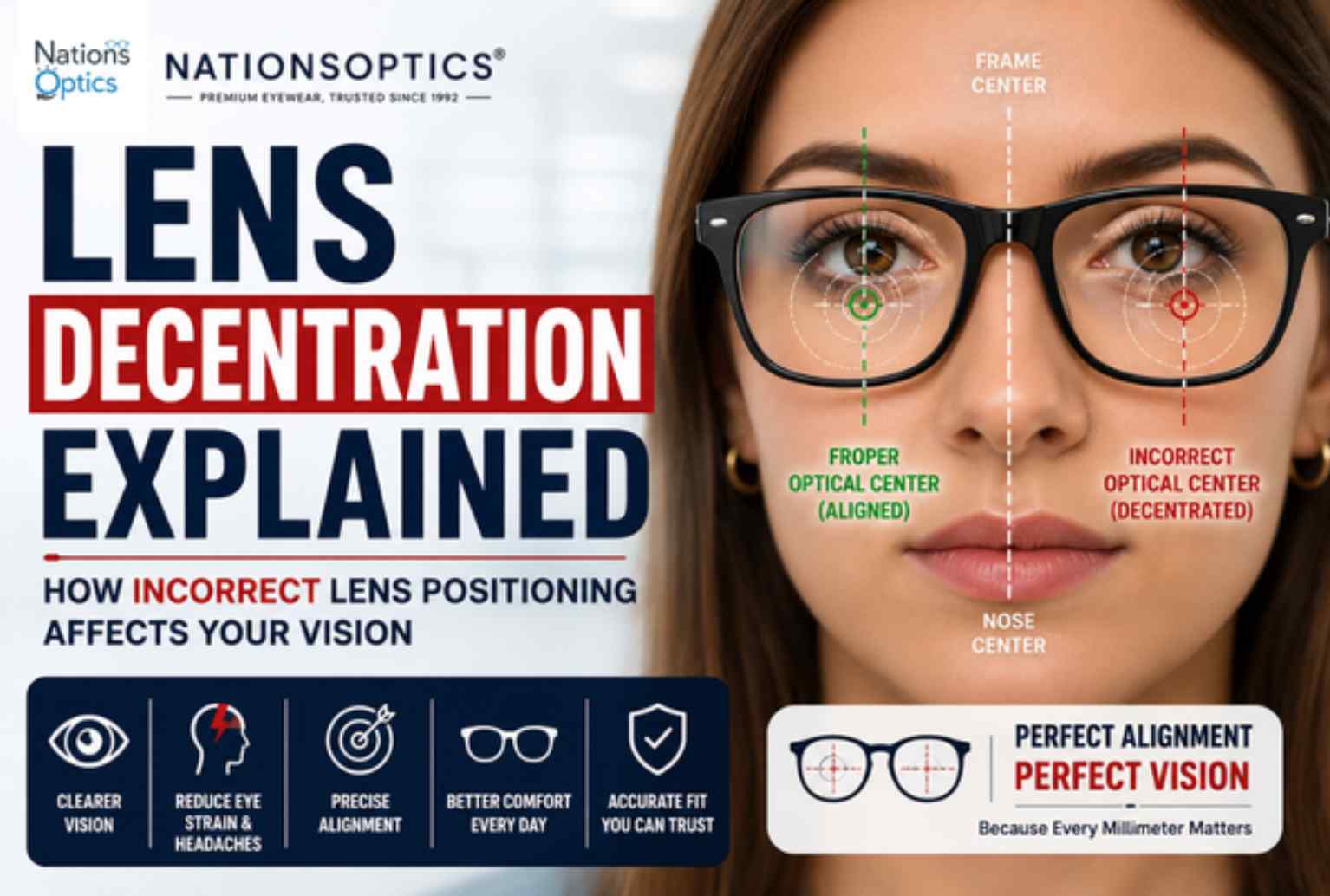
Lens decentration refers to the intentional or unintentional shifting of the lens's optical centre away from its geometric centre. The optical centre is the point where light passes without causing unwanted prism effects. Ideally it should align perfectly with your pupils when you look straight ahead.
When the optical centre doesn't match your eye position, the result is incorrect decentration, which forces your eyes to compensate continuously, leading to discomfort and distorted vision.
Correct Rx + Correct optical centre= Clear, comfortable vision
Correct Rx + Wrong optical centre= Vision problems & strain
Optical centre alignment
CENTRED optical centre = pupil DECENTRED centre offset = unwanted prismWhen the optical centre drifts from your pupil, the lens introduces unwanted prism.
02Why Is Lens Decentration Important?
Many people assume only prescription power determines how well glasses work. In reality, lens alignment is equally important. Proper centration affects:
Visual clarityEye comfortPeripheral visionReading performanceDigital screen useDriving safetyProgressive adaptation
Even premium lenses can't perform properly if the optical centre is positioned incorrectly.
03How Decentration Affects Vision
When lenses aren't centred properly, images may appear displaced or tilted, your eyes work harder to focus, unwanted prism is introduced, depth perception suffers, and reading or long screen sessions become tiring. These issues are more noticeable in higher prescriptions, since stronger lenses are more sensitive to positioning errors.
Blurry visionYour eyes look through an area of the lens not designed for your visual axis.
Eye strainEye muscles constantly adjust to compensate for the misalignment.
HeadachesContinuous focusing effort, especially after reading or computer work.
Double visionSignificant decentration can make images appear duplicated.
Reduced depth perceptionPoor alignment affects binocular vision and distance judgment.
Hard to adaptMany blame the prescription when alignment is the real issue.
04Incorrect Decentration Symptoms
Watch for these after new glasses
Blurry vision with new glasses
Headaches after wearing
Eye fatigue
Dizziness
Feeling off balance
Neck pain from head tilting
Difficulty focusing
Eyestrain on devices
Reading discomfort
Distorted peripheral vision
Trouble judging distances
Glasses feel "not quite right"
If these persist beyond a normal adaptation period, your glasses should be professionally checked.
05Common Causes of Decentration
Incorrect PD
The most common cause. An inaccurate PD measurement shifts the optical centre away from your pupils, even by a few millimetres.
Incorrect frame measurements
Different frame sizes need different lens positioning; errors during edging can decentre the lens.
Manufacturing errors
Uncommon, but production mistakes can occasionally mount lenses incorrectly.
Improper fitting
Frames that slide down the nose change the optical centre's position relative to your eyes.
Oversized or poorly fitting frames can also make correct optical-centre placement more challenging.
06Lens Decentration vs Pupillary Distance
These are related but not the same.
Pupillary Distance
The distance between your pupils
A fixed measurement of your face, in millimetres.
Lens Decentration
Positioning the optical centre to your PD
The process of aligning the lens centre with your pupils inside a specific frame.
An incorrect PD often leads directly to incorrect decentration, which is why accurate measurement matters so much. Learn more in our guides on incorrect PD measurement and single vs dual PD.
07Can It Cause Headaches or Blur?
Can lens decentration cause headaches?
Yes. When your eyes constantly compensate for poor alignment, the eye muscles stay under stress all day, causing forehead headaches, eye fatigue, pressure around the eyes, reduced concentration, and neck or shoulder tension. Correctly centred lenses usually eliminate these.
Can it cause blurry vision?
Yes. Even with a perfectly accurate prescription, looking through the wrong part of the lens reduces optical performance, blur can appear while reading, on the computer, driving, at distance, or at intermediate range. Many people wrongly think they need a stronger prescription when positioning is the real issue.
08Progressive vs Single Vision Fitting
Progressive lenses are especially sensitive to centration. Because they contain multiple viewing zones, even slight decentration can cause a swimming sensation, a narrow reading area, blurred intermediate vision, difficulty climbing stairs, and adaptation problems. Precise fitting is essential, and smoother results come from digital freeform progressives.
Single vision lenses are more forgiving, but proper fitting still matters, improving overall clarity, eye comfort, peripheral vision, and long-term wearability.
09How Opticians Measure Decentration
Professional dispensing measurements
Pupillary Distance (PD)
Monocular PD
Optical centre height
Frame dimensions
Vertex distance
Pantoscopic tilt
Face wrap angle
Lens diameter
Modern digital measuring systems provide even greater accuracy than traditional methods. For more on lens positioning, see our guide to vertex distance.
10Checking & Fixing Decentration
Warning signs at home
- One lens appears higher than the other
- Vision improves when you tilt your glasses
- Glasses constantly need adjustment
- Objects look clearer when you move your head
- Headaches only while wearing glasses
How it's fixed
- Recheck your prescription
- Measure PD again
- Verify optical-centre placement
- Refit the frame or re-edge lenses
- Replace incorrectly made lenses
Never attempt to modify prescription lenses yourself, consult an optician for a fitting evaluation.
11How NationsOptics Ensures Accurate Positioning
Precision fitting, verified
Every prescription order goes through careful verification to ensure precise lens fitting.
Accurate PD verification
Precision lens alignment
Professional optical-centre positioning
Quality-controlled edging
Careful frame-fitting checks
Single vision, bifocal & progressive checks
12Frequently Asked Questions
What is lens decentration in glasses?
It's the positioning of a lens's optical centre so it aligns correctly with your pupils for clear, comfortable vision.
Can lens decentration cause blurry vision?
Yes. Incorrect decentration can make vision blurry even when your prescription is accurate.
Can wrong PD cause lens decentration?
Yes. An inaccurate pupillary distance often results in improper optical-centre placement.
What happens if the optical centre is wrong?
A misplaced optical centre can lead to eye strain, headaches, blurred vision, dizziness, and reduced comfort.
Is decentration more important for progressive lenses?
Yes. Progressives need highly accurate centration because multiple zones must align precisely with your eyes.
13Final Thoughts
Understanding lens decentration is essential for anyone wearing prescription glasses. Prescription power gets the most attention, but lens alignment, accurate optical-centre placement, and proper fitting are just as important for clear, comfortable vision. If you experience blurry vision with new glasses, headaches, or persistent strain, don't assume the prescription is wrong, a professional evaluation of lens positioning and frame fit may reveal the real cause.
Choosing eyewear from an experienced provider that emphasises accurate measurements, precise fitting, and quality control makes all the difference. Properly centred lenses improve clarity and enhance long-term comfort, helping you enjoy your glasses exactly as designed.
References & further reading
- American Academy of Ophthalmology — Eyeglasses for Vision Correction
- American Optometric Association — Eyeglasses
- MedlinePlus (NIH) — Eye Strain
Precisely fitted, comfortably clear
Every Nations Optics pair is verified for accurate lens positioning. Not sure of your PD? Capture it with our AI face-measurement tool.
Measure My PDExclusive Offers
Sitewide
33%
OFF
Flat 33% off on all products
Already applied on every price · no coupon needed
Auto-applied
10%
OFF
On orders ₹1,200 – ₹1,799
No coupon needed · saves automatically
Auto-applied
15%
OFF
On orders ₹1,800 – ₹3,199
No coupon needed · saves automatically
Best Deal 🔥
20%
OFF
On orders above ₹3,200
No coupon needed · saves automatically
Pay Advance
₹50
SAVED
Pay advance amount at checkout
Flat ₹50 off · pay balance on delivery
Pay Full ✓
₹100
SAVED
Pay full amount at checkout
Maximum saving · instant confirmation
N
Nations Optics Assistant
● Online
👋 Hi! I'm your Nations Optics assistant. Ask me anything about lenses, frames, or prescriptions!