
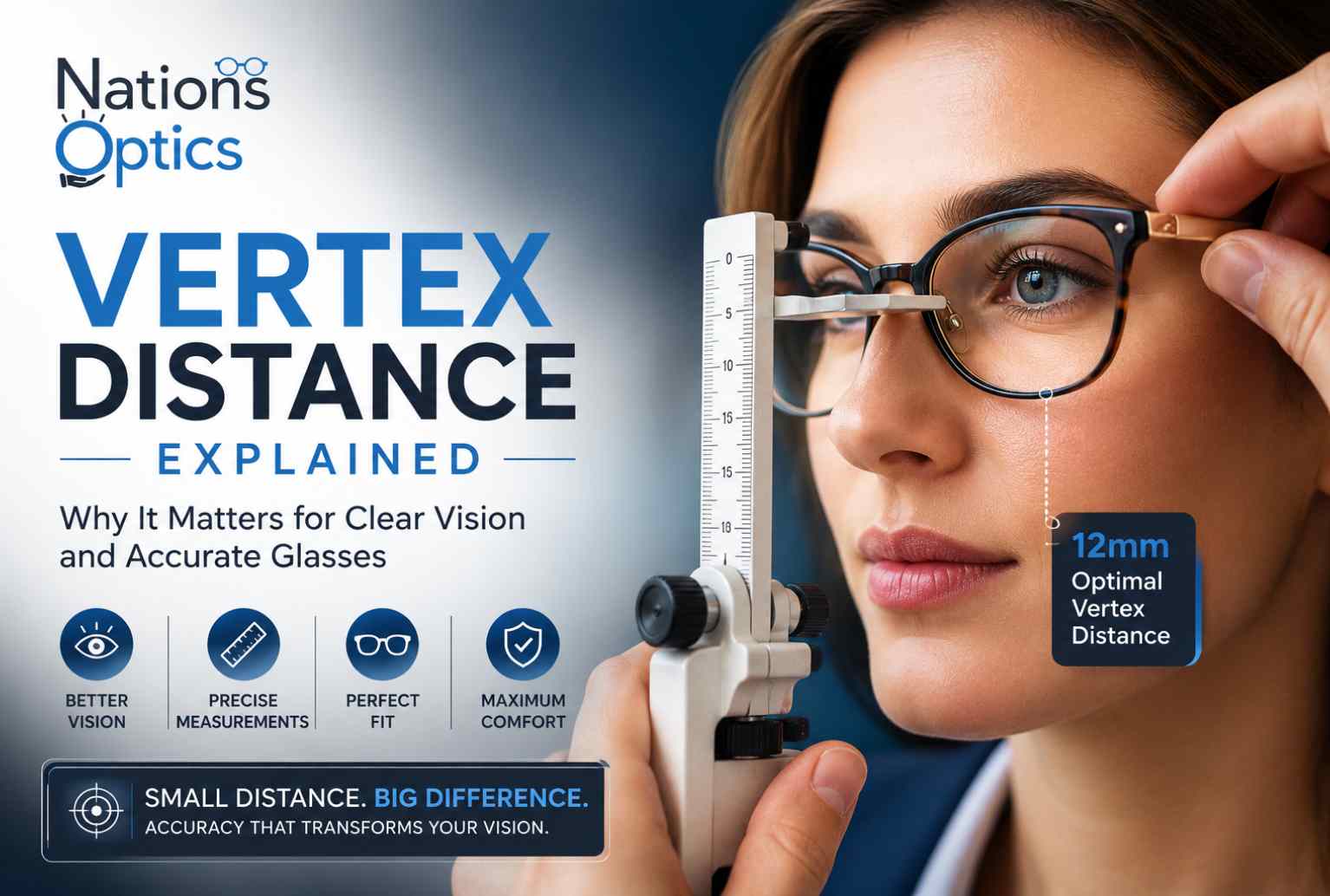
Vertex Distance Explained: Improve Glasses Vision Accuracy
Jul 8, 2026
By Rahul Jain
0 comment(s)
Lens Fitting Guide
Vertex Distance Explained: Why It Matters for Clear, Accurate Vision
Ever put on new glasses with a correct prescription, yet something felt slightly off? The culprit is often not the lenses, but how far they sit from your eyes.
If you've ever collected new glasses and noticed everything looked slightly different, even with the right prescription, the reason may not be the lenses themselves. One of the most overlooked factors in eyewear is vertex distance. Most people know about pupillary distance (PD), but very few understand why the space between your eyes and your lenses can significantly affect how well you see.
This guide covers what vertex distance is, why it matters for high prescriptions, how it affects vision, and how it's measured in optometry, so you can enjoy sharper, more comfortable vision.
01What Is Vertex Distance in Glasses?
Vertex distance is the measurement between the back surface of your eyeglass lens and the front surface of your eye (the cornea). It's measured in millimetres and generally falls between 10 mm and 14 mm for most eyewear.
Where vertex distance is measured
Eye Lens 10–14 mm vertex distanceThe small gap between the back of the lens and the front of the cornea, typically 10–14 mm.
Although this distance seems tiny, it plays a major role in how accurately your lenses perform. Even a few millimetres can alter the effective power of your glasses, especially for stronger prescriptions. Think of it this way: your prescription is calculated for a specific lens position. If the lenses sit much closer or farther than expected, the light entering your eyes changes, and so does your clarity.
02Why Is Vertex Distance Important?
Many people assume correct prescription numbers guarantee perfect vision, but that's only true when the lenses are positioned correctly. Accurate vertex distance:
Maintains accurate lens power
Improves vision clarity
Reduces eye strain
Provides better peripheral vision
Ensures maximum comfort
Helps progressives perform
Improves adaptation to new glasses
Even premium lenses can't deliver optimal results if the fitting is incorrect, which is why professional opticians always consider lens positioning.
03How Vertex Distance Affects Vision
This is why professionally fitted glasses feel so much better than poorly fitted ones. As the lens position changes, so does its effective power:
Lenses move FARTHER away
Minus lenses (myopia) ↓ weaker
Plus lenses (hyperopia) ↑ stronger
Lenses move CLOSER
Minus lenses (myopia) ↑ stronger
Plus lenses (hyperopia) ↓ weaker
These shifts may be almost unnoticeable for low prescriptions, but they grow increasingly important as power increases.
Symptoms of incorrect vertex distance
Blurred vision
Difficulty focusing
Eye fatigue
Frequent headaches
Distorted peripheral vision
Trouble reading
Feeling the prescription is "wrong"
In many cases the prescription is accurate, the lenses simply aren't at the intended distance from your eyes.
04Vertex Distance for High Prescription Glasses
±4.00 D+
At roughly ±4.00 dioptres or higher, vertex distance becomes much more critical, stronger lenses bend light more aggressively, so even a slight change in position noticeably affects vision.
High-prescription wearers often experience increased image distortion, magnification or minification, peripheral blur, reduced depth perception, and more noticeable changes from frame fitting. That's why experienced opticians often check frame fit before finalising high-prescription lenses.
Why high-power prescriptions need accurate measurements
Stronger prescriptions need more than accurate manufacturing, they also require:
Proper frame adjustmentCorrect pantoscopic tiltAccurate optical centre alignmentSuitable frame wrapPrecise vertex distance
Ignoring any of these can reduce the effectiveness of even the highest-quality lenses.
05Vertex Distance Measurement in Optometry
Accurate measurement is a standard part of professional dispensing, particularly for stronger prescriptions and progressive lenses. Optometrists and dispensing opticians use specialised tools to determine how far the lenses will sit from the eyes once the frame is adjusted. Measurements may be taken during the eye exam, during frame selection, before lens manufacturing, or at the final fitting. Modern practices often use digital systems that capture multiple fitting parameters at once for greater precision.
06What Happens If It's Incorrect?
Blurry visionThe most common complaint, objects don't appear perfectly sharp.
Eye strainYour eyes work harder to compensate for incorrect positioning.
HeadachesContinuous focusing effort, especially during long computer use.
Poor progressive performanceEven a small positioning error makes adaptation difficult.
Reduced driving comfortMay affect distance judgment and night vision.
07Vertex Distance vs Pupillary Distance
These are often confused, but they measure completely different things.
Vertex Distance
How far lenses sit from your eyes
Ensures the prescription performs exactly as intended, measured front-to-back.
Pupillary Distance
Distance between pupil centres
Ensures the optical centre aligns with your pupils, measured side-to-side.
Both are essential for producing accurate prescription eyewear, they work together.
08Can Changing Frames Affect Vertex Distance?
Absolutely. Different frame styles naturally position lenses differently:
- Large frames may sit farther from the face
- Sports frames often wrap around the head
- Rimless frames may sit slightly differently
- Adjustable nose pads allow customised positioning
- Plastic frames have fixed bridge designs that can alter lens distance
This is why switching to a very different frame style may require adjustments, even if your prescription hasn't changed.
Why frame fitting matters
A properly adjusted frame should sit comfortably on your nose, keep lenses centred over your eyes, maintain consistent vertex distance, prevent slipping, and distribute weight evenly. Small adjustments often make a dramatic difference in comfort.
09Vertex Distance & Progressive Lenses
Progressive lenses are among the most measurement-sensitive designs available. They require accurate PD, correct fitting height, proper pantoscopic tilt, and accurate vertex distance. If any measurement is off, wearers may experience the "swim" effect, peripheral blur, reading difficulty, narrow viewing zones, and longer adaptation. That's why premium progressives are always paired with precise fitting measurements.
Does it matter for single vision lenses?
Yes, though it depends on strength. For lower prescriptions the impact is small, but as power increases, accurate vertex distance becomes increasingly important even with single vision lenses.
10Contact Lenses vs Glasses
An interesting fact: contact lenses have virtually zero vertex distance because they sit directly on the eye, while glasses sit several millimetres away. This explains why people switching between contacts and glasses, especially with stronger prescriptions, may notice slight differences in vision. Optometrists sometimes adjust the prescription to account for this.
11Signs & Maintenance
Signs of incorrect vertex distance
- Vision feels slightly off
- Objects appear unusually large or small
- Difficulty focusing at different distances
- Frequent headaches
- Eyes tire quickly
- Glasses slide down your nose
- Better vision when pushing glasses closer
Tips to maintain correct fit
- Avoid bending frames yourself
- Have glasses adjusted regularly
- Replace worn nose pads
- Tighten loose temples when needed
- Store glasses in a protective case
- Choose professionally fitted frames
- Schedule routine eye exams
If you notice these issues, a professional frame adjustment may solve the problem without changing your prescription.
12Frequently Asked Questions
What is vertex distance in glasses?
It's the space between the back surface of your lens and the front of your eye. It affects how accurately your prescription performs.
Does vertex distance affect vision?
Yes. Incorrect vertex distance changes the effective power of your lenses, causing blur, eye strain, and discomfort, especially with stronger prescriptions.
Why is it important for high prescription glasses?
Stronger prescriptions are more sensitive to lens position, even a small difference can noticeably affect vision quality.
Can vertex distance be adjusted?
Yes. Opticians can often adjust frame fit, nose pads, and temple arms to achieve a more appropriate lens position.
Is it measured during an eye exam?
It may be measured during dispensing or frame fitting, particularly for high prescriptions and progressive lenses.
13Conclusion
Understanding vertex distance helps explain why properly fitted glasses provide clearer, more comfortable vision than poorly adjusted eyewear. Your prescription determines lens power, but lens position is just as important for achieving the intended correction. For stronger prescriptions this becomes especially critical, since even minor changes alter effective power, and it explains why blur, strain, or headaches are sometimes caused by frame fit rather than a wrong prescription.
Paired with quality lenses and expert fitting, correct vertex distance contributes to better visual performance, easier adaptation to new glasses, and long-term wearing comfort. At NationsOptics, every pair is carefully prepared to match your vision needs, from accurate lens manufacturing to properly fitted frames.
Vision that fits you precisely
From accurate lens manufacturing to properly fitted frames, every Nations Optics pair is prepared for clear, comfortable vision.
Shop Prescription GlassesExclusive Offers
Sitewide
33%
OFF
Flat 33% off on all products
Already applied on every price · no coupon needed
Auto-applied
10%
OFF
On orders ₹1,200 – ₹1,799
No coupon needed · saves automatically
Auto-applied
15%
OFF
On orders ₹1,800 – ₹3,199
No coupon needed · saves automatically
Best Deal 🔥
20%
OFF
On orders above ₹3,200
No coupon needed · saves automatically
Pay Advance
₹50
SAVED
Pay advance amount at checkout
Flat ₹50 off · pay balance on delivery
Pay Full ✓
₹100
SAVED
Pay full amount at checkout
Maximum saving · instant confirmation
N
Nations Optics Assistant
● Online
👋 Hi! I'm your Nations Optics assistant. Ask me anything about lenses, frames, or prescriptions!