Best Glasses for Long Hours of Reading: Complete Guide
Aug 18, 2026
By Rahul Jain
0 comment(s)
Prescription & Comfort Guide
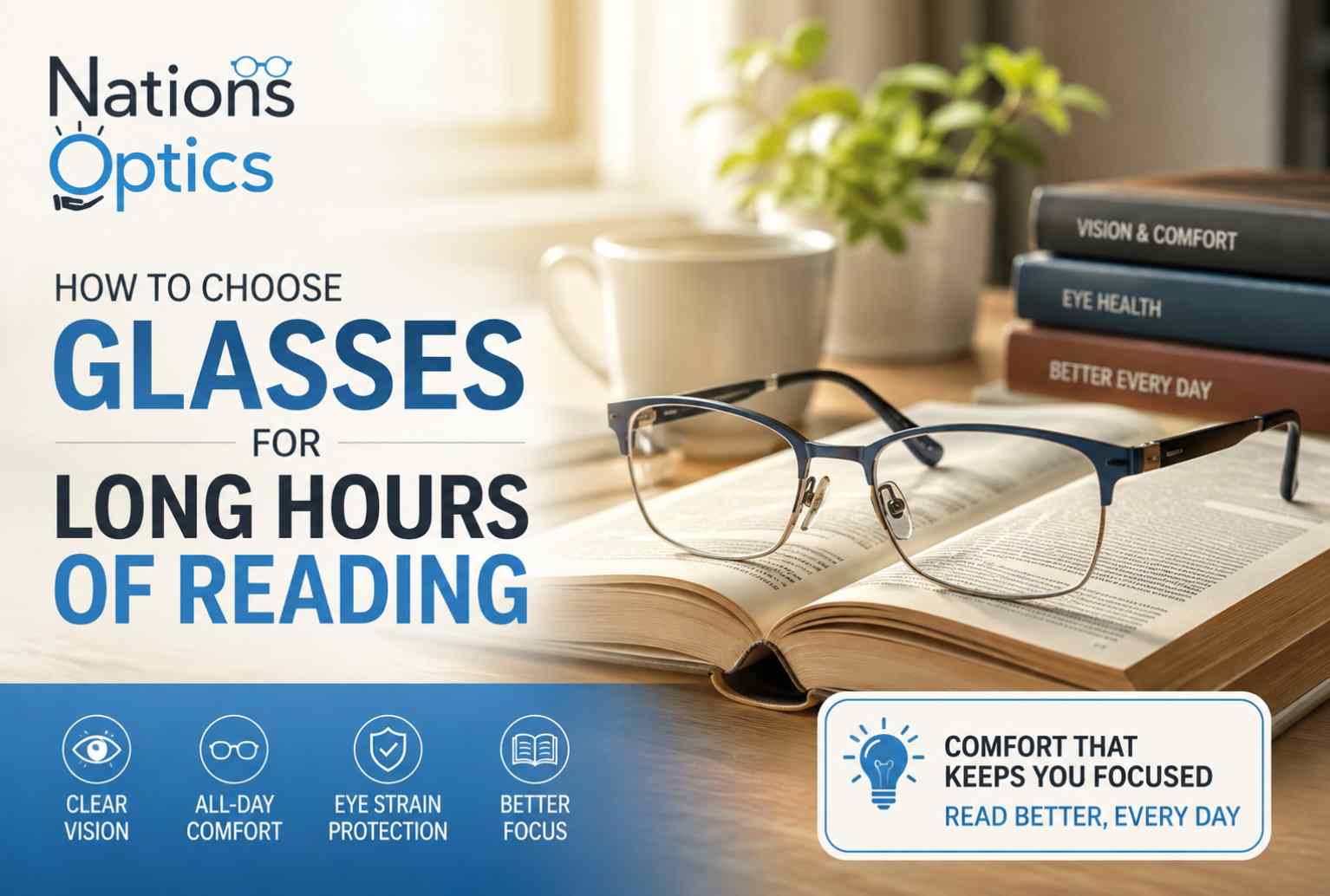
How to Choose Glasses for Long Hours of Reading
Tired eyes, blurry text, and headaches after reading usually aren't about needing "stronger" glasses — they're about the wrong prescription, distance, or fit.
Reading for hours can be enjoyable and productive, but if your eyes become tired, your vision gets blurry, or you develop headaches while reading, your glasses may not be providing the right correction or comfort.
Whether you spend hours reading books, studying, working through documents, or switching between printed pages and digital screens, choosing the best glasses for reading involves more than simply picking a frame that looks good. Your prescription, reading distance, lens type, frame fit, lens coatings, and overall comfort all matter.
Reference: The National Eye Institute notes that presbyopia commonly develops after about age 45 and can cause difficulty seeing close objects, eye strain, and headaches.
Presbyopia
Single Vision Lenses
Progressive Lenses
Reading Distance
Eye Strain
Why Do Your Eyes Feel Tired While Reading?
Reading requires your eyes to maintain focus on a nearby target for an extended period. If your prescription is incorrect, outdated, or incomplete, your eyes may have to work harder to maintain clear vision.
Common Symptoms of Prolonged Close-Up Work
- Eye strain
- Tired or sore eyes
- Blurry vision
- Headaches
- Difficulty focusing
- Squinting
- Difficulty reading small print
- Needing to hold a book farther away
If these symptoms happen frequently, don't assume you simply need stronger reading glasses. An eye examination can determine whether you need a different prescription or whether another vision issue is contributing.
What Are the Best Glasses for Reading?
The best glasses for reading are the ones that provide the appropriate near-vision correction while remaining comfortable during extended wear. There isn't one universal pair of best reading glasses for everyone — the right choice depends on your age, prescription, reading distance, whether you need distance correction, and how you use your glasses.
For some people, single vision reading glasses are ideal because they're designed specifically for near vision. For others, bifocal or progressive lenses may be more practical because they need clear vision at multiple distances.
14 Things to Consider Before Choosing Reading Glasses
1
Start With the Correct Eye Prescription
Your reading prescription may involve more than simply choosing a "+" power off a ready-made rack. You may also have myopia, hyperopia, astigmatism, presbyopia, different prescriptions between your two eyes, or a need for distance, intermediate, and near correction. Ready-made readers generally have the same power in both eyes — prescription glasses can be customized to each eye and account for astigmatism and other refractive errors.
2
Understand Reading Glasses Power
Reading glasses power isn't something to select based on age or by guessing which strength "feels strongest." A stronger lens isn't automatically a better lens. Start with a proper eye examination rather than increasing lens power whenever text appears blurry.
3
Consider Your Normal Reading Distance
Think about how you actually read — close to your face, at arm's length, small-print documents, a tablet, or alternating between books and a computer. Someone who spends the day reading books may have different requirements from someone who switches between documents and a screen.
4
Choose the Right Lens Type
Single vision, bifocal, or progressive lenses each suit different needs — covered in more detail below.
5
Don't Ignore Frame Comfort
The frame matters as much as the lenses if you wear glasses for hours. Look for lightweight construction, a comfortable bridge, proper frame width, secure temples, comfortable nose pads, good balance, and a shape that doesn't press against your head.
6
Pay Attention to Lens Coatings
An anti-reflective coating reduces reflections from the lens surface, particularly useful under overhead lighting or near windows. Coatings should complement — not replace — the correct prescription.
7
Reading Glasses vs Prescription Glasses
Not the same thing. Over-the-counter readers generally have the same power in both lenses; prescription glasses can be customized to each eye's specific requirements. For long hours of reading, prescription glasses may be worth considering if you have astigmatism or unequal prescriptions.
8
Glasses Should Address the Cause, Not Just "Eye Strain"
Eye strain can have several causes, including uncorrected refractive errors. Glasses should address the underlying vision requirement rather than simply being marketed as a general eye-strain solution.
9
Don't Automatically Choose Stronger Glasses
Blurry or uncomfortable near vision can result from an outdated prescription, presbyopia, astigmatism, incorrect reading distance, poor lighting, an inappropriate lens type, or another underlying condition — not just needing more power.
10
Choose Glasses Based on How You Read
The best glasses for reading books aren't necessarily the best for every close-up activity — see the scenarios below.
11
Consider Reading and Computer Use Together
Many people move between books, smartphones, tablets, computers, and printed documents throughout the day. A pair optimized for very close reading may not perform the same way at an intermediate computer distance.
12
Lighting Matters Too
Even the best reading glasses can't compensate for poor reading conditions. Use adequate room lighting, avoid harsh glare directly on the page, position your reading light appropriately, and increase font size when reading digitally.
13
Give Your Eyes Regular Breaks
Don't focus continuously without changing your visual task. Look away from the page periodically, focus on something farther away, relax your eyes, adjust your posture, and blink normally.
14
Review Your Prescription Regularly
Vision needs change over time. If you consistently experience blurry vision, headaches, double vision, or discomfort, don't simply keep increasing your reading-glasses power — get your prescription reviewed.
Choosing the Right Lens Type
Choose Glasses Based on How You Actually Read
Mainly Read Books
Single-vision reading glasses with the appropriate near prescription and a comfortable lightweight frame.
Read and Use a Computer
Consider intermediate vision alongside near vision — a standard reading prescription may not be ideal for every computer working distance.
Need Distance and Near Vision
Bifocal or progressive lenses may provide greater everyday convenience than switching between multiple pairs.
Frequently Switch Between Tasks
Progressive lenses are worth discussing with an optician, since they provide multiple vision zones in one pair.
Reading Glasses for Different Age Groups
Younger Adults
Often need glasses because of myopia, hyperopia, astigmatism, or other refractive errors rather than age-related presbyopia.
40s and 50s
Presbyopia commonly becomes noticeable during this stage — small print may get harder to read, and reading material often gets held farther away.
Older Adults
Near-vision requirements may continue changing over time, making regular eye examinations particularly important.
Good lighting helps too: the National Eye Institute specifically notes that increasing font size and using brighter reading light can help people with early presbyopia read more easily — a simple habit that costs nothing and complements the right prescription.
When Should You Get Your Eyes Checked?
Consider an eye examination if you notice:
- Persistent blurry vision
- Frequent headaches while reading
- Significant eye strain
- Difficulty reading small print
- Double vision
- Sudden changes in vision
- Difficulty focusing at close distances
- Symptoms despite wearing your current glasses
Don't assume every reading problem is caused by needing stronger glasses — an eye examination can help identify whether the issue is related to your prescription or another vision condition.
Quick Checklist Before You Buy
- Prescription: Is your current prescription accurate?
- Reading distance: How far away do you normally hold your book?
- Lens type: Single vision, bifocal, or progressive?
- Frame fit: Is the frame comfortable and properly sized?
- Weight: Can you comfortably wear the glasses for several hours?
- Lens coating: Would an anti-reflective coating help your environment?
- Eye health: Have you had a recent eye examination?
- Lifestyle: Do you read books, work on computers, use smartphones, or all three?
Frequently Asked Questions
What are the best glasses for reading?
Ones with the appropriate near-vision correction for your eyes and a comfortable frame suited to your reading distance and daily use.
Can reading glasses help with eye strain?
If eye strain relates to an uncorrected refractive error or difficulty focusing at near distances, appropriate glasses may improve clarity and comfort. Persistent eye strain should still be evaluated by an eye-care professional.
Are stronger reading glasses better?
No. Stronger isn't automatically better — the correct power should match your individual near-vision requirements, not a guess.
Are prescription reading glasses better than ready-made readers?
Prescription glasses can be customized for each eye and correct issues like astigmatism or unequal prescriptions. Ready-made readers may work for some people, but regular eye exams remain important either way.
What glasses are best for reading and computer work?
It depends on your working distances — someone alternating between reading and computer work may need a lens design supporting both near and intermediate vision, not just a standard reading-only prescription.
Why do my eyes hurt when reading?
It can be associated with uncorrected refractive errors, difficulty focusing, or other vision problems. Headaches, blurry vision, and tired eyes while reading are good reasons to consider an eye examination.
When should I replace my reading glasses?
Consider having your vision checked if your current glasses no longer provide comfortable, clear vision, or if new symptoms appear while reading — prescriptions can change over time.
Reading Glasses Built for Your Actual Prescription
At Nations Optics, we match your lens type, coating, and frame to how you actually read — not just a guessed power off a rack.
- Single vision, bifocal & progressive lens options
- Customized correction for each eye
- Anti-reflective coating available
- Lightweight, comfortable frame options
- Guidance based on your reading habits
The best glasses for long hours of reading aren't simply the strongest reading glasses you can find. They should provide the right prescription, suit your reading distance, fit comfortably, and match the way you use your eyes every day.
For occasional readers, simple reading glasses may be enough. For people who read for several hours every day, prescription reading glasses, single-vision lenses, bifocals, or progressive lenses may be more appropriate depending on their individual vision needs. If reading has recently become difficult, don't simply guess your reading-glasses power — get your vision checked and choose eyewear based on your actual prescription and visual needs.
Exclusive Offers
Sitewide
33%
OFF
Flat 33% off on all products
Already applied on every price · no coupon needed
Auto-applied
10%
OFF
On orders ₹1,200 – ₹1,799
No coupon needed · saves automatically
Auto-applied
15%
OFF
On orders ₹1,800 – ₹3,199
No coupon needed · saves automatically
Best Deal 🔥
20%
OFF
On orders above ₹3,200
No coupon needed · saves automatically
Pay Advance
₹50
SAVED
Pay advance amount at checkout
Flat ₹50 off · pay balance on delivery
Pay Full ✓
₹100
SAVED
Pay full amount at checkout
Maximum saving · instant confirmation
N
Nations Optics Assistant
● Online
👋 Hi! I'm your Nations Optics assistant. Ask me anything about lenses, frames, or prescriptions!