Zero-Power Blue Light Glasses: The Non-Prescription Trend Explained
Aug 13, 2026
By Rahul Jain
0 comment(s)
Trending in Eyewear · 2026
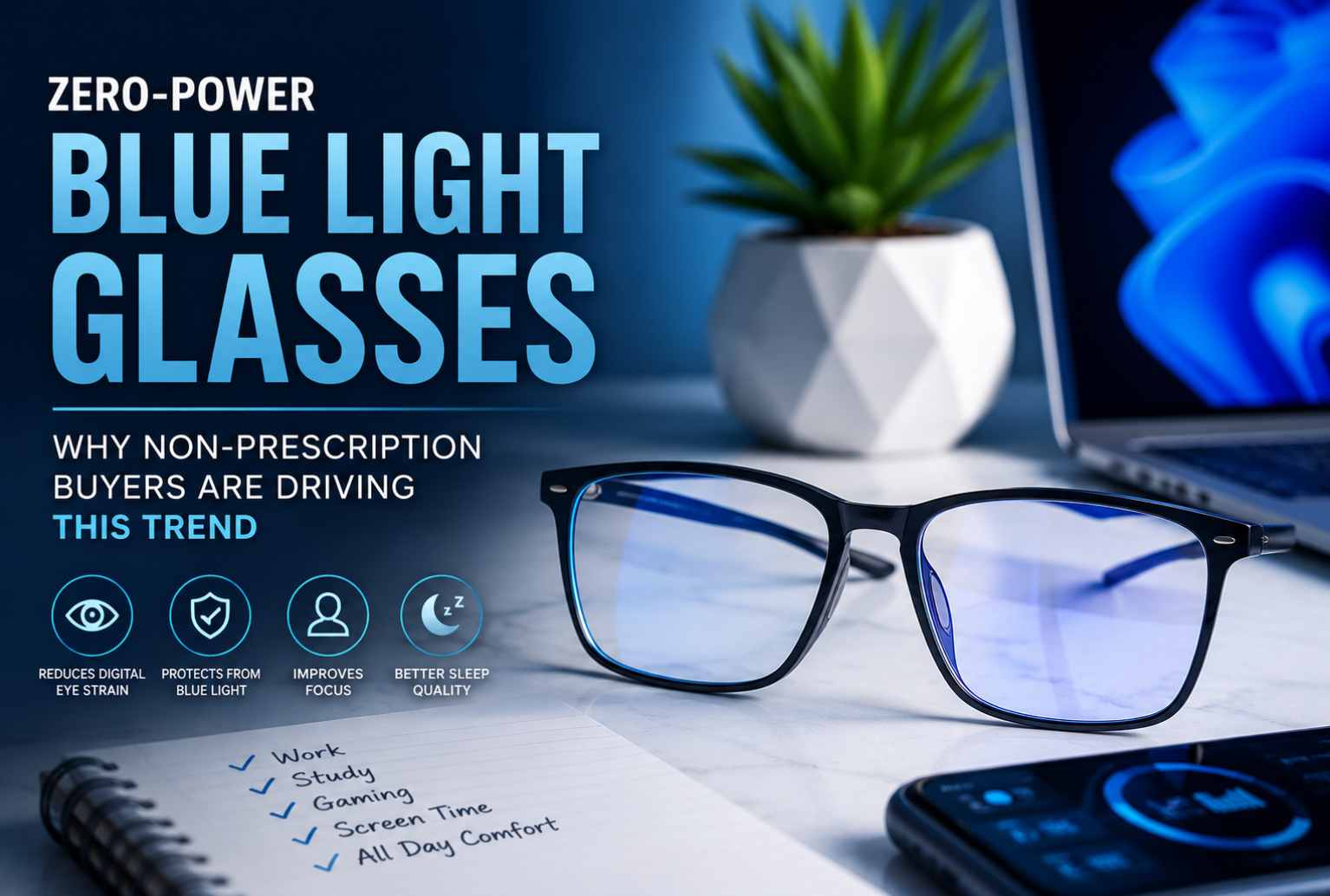
Zero-Power Blue Light Glasses: Why Non-Prescription Buyers Are Driving This Trend
You don't need a prescription anymore to walk out with a pair of glasses. Here's why zero-power blue light frames have become one of eyewear's fastest-growing categories.
For most of eyewear's history, glasses were a medical purchase — you bought them because you needed corrected vision, full stop. That assumption has quietly broken down. A growing share of eyewear buyers today have perfect 20/20 vision and are still walking out with a pair of glasses on their face, and the reason is almost always the same: zero-power blue light lenses.
This guide explains what zero-power blue light glasses actually are, why non-prescription buyers are driving so much of this trend, whether the science holds up, and how to decide if they're worth adding to your own routine.
Zero Power Lenses Non-Prescription Eyewear Screen Time Fashion Eyewear Gen Z Buyers
What Are Zero-Power Blue Light Glasses?
Zero-power (or "plano") blue light glasses look and function exactly like regular prescription glasses, except the lenses have no corrective power at all — they don't magnify, minify, or change your vision in any way. What they do carry is a blue-light filtering treatment, the same lens technology found in prescription computer glasses, just without any SPH, CYL, or axis correction ground into the lens.
In other words: the frame is real, the lens is real, but there's zero optical correction behind it. The person wearing them sees exactly as well without the glasses as with them — the lens is simply there to filter light and complete a look.
Who's Actually Buying These?
The customer profile here looks nothing like a traditional optical shop customer. Common buyer segments include:
Students & young professionalsContent creators & streamersGamersRemote workers with 20/20 visionFashion-first Gen Z shoppersOffice workers wanting a "desk look"
What connects them isn't a vision problem — it's screen time, aesthetics, or both. This is a fundamentally different buyer than the person walking in with an outdated prescription, and it's part of why this category has grown so quickly outside traditional optical retail.
What's Actually Driving This Trend
1
Screen Time Has Become Universal
It's no longer just office workers staring at monitors all day — students attend classes on laptops, gamers spend hours on displays, and nearly everyone scrolls a phone for several hours daily. Blue light glasses have positioned themselves as a simple, visible response to that shift, whether or not a person has a vision problem to correct.
2
Glasses Became a Fashion Category, Not Just a Medical One
Frames are now styled and marketed the same way sunglasses or watches are — as an accessory that signals personality and taste. Zero-power lenses let anyone participate in that trend regardless of whether they need vision correction.
3
Content Creator and Streaming Culture
People on camera for hours — streamers, YouTubers, remote presenters — cite both a desire to reduce screen glare on camera and simply liking how frames look on video. Zero-power blue light glasses solve for both without requiring a vision correction need.
4
Lower Barrier to Entry
Buying zero-power glasses skips the eye exam, the prescription, and the wait — you can pick a frame and lens combination and wear it the same day. That convenience matters a lot to a buyer who's shopping for style rather than necessity.
5
Social Proof and Visibility
Once frames became common in influencer and celebrity photos regardless of actual vision needs, "wearing glasses" shifted from a medical signal to a style signal — normalizing non-prescription purchases at scale.
Do Blue Light Lenses Actually Do Anything?
This is the most contested part of the trend, and it's worth being straightforward about it.
What the Lenses Do
- Filter or reduce a portion of blue-wavelength light reaching the eye
- Can reduce glare and reflections from screens, depending on the coating
- May make extended screen sessions feel more visually comfortable for some people
What They Don't Do
- Eliminate digital eye strain on their own
- Replace the need for the 20-20-20 rule or proper breaks
- Correct vision problems (they have zero power, by definition)
- Guarantee better sleep — the research on this is still mixed
The honest answer is that blue light filtering is one small piece of a much bigger picture that includes screen habits, lighting, and break frequency. For many buyers, though, that's not really the point — the glasses are as much a style and comfort purchase as a scientifically airtight health intervention, and there's nothing wrong with buying them for that reason as long as expectations are set accurately.
Who Should Actually Consider Zero-Power Blue Light Glasses?
Good Fit
People with genuinely long daily screen exposure who want a low-cost, no-appointment way to test whether reduced glare feels more comfortable — and people who simply want to wear frames as a style choice.
Reconsider
Anyone experiencing real, persistent eye strain, headaches, or blurred vision. These are signals worth an actual eye exam — zero-power glasses won't diagnose or fix an underlying vision problem.
Already need vision correction? Skip zero-power and go straight to prescription lenses with blue light filtering built in — you get both the correction and the same filtering benefit in a single lens, with no compromise either way.
How to Buy Zero-Power Blue Light Glasses the Right Way
1
Confirm the lens has no power — it should be labeled plano or zero-power; this isn't a substitute for an eye exam if you suspect a real vision issue.
2
Check the actual coating quality — not all blue light treatments are equal; ask what percentage of blue light is filtered and whether anti-reflective coating is included too.
3
Pick a frame you'll actually want to wear daily — since there's no vision necessity driving the purchase, comfort and style matter even more than usual.
4
Don't skip real eye care — if you're buying because of genuine discomfort, pair the purchase with an actual eye exam rather than assuming the glasses alone will solve it.
Frequently Asked Questions
What does "zero power" mean in glasses?
It means the lens has no corrective prescription — it doesn't magnify or change your vision at all. The frame and lens are real, but there's no optical correction.
Can I wear zero-power blue light glasses if I have perfect vision?
Yes — that's exactly who they're designed for. Many buyers have no vision correction needs and wear them purely for screen comfort or style.
Do zero-power blue light glasses actually reduce eye strain?
They may help some people feel more comfortable during screen use by reducing glare and blue light exposure, but they're not a complete solution on their own — screen habits and breaks still matter.
Are zero-power glasses bad for your eyes?
No — since there's no incorrect prescription being forced on the eye, wearing a zero-power lens doesn't harm your vision.
Should I get an eye exam before buying blue light glasses?
If you're buying purely for style or mild screen comfort, it's optional. If you're experiencing real eye strain, headaches, or blurry vision, an eye exam is worth doing first — those symptoms may point to an actual vision correction need.
Can I add blue light filtering to my actual prescription lenses?
Yes — if you already need vision correction, blue light filtering can typically be added directly to your prescription lenses, so there's no need to choose between the two.
Blue Light Glasses, With or Without a Prescription
At Nations Optics, we offer zero-power blue light frames for style and screen comfort, plus prescription options with blue light filtering built in.
- Zero-power (plano) blue light lens options
- Blue light filtering added to any prescription
- Anti-reflective coating available on all lenses
- Wide range of everyday and statement frame styles
- Guidance on what's right for your actual needs
Zero-power blue light glasses sit at an interesting intersection of fashion, screen-heavy lifestyles, and genuine (if modest) visual comfort benefits. The trend isn't going anywhere soon — if anything, as glasses continue shifting from a purely medical purchase to a style category, expect more non-prescription buyers to keep driving it.
Whether you pick them up for the aesthetic, the glare reduction, or both, the important thing is knowing exactly what you're buying: a real frame, a light-filtering lens, and zero optical correction. That's not a downside — it's just worth being clear-eyed about, so the purchase actually matches what you need it to do.
Exclusive Offers
Sitewide
33%
OFF
Flat 33% off on all products
Already applied on every price · no coupon needed
Auto-applied
10%
OFF
On orders ₹1,200 – ₹1,799
No coupon needed · saves automatically
Auto-applied
15%
OFF
On orders ₹1,800 – ₹3,199
No coupon needed · saves automatically
Best Deal 🔥
20%
OFF
On orders above ₹3,200
No coupon needed · saves automatically
Pay Advance
₹50
SAVED
Pay advance amount at checkout
Flat ₹50 off · pay balance on delivery
Pay Full ✓
₹100
SAVED
Pay full amount at checkout
Maximum saving · instant confirmation
N
Nations Optics Assistant
● Online
👋 Hi! I'm your Nations Optics assistant. Ask me anything about lenses, frames, or prescriptions!