
The Ultimate Guide to Progressive Lenses: Benefits, Types & Buying Tips 2026
Jun 9, 2026
By Rahul Jain
0 comment(s)
The Ultimate Guide to Progressive Lenses: Everything You Need to Know Before Buying in 2026
Discover how progressive lenses work, their benefits, lens types, costs, adaptation tips, and how to choose the best progressive lenses for crystal-clear vision at every distance.
Progressive lenses have become one of the most popular vision correction solutions for adults who require multiple prescriptions in a single pair of glasses. Unlike traditional bifocals and trifocals, progressive lenses provide a smooth transition between near, intermediate, and distance vision without visible lines. As lens technology continues to improve in 2026, progressive lenses offer wider viewing zones, enhanced comfort, and superior visual performance for everyday activities.
Whether you're reading a book, working on a computer, driving, or using a smartphone, progressive lenses eliminate the inconvenience of switching between multiple pairs of glasses. This guide explains everything you need to know before purchasing progressive lenses, helping you make an informed decision for your vision and lifestyle.
In This Guide You'll Learn:
- What progressive lenses are
- How progressive lenses work
- Benefits of progressive lenses
- Different types available
- Progressive lens costs
- Adaptation tips
- How to choose the best progressive lenses
What Are Progressive Lenses?
Progressive lenses are advanced multifocal lenses that combine multiple prescriptions into a single lens. Unlike bifocals, which contain visible segments, progressive lenses offer a seamless progression between different viewing distances.
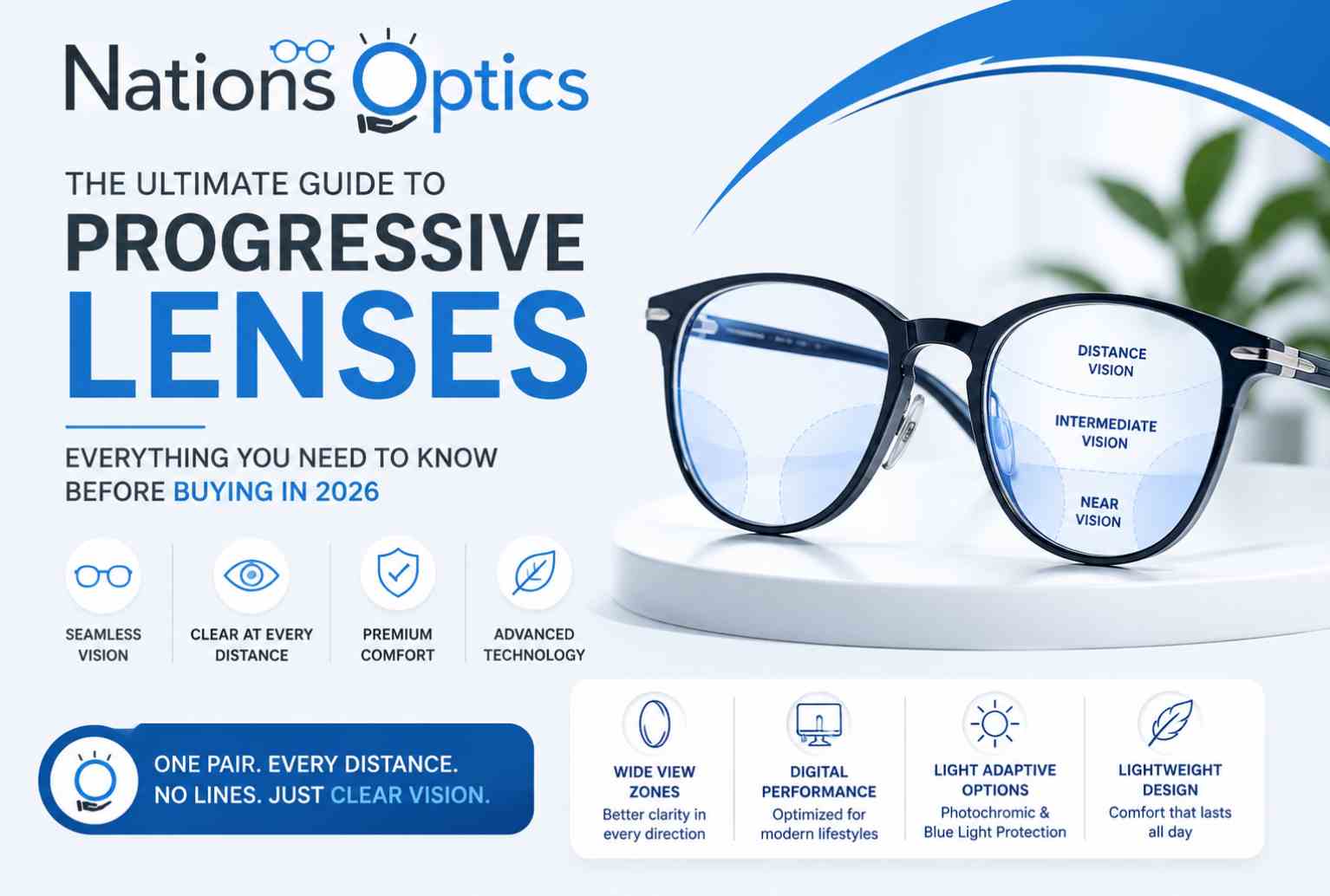
The top portion of the lens is designed for distance vision, the middle section supports intermediate viewing such as computer work, and the lower section provides clear near vision for reading and close-up tasks.
This smooth transition allows wearers to see naturally without noticeable lines or image jumps.
How Do Progressive Lenses Work?
Progressive lenses gradually change lens power from top to bottom. This design mimics natural vision and enables users to focus comfortably at different distances by simply moving their eyes rather than switching glasses.
Modern progressive lens technology utilizes advanced digital surfacing techniques that optimize visual zones and minimize peripheral distortion. Premium progressive lenses offer wider viewing areas and faster adaptation compared to older lens designs.
Benefits of Progressive Lenses
1. Seamless Vision Correction
Progressive lenses eliminate visible lines found in bifocals and trifocals. The gradual power transition creates a more natural viewing experience.
2. One Pair for All Activities
Instead of carrying separate reading glasses and distance glasses, progressive lenses provide complete vision correction in a single pair.
3. Modern Appearance
Because there are no visible segments, progressive lenses look identical to standard single-vision lenses, making them aesthetically appealing.
4. Improved Daily Convenience
Whether driving, working, shopping, or reading, progressive lenses adapt to your needs throughout the day.
Types of Progressive Lenses
Standard Progressive Lenses
Standard progressives provide effective multifocal correction at an affordable price. They are ideal for first-time wearers seeking an economical solution.
Premium Progressive Lenses
Premium progressive lenses feature wider viewing zones and reduced peripheral distortion. They offer superior visual comfort and faster adaptation.
Digital Progressive Lenses
Digital freeform progressive lenses are customized using advanced computer technology. These lenses deliver highly accurate vision correction tailored to individual prescriptions.
Occupational Progressive Lenses
Designed for office environments, occupational progressive lenses optimize intermediate and near vision for computer users and professionals.
Looking for Premium Progressive Lenses?
Experience seamless vision at every distance with advanced progressive lenses designed for superior comfort and clarity.
Shop Progressive LensesProgressive Lenses vs Bifocals
| Feature | Progressive Lenses | Bifocals |
|---|---|---|
| Visible Lines | No | Yes |
| Intermediate Vision | Included | Limited |
| Appearance | Modern | Traditional |
| Comfort | Excellent | Moderate |
| Adaptation | Short Learning Period | Easy |
How Much Do Progressive Lenses Cost?
The cost of progressive lenses varies depending on lens design, materials, coatings, and customization options. Basic progressive lenses are generally more affordable, while premium digital progressives offer enhanced performance and wider visual fields.
Factors affecting price include:
- Lens material
- High-index options
- Anti-reflective coatings
- Blue light protection
- Photochromic technology
- Digital freeform customization
Are Progressive Lenses Worth It?
For most adults experiencing presbyopia, progressive lenses are one of the best investments in visual comfort. They provide clear vision at multiple distances while eliminating the need for multiple pairs of glasses.
Modern progressive lenses have significantly improved compared to earlier generations, offering wider viewing areas and easier adaptation.
Tips for Adapting to Progressive Lenses
New wearers may require a short adjustment period. Following these tips can help:
- Wear your progressive lenses consistently.
- Move your head rather than only your eyes.
- Practice looking through different lens zones.
- Use proper frame positioning.
- Allow one to two weeks for adaptation.
Choosing the Best Progressive Lenses in 2026
When selecting progressive lenses, consider your lifestyle, occupation, prescription strength, and daily visual demands. Individuals who spend significant time using computers may benefit from digital progressive lenses, while active users may prefer lightweight high-index materials.
Premium coatings such as anti-reflective treatment, blue light protection, and photochromic technology can further enhance visual comfort and lens performance.
Upgrade Your Vision Today
Explore premium progressive lenses with advanced coatings, lightweight materials, and modern lens technology designed for everyday comfort.
Browse Lens Collections Get StartedFrequently Asked Questions
How long does it take to adjust to progressive lenses?
Most users adapt within a few days to two weeks depending on prescription complexity and wearing habits.
Can progressive lenses be used for computer work?
Yes. Progressive lenses provide intermediate vision zones specifically designed for computer use.
Are progressive lenses better than bifocals?
Progressive lenses offer smoother vision transitions, modern aesthetics, and improved functionality compared to traditional bifocals.
Can I get photochromic progressive lenses?
Absolutely. Many progressive lenses can be combined with photochromic technology for indoor and outdoor convenience.
Final Thoughts
Progressive lenses continue to be the preferred solution for individuals seeking seamless vision correction in 2026. With advancements in digital lens design, premium coatings, and customization options, today's progressive lenses provide exceptional visual clarity, comfort, and convenience.
Whether you're upgrading from bifocals or purchasing multifocal lenses for the first time, investing in high-quality progressive lenses can significantly improve your daily visual experience. Explore premium progressive lens options from Nations Optics and discover the difference advanced lens technology can make.
Exclusive Offers
Sitewide
33%
OFF
Flat 33% off on all products
Already applied on every price · no coupon needed
Auto-applied
10%
OFF
On orders ₹1,200 – ₹1,799
No coupon needed · saves automatically
Auto-applied
15%
OFF
On orders ₹1,800 – ₹3,199
No coupon needed · saves automatically
Best Deal 🔥
20%
OFF
On orders above ₹3,200
No coupon needed · saves automatically
Pay Advance
₹50
SAVED
Pay advance amount at checkout
Flat ₹50 off · pay balance on delivery
Pay Full ✓
₹100
SAVED
Pay full amount at checkout
Maximum saving · instant confirmation
N
Nations Optics Assistant
● Online
👋 Hi! I'm your Nations Optics assistant. Ask me anything about lenses, frames, or prescriptions!