Aspheric vs Spherical Lenses: Which Is Better for You?
Jul 23, 2026
By Rahul Jain
0 comment(s)
Lens Guide
Aspheric vs Spherical Lenses: Key Differences, Benefits & Which Is Better?
Same prescription, different lens curve. Here's how aspheric and spherical designs differ — and which one actually suits your eyes.
Choosing the right prescription lenses is about more than simply matching your eye power. The design of the lens can affect its thickness, appearance, visual performance, comfort, and how naturally your eyes look behind your glasses.
Two common lens designs people compare are aspheric and spherical lenses. Are aspheric lenses better? Are they thinner? Do they provide better vision? In this guide, we break down the difference in simple terms so you can decide which design fits your eyewear needs.
Lens Curvature Myopia Hyperopia Peripheral Distortion High Prescriptions
Aspheric vs Spherical Lenses: Quick Comparison
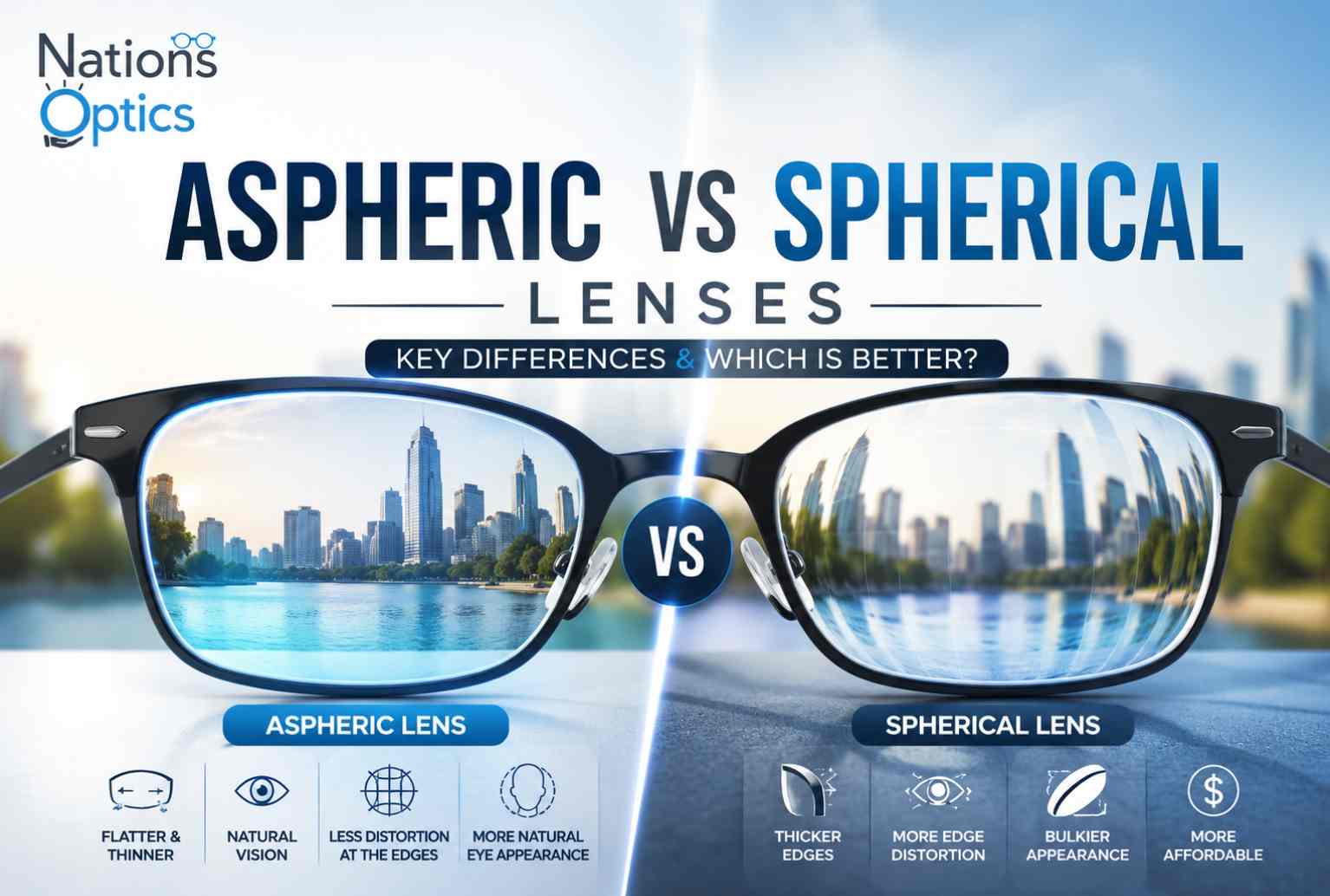
The main difference between the two is the shape of the lens surface. A spherical lens has a consistently curved surface, like a section of a sphere — a traditional, widely used, and often economical design. An aspheric lens has a more gradually changing curvature, becoming flatter toward the edges — creating a thinner, flatter-looking lens with potentially reduced distortion.
| Feature | Spherical | Aspheric |
|---|---|---|
| Surface design | Consistent spherical curve | Gradually changing curvature |
| Lens profile | Generally more curved | Flatter, more streamlined |
| Thickness | Can be thicker in strong Rx | Often reduces apparent thickness |
| Appearance | More traditional | Flatter, more modern |
| Distortion | More peripheral distortion possible | Can reduce certain distortions |
| Eye appearance | More magnification/minification | More natural eye appearance |
| Cost | Usually more economical | May cost more |
| Best suited for | Many standard prescriptions | Stronger Rx & cosmetic preference |
Neither design is automatically best for everyone — the ideal option depends on your prescription, lens material, frame choice, visual needs, and personal preferences.
What Is a Spherical Lens?
A spherical lens is a traditional design with a surface that follows a consistent spherical curve, relatively uniform across the lens. It's been used in prescription eyewear for many years and suits a wide range of prescriptions. For low to moderate prescriptions, spherical lenses provide clear, comfortable, and affordable vision.
Advantages
- Traditional, well-established design
- Suitable for many common prescriptions
- Generally cost-effective
- Available in different materials & coatings
- Clear vision when properly fitted
Disadvantages
- Can appear thicker in stronger Rx
- More curved profile
- More noticeable peripheral distortion in some Rx
- More visible eye magnification/minification
What Is an Aspheric Lens?
An aspheric lens uses a more advanced surface design — the curvature gradually changes from center to edge instead of staying uniform. This flatter design reduces the overall bulging or curved appearance of the lens, making aspheric lenses popular for stronger prescriptions where lens appearance, thickness, and optical performance matter most.
Advantages
- Flatter, more streamlined lens profile
- More natural cosmetic appearance
- Potentially reduced optical distortion
- More advanced, modern lens design
- Well-suited to certain strong prescriptions
Disadvantages
- May cost more than basic spherical lenses
- Requires more accurate fitting & measurements
- Some wearers need an adaptation period
- Benefits vary by prescription and design
- Not every prescription needs it
Difference Between Aspheric and Spherical Lenses
The most important difference is how the lens surface is shaped — spherical is a consistent curve, aspheric is a changing curvature that flattens across the surface. This affects several aspects of your eyewear.
1
Lens Shape and Profile
Spherical lenses have a uniform curved profile that can look more curved or bulky depending on the prescription. Aspheric lenses use a changing curve, giving the lens a flatter, more streamlined profile once fitted into a frame.
2
Lens Thickness
For stronger prescriptions, an aspheric design can help reduce apparent bulging or thickness. But thickness also depends on prescription power, lens material, index of refraction, frame size, frame shape, PD, optical center placement, and lens design — so aspheric design alone doesn't guarantee the thinnest lens.
3
Optical Distortion
Some spherical lenses, especially in stronger prescriptions, create noticeable distortion toward the edges. Aspheric designs can reduce certain distortions through their more complex curvature — giving a more natural visual experience away from the lens center.
4
Eye Appearance Behind Glasses
Strong prescriptions can make eyes look magnified or smaller behind the lens. An aspheric design may reduce this visual effect — one reason it's popular with people concerned about the cosmetic appearance of high-prescription eyewear.
Which Is Thinner: Aspheric or Spherical?
Aspheric lenses can provide a flatter, more streamlined profile — but final thickness depends on more than the surface design. The same prescription can vary in thickness depending on whether it's made from CR-39, polycarbonate, or a high-index material. Frame size matters too: a smaller frame reduces the lens material required, while a larger frame can mean thicker edges or centers.
Bottom line: The best approach considers the complete combination of prescription, lens material, lens design, and frame size — not lens design in isolation.
Aspheric vs Spherical Lenses by Prescription Type
For Myopia (Nearsightedness)
Myopia generally requires minus-powered lenses. Stronger minus prescriptions cause thicker edges — an aspheric design may create a flatter-looking profile. For higher myopia, high-index materials, smaller frames, and accurate optical measurements matter just as much as the lens design.
For Hyperopia (Farsightedness)
Hyperopia generally requires plus-powered lenses, which can become thicker toward the center. An aspheric design may help create a flatter, more aesthetically pleasing appearance — especially useful for higher plus prescriptions where traditional designs show more noticeable bulging.
For High Prescriptions
Stronger prescriptions bring thicker lenses, greater curvature, more noticeable magnification or minification, and possible peripheral optical effects. An aspheric design may offer real advantages here, depending on prescription and material — but a qualified optician should evaluate the full prescription and frame combination first.
Spherical vs Aspheric: Which Should You Choose?
Choose Spherical If:
- You have a low or moderate prescription
- You want a more economical option
- You're comfortable with a traditional design
- Lens appearance/thickness aren't major concerns
Consider Aspheric If:
- You have a stronger prescription
- You want a flatter-looking lens profile
- You're concerned about lens thickness
- You want a more natural eye appearance
- You want to reduce certain optical distortions
- You prefer a more advanced lens design
Remember: lens design is only one part of the full eyewear solution. Lens material, frame size, frame shape, optical measurements, and accurate prescription fitting all matter just as much.
Frequently Asked Questions
What is the main difference between aspheric and spherical lenses?
The curvature of the lens surface. Spherical lenses have a consistent curved surface; aspheric lenses use a gradually changing curvature across the lens.
Are aspheric lenses thinner than spherical lenses?
They can provide a flatter-looking profile and may reduce apparent thickness for certain prescriptions, but actual thickness also depends on prescription power, lens material, and frame size.
Which is better: aspheric or spherical lenses?
Neither is universally better. Aspheric lenses may benefit certain stronger prescriptions and cosmetic preferences, while spherical lenses work excellently for many standard prescriptions.
Are aspheric lenses good for high prescriptions?
They may be suitable, since the flatter design can reduce certain optical effects — but the best choice depends on the individual prescription and lens material.
Do aspheric lenses reduce distortion?
They may help reduce certain optical distortions compared with traditional spherical designs, though the actual experience depends on prescription, fitting, and measurements.
Are aspheric lenses worth the extra cost?
For stronger prescriptions or specific cosmetic/optical preferences, often yes. For lower prescriptions, a standard spherical lens may be entirely sufficient.
Do aspheric lenses make eyes look more natural?
Depending on the prescription, they may reduce the magnification or minification effect common with stronger prescriptions, creating a more natural appearance.
Can I get aspheric lenses for any prescription?
Availability depends on your specific prescription, lens material, and design. An optician can confirm whether an aspheric option suits your prescription.
Find the Right Lens Design for You
At Nations Optics, we match lens design to your prescription and priorities — not just a name on a spec sheet.
- Spherical & aspheric lens design options
- Guidance based on your exact prescription
- High-index materials for stronger Rx
- Frame recommendations to minimize thickness
- Anti-reflective & UV coatings available
Spherical lenses use a traditional, consistent curvature and remain an affordable, effective option for many prescriptions. Aspheric lenses use a more advanced curvature that may offer a flatter profile, more natural appearance, and reduced optical distortion in certain situations.
For lower prescriptions, spherical lenses may be completely suitable. For stronger prescriptions, or if you want a thinner-looking, flatter, more cosmetically appealing lens, aspheric lenses may be worth considering. The best lens is the one that matches your prescription, lifestyle, frame, visual requirements, and budget.
Exclusive Offers
Sitewide
33%
OFF
Flat 33% off on all products
Already applied on every price · no coupon needed
Auto-applied
10%
OFF
On orders ₹1,200 – ₹1,799
No coupon needed · saves automatically
Auto-applied
15%
OFF
On orders ₹1,800 – ₹3,199
No coupon needed · saves automatically
Best Deal 🔥
20%
OFF
On orders above ₹3,200
No coupon needed · saves automatically
Pay Advance
₹50
SAVED
Pay advance amount at checkout
Flat ₹50 off · pay balance on delivery
Pay Full ✓
₹100
SAVED
Pay full amount at checkout
Maximum saving · instant confirmation
N
Nations Optics Assistant
● Online
👋 Hi! I'm your Nations Optics assistant. Ask me anything about lenses, frames, or prescriptions!