
Why PD (Pupillary Distance) is the Most Critical Measurement for Progressive Lenses | NationsOptics
Apr 18, 2026
By Rahul Jain
0 comment(s)
Why PD (Pupillary Distance) is the Most Critical Measurement for Progressive Lenses
When it comes to ordering progressive lenses online, one measurement stands above all others — Pupillary Distance (PD). Get it wrong, and even the most expensive, perfectly crafted progressive lens will leave you with blurry vision, headaches, and eye strain. This guide explains exactly what PD is, why it is non-negotiable for progressive lenses, and how to ensure yours is accurate.
What Is Pupillary Distance (PD)?
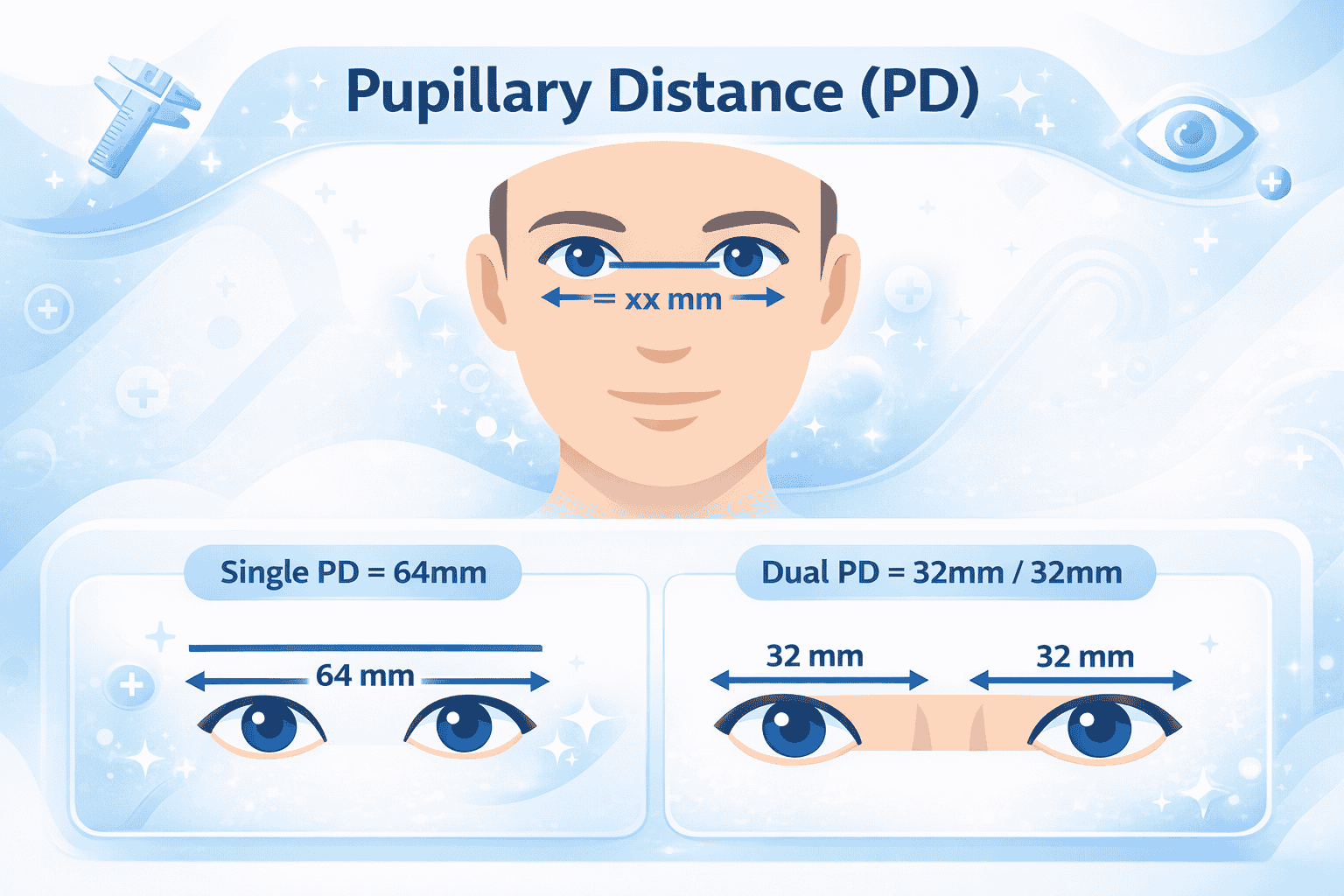
Pupillary Distance, commonly referred to as PD, is the measurement in millimetres (mm) of the distance between the centre of one pupil to the centre of the other. It tells the optician — or in this case, the lens-cutting machine — exactly where on each lens your eye will look through.
For most adults, PD ranges between 54 mm and 74 mm, with the average sitting around 63–64 mm. PD can be expressed in two ways:
| PD Type | What It Means | Example |
|---|---|---|
| Single PD (Binocular) | Total distance between both pupils | 64 mm |
| Dual PD (Monocular) | Distance from nose centre to each pupil separately | 32/32 mm or 31/33 mm |
For progressive lenses, dual (monocular) PD is strongly preferred because very few people have perfectly symmetrical eyes. Even a 0.5 mm asymmetry matters when fitting multifocal optics.
How Progressive Lenses Actually Work
Unlike single-vision lenses where the entire lens is the same power, progressive lenses contain three distinct optical zones built into a single lens:
| Zone | Position on Lens | Used For |
|---|---|---|
| Distance Zone | Upper portion | Driving, watching TV, seeing far |
| Intermediate Zone | Middle corridor | Computer work, dashboard, cooking |
| Near Zone | Lower portion | Reading, mobile, close-up tasks |
The transition between these zones is seamless and progressive — hence the name. However, this progression happens along a very specific vertical and horizontal optical axis that is precisely calculated based on your PD.
The optical centre of the progressive lens must align exactly with your pupil. If it does not, your eye is forced to look through the wrong zone at every distance — leading to distortion, fatigue, and poor clarity.
Why PD Is Especially Critical for Progressive Lenses
Key Insight: For single-vision lenses, a PD error of 1–2 mm is often tolerable, especially in lower prescriptions. For progressive lenses, even a 1 mm error can shift the optical corridor enough to cause noticeable distortion, uncomfortable vision, and headaches.
1. The Optical Corridor Is Narrow
The progressive corridor — the narrow, clear channel through which you see at intermediate distances — is typically only 2–4 mm wide on the lens. Any misalignment of the PD shifts this corridor away from your natural line of sight, making it difficult or impossible to find comfortable intermediate vision.
2. Your Eyes Must Work in Perfect Harmony
Progressive lenses require both eyes to converge and work together as you shift focus from far to near. If the PD for one eye is even slightly off, both eyes struggle to coordinate, causing the brain to overwork — leading to headaches, dizziness, and nausea, especially in new wearers.
3. The Near Zone Becomes Unusable
The near zone at the bottom of a progressive lens is the smallest and most precise zone. An incorrect PD — even by 1.5 mm — can place this zone completely outside your line of sight when you look down to read, making the lens functionally useless for close work.
4. Adaptation Becomes Impossible
New progressive wearers expect a short adaptation period of 1–2 weeks. But with a wrong PD, no amount of adaptation will fix the problem. Many people incorrectly believe they "cannot wear progressives" when the real issue was simply an inaccurate PD measurement.
⚠ Common Mistake
Many people assume that because their single-vision glasses were fine without knowing their PD, progressives will be the same. This is incorrect. Progressive lens fitting is significantly more demanding — an accurate PD is not optional, it is mandatory.
What Happens When PD Is Wrong in Progressive Lenses?
A wrong PD in progressive lenses does not just cause minor discomfort — it can make the glasses completely unwearable. Here are the symptoms of an incorrect PD fit:
- Blurred or double vision, especially at near or intermediate distances
- Headaches after 20–30 minutes of wear
- Eye strain and fatigue throughout the day
- Dizziness or a "swimming" sensation when moving your head
- Difficulty finding the reading zone at the bottom of the lens
- Neck strain from tilting or turning your head to compensate
- A constant feeling that the glasses are "not right" despite a valid prescription
How to Measure Your PD Accurately
The most accurate PD is always measured by a qualified optician using a pupillometer or a millimetre ruler. However, here is a reliable at-home method if needed:
-
Stand in front of a mirror (40–50 cm away) Keep your head straight and look directly at your own reflection. Good lighting is essential.
-
Hold a mm ruler across your nose bridge Align the 0 mm mark with the centre of one pupil. Keep the ruler perfectly horizontal.
-
Read the measurement at the second pupil The number in mm at the centre of the second pupil is your single PD.
-
Measure from the nose centre for dual PD For monocular PD, measure the distance from the centre of the nose bridge to each pupil separately. Add both values to verify your total PD.
-
Repeat 3 times and take the average Measurement consistency is key. If readings vary by more than 1 mm, visit your optician for a professional measurement.
Pro Tip: When ordering progressive lenses at NationsOptics, always provide your dual (monocular) PD — for example, 32/32 or 31/33 — rather than a single combined figure. This allows our lab to position each lens corridor with maximum precision for your individual eye alignment.
PD Accuracy Standards for Progressive Lenses
| Measurement Type | Acceptable Tolerance | Progressive Lens Standard |
|---|---|---|
| Single Vision Lenses | ±2.0 mm | ±1.5 mm recommended |
| Bifocal Lenses | ±1.5 mm | ±1.0 mm recommended |
| Progressive Lenses | ±1.0 mm | ±0.5 mm ideal |
As you can see, progressive lenses demand the tightest PD accuracy of any lens type. This is why, at NationsOptics, we ask customers to double-check their PD before placing a progressive lens order.
Where to Find Your PD
Your PD may already be noted in one of these places:
- On your written optical prescription slip (sometimes listed as "PD" or "IPD")
- On the receipt from your last pair of glasses if purchased from an optical store
- On an existing pair of glasses — in some cases, it is printed on the inner arm of the frame
- Through a free measurement by any optician or optical store
- Using a PD measurement app (less precise, but useful as an estimate)
Frequently Asked Questions
Can I use the same PD for progressive lenses as my single-vision glasses?
Yes — the same PD applies. However, for progressives, ensure you have your monocular (dual) PD if available, as it allows for more precise fitting than a single combined number.
What if I don't know my PD and need to order urgently?
For progressive lenses, we strongly recommend getting your PD measured professionally before ordering. An estimated PD for progressives carries a significant risk of the lenses being uncomfortable or unusable.
Does PD change as I get older?
Your PD is generally stable in adulthood. However, if you have not had it measured in several years — particularly if you have had any facial surgery or significant weight changes — it is worth re-measuring before ordering progressive lenses.
Is near PD different from distance PD for progressives?
Yes. When your eyes converge to look at something close, your pupils move slightly inward. Some opticians measure both distance PD and near PD. For progressive lens orders, always provide your distance PD unless your optician specifies otherwise.
Ready to Order Your Progressive Lenses?
At NationsOptics, our optical team ensures every progressive lens is crafted with precision — starting with your exact PD measurement. Get crystal-clear, comfortable multifocal vision delivered to your door.
Shop Progressive Lenses →Exclusive Offers
Sitewide
33%
OFF
Flat 33% off on all products
Already applied on every price · no coupon needed
Auto-applied
10%
OFF
On orders ₹1,200 – ₹1,799
No coupon needed · saves automatically
Auto-applied
15%
OFF
On orders ₹1,800 – ₹3,199
No coupon needed · saves automatically
Best Deal 🔥
20%
OFF
On orders above ₹3,200
No coupon needed · saves automatically
Pay Advance
₹50
SAVED
Pay advance amount at checkout
Flat ₹50 off · pay balance on delivery
Pay Full ✓
₹100
SAVED
Pay full amount at checkout
Maximum saving · instant confirmation
N
Nations Optics Assistant
● Online
👋 Hi! I'm your Nations Optics assistant. Ask me anything about lenses, frames, or prescriptions!