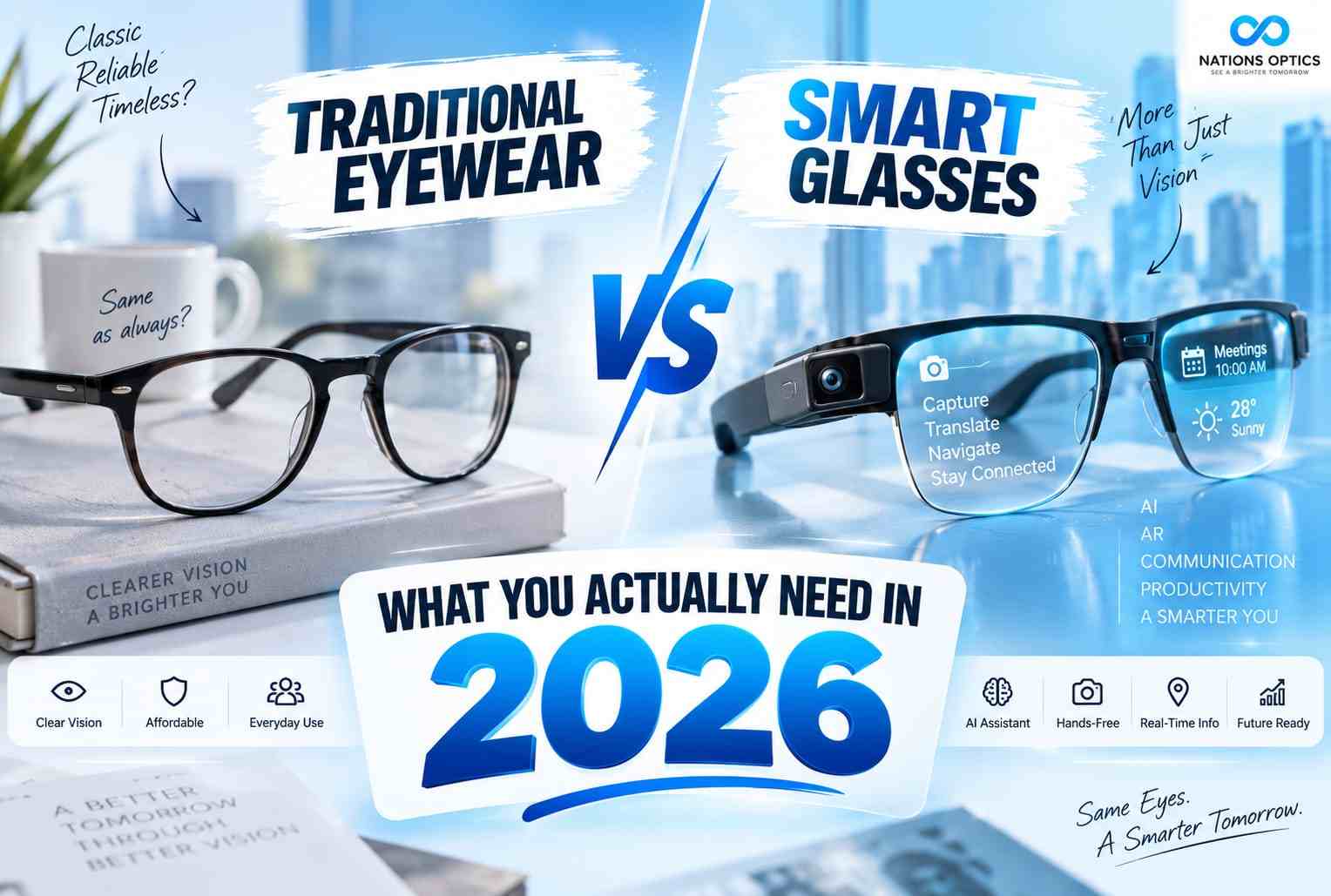
In this guide, we compare smart glasses vs traditional glasses, explain how smart eyewear differs from regular prescription glasses, discuss the benefits and disadvantages of smart glasses, and help you decide what type of eyewear makes sense for you in 2026.
What Are Smart Glasses?
Smart glasses are wearable devices designed to look and function partly like conventional eyewear while incorporating electronic technology.
Depending on the model, smart glasses may include features such as:
- AI-powered assistance
- Voice commands
- Built-in microphones
- Speakers or open-ear audio
- Cameras
- Bluetooth connectivity
- Smartphone integration
- Calls and messaging
- Music and podcasts
- Photography and video recording
- Navigation and other connected features
Some smart eyewear can also be fitted with prescription lenses, making them useful for people who require vision correction.
However, smart glasses are not automatically a replacement for every type of prescription eyewear. Their technology and prescription capabilities vary by product.
Smart Glasses vs. Traditional Glasses: What's the Difference?
The simplest difference between smart glasses and traditional glasses is their primary purpose. Traditional glasses are primarily designed to correct or protect vision, while smart glasses combine eyewear with technology.
| Feature | Smart Glasses | Traditional Eyewear |
|---|---|---|
| Vision correction | Depends on model and lenses | Yes, with prescription lenses |
| AI features | Available on some models | No |
| Voice assistant | Available on some models | No |
| Camera | Available on some models | No |
| Audio | Available on some models | No |
| Bluetooth | Usually available | No |
| Battery | Required for electronic features | Not required |
| Prescription compatibility | Depends on model | Widely available |
| Privacy considerations | Higher | Minimal |
| Technology dependence | Yes | No |
| Everyday simplicity | Lower | Higher |
This makes the decision less about which category is universally better and more about which eyewear matches your lifestyle and vision needs.
Smart Glasses vs. Regular Glasses: Which Is Better?
There is no universal winner in the smart glasses vs regular glasses debate.
If your main requirement is prescription vision correction, traditional prescription glasses remain one of the simplest and most dependable options.
If you want your eyewear to perform additional functions such as taking photos, answering calls, listening to audio, accessing an AI assistant, or interacting with your smartphone without reaching for it, smart glasses can provide additional convenience.
Traditional glasses solve a vision problem. Smart glasses can combine vision correction with technology.
What Are the Benefits of Smart Glasses?
The growing popularity of smart glasses is largely connected to their ability to integrate technology into something people already wear.
1. Hands-Free Technology
One of the biggest advantages of smart glasses is hands-free interaction. Instead of constantly reaching for your smartphone, compatible smart glasses can allow you to interact with certain functions using voice commands or built-in controls.
2. AI-Powered Features
Modern AI smart glasses can provide access to artificial intelligence features through voice interaction. Depending on the device and software, users may be able to ask questions, receive information, identify objects, interact with digital assistants, or perform other AI-related tasks.
3. Audio Without Traditional Headphones
Some smart glasses include built-in speakers that allow users to listen to calls, music, podcasts, or other audio. For people who do not want to wear traditional headphones or earbuds throughout the day, this can be convenient.
4. Cameras and Photography
Certain camera-enabled smart glasses allow users to capture photos and videos from a first-person perspective. However, camera-equipped eyewear also introduces privacy considerations that traditional glasses do not have.
5. Smartphone Connectivity
Many connected glasses communicate with a smartphone through Bluetooth and companion applications. This can extend smartphone functions to your eyewear and create a more hands-free experience.
What Are the Disadvantages of Smart Glasses?
1. Battery Dependence
Unlike traditional glasses, electronic smart glasses require power. The battery determines how long features such as audio, cameras, AI, or connectivity can be used.
2. Higher Cost
Adding electronics, sensors, cameras, microphones, speakers, batteries, and processors can make smart glasses more expensive than basic prescription glasses.
3. Privacy Concerns
Camera and microphone-equipped smart glasses raise privacy questions. People around you may be uncomfortable with recording capabilities, particularly in workplaces, schools, restaurants, or other private environments.
4. Weight and Comfort
Traditional eyewear has been optimized for comfortable daily wear for decades. Adding electronics can affect the weight, balance, thickness, or overall design of smart glasses.
5. Technology Can Become Outdated
Smart glasses depend on hardware and software. Technology changes quickly, meaning today's features may eventually become outdated. Traditional glasses are considerably less dependent on software updates, applications, operating systems, or battery technology.
Can Smart Glasses Replace Traditional Glasses?
This is one of the most important questions people ask when comparing smart glasses vs prescription glasses.
The answer is: sometimes, but not necessarily.
Some smart glasses support prescription lenses and can therefore serve as both technological devices and vision-correction eyewear.
However, not every smart glasses model supports every prescription, lens type, frame design, or optical requirement.
If you have a more complex prescription, progressive lenses, special lens requirements, or specific frame preferences, traditional prescription eyewear may offer a wider range of choices.
Important: Smart glasses should not automatically be considered a complete replacement for traditional eyewear. Always check prescription and lens compatibility before purchasing.
Can Smart Glasses Have Prescription Lenses?
Yes, some smart glasses can be ordered or fitted with prescription lenses. This is an important development because people who require corrective eyewear do not necessarily have to choose between technology and vision correction.
Before purchasing, check:
- Prescription range
- Lens compatibility
- Frame dimensions
- Lens material requirements
- Single-vision compatibility
- Progressive compatibility
- Pupillary distance requirements
- Optical fitting requirements
Smart Glasses With Prescription Lenses vs. Traditional Prescription Glasses
Smart glasses with prescription lenses can be attractive if you want technology integrated into your everyday eyewear.
Traditional prescription glasses remain attractive if you prioritize:
- Clear vision
- Lightweight comfort
- Simplicity
- Wide frame selection
- Lens customization
- Lower cost
- No charging
- No electronic maintenance
FIND YOUR PERFECT EYEWEAR
Need Prescription Glasses for Everyday Vision?
Whether you prefer classic traditional eyewear or want to explore the latest eyewear trends, start with glasses that match your vision needs, lifestyle, comfort, and budget. Explore prescription-friendly eyewear from Nations Optics and find a frame that's right for you.
Shop EyeglassesAre Smart Glasses Worth It in 2026?
So, are smart glasses worth it? For the right user, yes.
Smart glasses can be worth considering if you frequently use:
- Voice assistants
- AI tools
- Smartphone calls
- Music
- Navigation
- Photography
- Hands-free communication
- Wearable technology
Smart glasses may be particularly appealing to technology enthusiasts, travellers, content creators, professionals, and people who enjoy experimenting with new wearable devices.
But if you simply need dependable prescription eyewear for everyday vision correction, traditional glasses may provide better value.
The smartest question isn't “Are smart glasses better?” — it's “Will I actually use the smart features enough to justify the additional cost and complexity?”
Smart Glasses Pros and Cons
Advantages of Smart Glasses
- Hands-free technology
- AI-powered features
- Voice interaction
- Smartphone connectivity
- Built-in audio
- Camera capabilities on supported models
- Convenient access to digital services
- Some models support prescription lenses
Disadvantages of Smart Glasses
- Higher purchase price
- Battery dependence
- Electronic components
- Potential privacy concerns
- Technology can become outdated
- Limited compatibility with certain prescriptions
- Potentially greater weight
- Dependence on smartphones or apps
Benefits of Traditional Eyewear
Traditional eyewear may not have AI or Bluetooth, but its simplicity is one of its biggest strengths.
Reliable Vision Correction
Prescription glasses are designed primarily around optical correction. Whether you need correction for myopia, hyperopia, astigmatism, or another refractive error, appropriately prescribed lenses can provide the vision correction you need.
No Charging Required
Traditional glasses don't have batteries. You can wear them all day without worrying about charging levels, software updates, or electronic failures.
Wide Range of Styles
Traditional eyewear is available in numerous frame shapes, sizes, materials, and designs. From full-rim and semi-rimless designs to rimless frames, there are options for different face shapes, preferences, and prescriptions.
Easier Maintenance
Traditional glasses generally require basic cleaning and proper storage. There are no charging ports, companion applications, firmware updates, or electronic components to manage.
Often More Affordable
If your primary goal is prescription correction, traditional glasses can provide excellent value without paying extra for technology you may not use.
Smart Glasses or Normal Glasses: Which Should You Choose?
Choose Smart Glasses If You:
- Enjoy wearable technology.
- Want hands-free access to digital features.
- Regularly use voice assistants.
- Want built-in audio.
- Want camera functionality.
- Have a compatible prescription.
- Are co ```