Krishna's Peacock Feather: A Lesson in Bold Eyewear | Nations Optics
Sep 4, 2026
By Rahul Jain
0 comment(s)
Janmashtami Feature
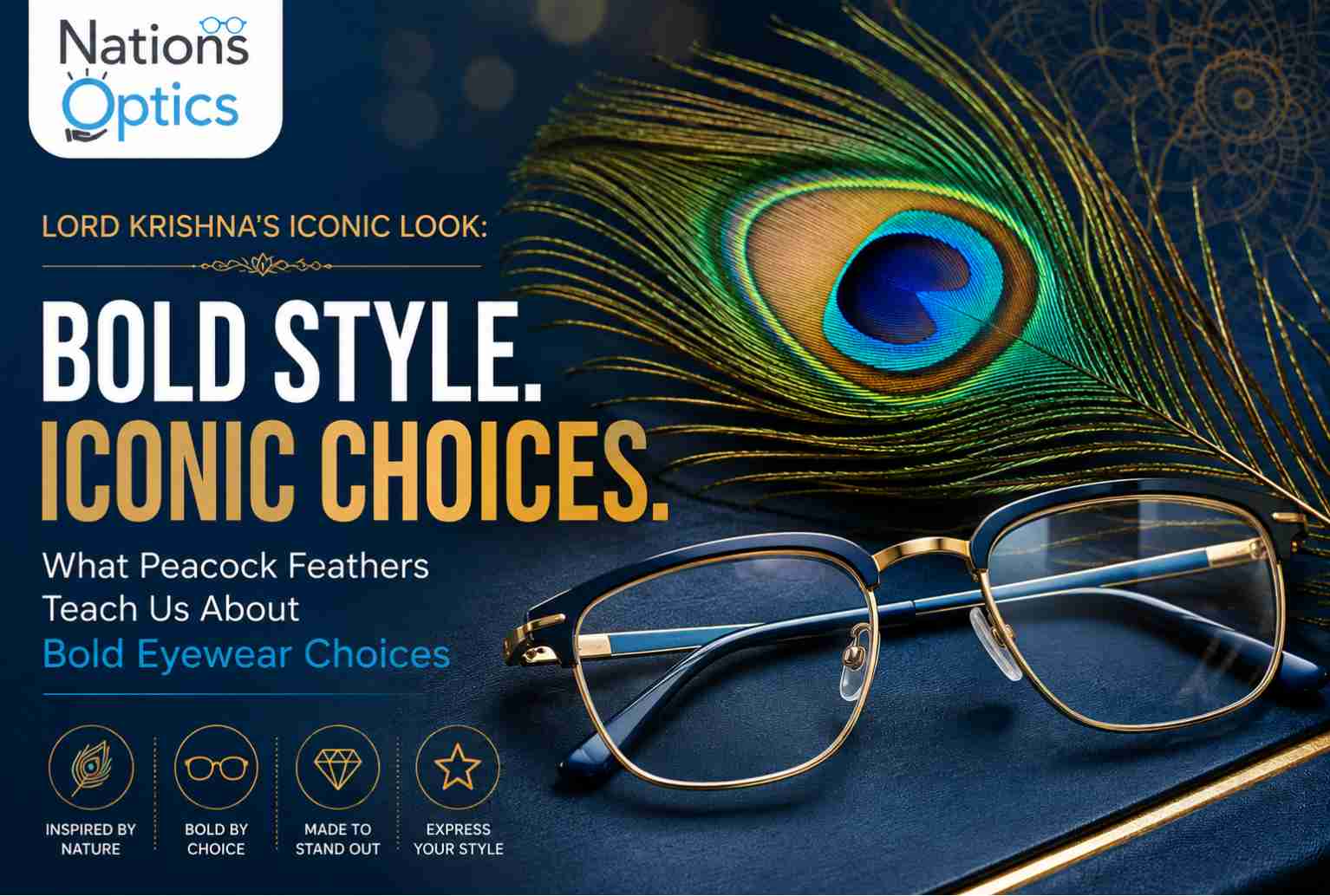
Lord Krishna's Iconic Look: What Peacock Feathers Teach Us About Bold Eyewear Choices
A tilt, a shimmer, a shape that never blends in — the peacock feather has been teaching a style lesson for centuries.
Every Janmashtami, one image returns to temples, homes, and hearts across the country: Krishna, flute in hand, a peacock feather tilted just so above his brow. It's one of the most recognizable silhouettes in Indian iconography — instantly identifiable, endlessly reproduced, and never boring.
That feather isn't an accessory. It's a statement. And it holds a surprisingly relevant lesson for anyone standing in front of a mirror trying on frames.
The Feather Was Never "Safe"
Krishna could have been depicted plainly. Instead, tradition gave him iridescent blue-greens, a dramatic tilt, and a shape that catches light from every angle. The peacock feather works because it doesn't try to blend in — it draws the eye upward, frames the face, and adds movement to an otherwise still image.
Eyewear does the same job for a face that most people underestimate. Frames aren't just a vision correction tool sitting quietly on your nose — they're the single most prominent accessory on your face, seen before anything else in a conversation. Treating that real estate as an afterthought is a missed opportunity.
Three Style Lessons From the Feather
1
Colour can be the whole point
The peacock feather's blue-green shimmer isn't subtle, and it isn't meant to be. If you've been reaching for the same black or tortoiseshell frame for years, consider what a genuinely rich colour — deep teal, emerald, or even a shifting iridescent finish — could do for your look. Bold colour on eyewear works the same way it does on the feather: it becomes your signature.
2
Asymmetry and angle create character
The feather is never placed dead-centre or perfectly straight — its tilt is what gives the image life. Similarly, frame shapes that break from strict symmetry (cat-eye angles, geometric edges, subtly asymmetric temples) tend to feel more alive on the face than perfectly round or perfectly square shapes.
3
Contrast makes a statement pop
Krishna's feather stands out precisely because it sits against simpler tones — skin, fabric, calm backgrounds. The same principle applies to frame selection: a bold frame works best when the rest of your styling is relatively understated, letting the eyewear do the talking.
"The right pair shouldn't just help you see clearly — it should look like you."
Jewel Tones Worth Trying
Jewel tones — sapphire, emerald, deep maroon — photograph beautifully and suit most skin tones better than people expect.
Sapphire
Emerald
Deep Maroon
Peacock Teal
Iridescent
Bringing Festival Boldness Into Everyday Eyewear
You don't need face paint or a flute to borrow this confidence. A few practical ways to channel it:
Three Ways to Start
- Try a colour you'd normally skip. Jewel tones photograph beautifully and suit most skin tones better than people expect.
- Consider a statement shape for one pair. Even if your daily frames stay classic, having one bold pair for festive days, celebrations, or photos adds range to your look.
- Let the frame lead. Pair bold eyewear with simpler clothing choices so the frame becomes the focal point, the way the feather becomes Krishna's.
A Festive Thought
Janmashtami celebrates a figure who was never afraid to stand out — playful, magnetic, unmistakably himself. That's not a bad philosophy for choosing eyewear either. The right pair shouldn't just help you see clearly; it should look like you, worn with the same quiet confidence as a feather that never needed to ask for attention.
This Janmashtami, from all of us at Nations Optics — here's to seeing clearly, and being seen boldly.
Find Your Statement Frame
Browse bold frames and festive eyewear collections at Nations Optics — jewel tones, geometric shapes, and everything in between.
Browse Bold FramesExclusive Offers
Sitewide
33%
OFF
Flat 33% off on all products
Already applied on every price · no coupon needed
Auto-applied
10%
OFF
On orders ₹1,200 – ₹1,799
No coupon needed · saves automatically
Auto-applied
15%
OFF
On orders ₹1,800 – ₹3,199
No coupon needed · saves automatically
Best Deal 🔥
20%
OFF
On orders above ₹3,200
No coupon needed · saves automatically
Pay Advance
₹50
SAVED
Pay advance amount at checkout
Flat ₹50 off · pay balance on delivery
Pay Full ✓
₹100
SAVED
Pay full amount at checkout
Maximum saving · instant confirmation
N
Nations Optics Assistant
● Online
👋 Hi! I'm your Nations Optics assistant. Ask me anything about lenses, frames, or prescriptions!