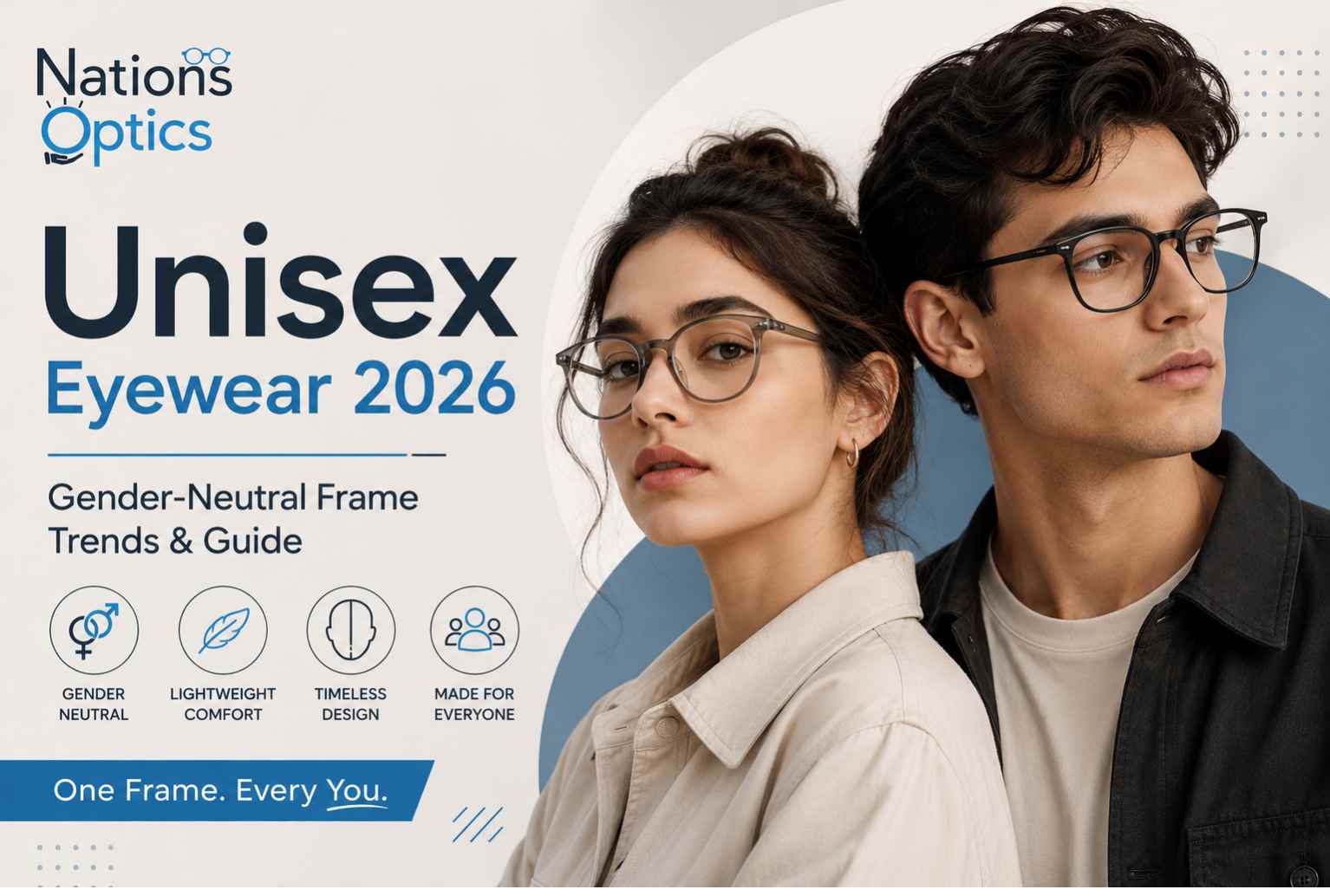
Unisex Eyewear 2026: Gender-Neutral Frame Trends & Guide
Aug 26, 2026
By Rahul Jain
0 comment(s)
Frame Trends · 2026
Gender-Neutral & Unisex Eyewear: The Trend Reshaping How Frames Are Designed
Fit, comfort, and personal style are replacing "men's" and "women's" as the questions that actually matter when choosing glasses.
Eyewear is no longer defined by rigid categories like "men's glasses" and "women's glasses." Today, more people are choosing frames based on fit, comfort, face shape, personal style, and individuality rather than traditional gender labels.
This shift has made unisex and gender-neutral eyewear increasingly popular — from classic round and rectangular frames to modern geometric and aviator styles, today's designs are becoming more versatile and adaptable for different faces and personal aesthetics. In 2026, gender-neutral eyewear isn't simply about creating a "neutral" look — it's about giving people more freedom to choose glasses that match their personality.
35.6%
Estimated share of India's eyewear market's gender segmentation held by the unisex segment in 2025, according to recent market research — making this far more than a niche fashion concept.
Unisex Frames
Face Shape Guide
Frame Measurements
India Eyewear Market
Personal Style
What Is Unisex Eyewear?
Unisex eyewear refers to glasses and frames designed to be suitable for people regardless of gender. Instead of creating separate designs based primarily on traditional assumptions about men's and women's fashion, gender-neutral glasses focus on characteristics that matter to almost everyone:
- Comfortable proportions
- Practical frame dimensions
- Versatile shapes
- Balanced styling
- Lightweight construction
- Everyday wearability
- Personal expression
The important point is that gender-neutral eyewear does not mean boring eyewear. Modern genderless designs can be bold, oversized, geometric, minimalist, vintage-inspired, or highly contemporary — increasingly emphasizing shape, scale, personality, and fit rather than gender labels.
Why Are Gender-Neutral Glasses Becoming So Popular?
The growth of gender-neutral glasses reflects a larger change in how people approach fashion. Consumers increasingly want products that fit their individual identity rather than forcing them into predefined categories. Eyewear is particularly suited to this shift because the most important considerations are often practical:
- Does the frame fit comfortably?
- Is the frame width appropriate?
- Does the shape complement the face?
- Is it suitable for everyday use?
- Does it match the person's style?
- Is it compatible with their prescription?
These factors have little to do with gender. Current eyewear discussions increasingly emphasize fit, proportions, and individual style over traditional men's-versus-women's classifications.
What Makes a Pair of Glasses Gender Neutral?
There isn't one specific frame shape that automatically makes glasses gender neutral. Instead, gender-neutral eyewear generally focuses on balanced proportions, versatile styling, and comfortable fit.
1
Balanced Frame Proportions
A frame that isn't excessively narrow or excessively wide can work across different facial structures when the measurements are appropriate. But "unisex" doesn't mean "one size fits everyone" — your frame width, bridge width, and temple length still need to work with your individual facial measurements.
2
Versatile Shapes
Some shapes naturally lend themselves to unisex frames because they complement a wide variety of personal styles — round, rectangular, square, soft-square, browline, geometric, and aviator-inspired frames are among the most popular examples highlighted in current trend coverage.
3
Clean Design
Many genderless glasses use clean lines without excessive decorative details, letting them transition easily between office wear, casual outfits, college looks, business settings, and evening occasions.
4
Comfortable Materials
A good pair of unisex optical frames should prioritize comfort as much as style. Depending on the design, TR90, acetate, stainless steel, and lightweight metals each offer different combinations of durability, flexibility, and feel — important for anyone wearing prescription glasses throughout the day.
The Most Popular Unisex Glasses Shapes in 2026
Round
A timeless, relaxed appearance suited to vintage-inspired styling, a creative look, softer visual lines, and a distinctive everyday frame — particularly useful for balancing stronger or more angular facial features.
Rectangular
Among the most versatile everyday choices — a structured, professional, modern look with strong facial definition. Useful visual contrast for people with rounder facial features.
Square
A confident, contemporary appearance that transitions well between professional and casual environments.
Geometric
Hexagonal, octagonal, and other geometric shapes are increasingly popular for people wanting something more distinctive — proof that removing gender labels doesn't mean removing personality.
Browline
A stronger upper frame with a lighter lower section, striking a balance between vintage and contemporary styling.
Aviator-Inspired
Long crossing traditional gender boundaries. Modern versions feature thinner profiles, updated proportions, and lighter construction.
How to Choose the Best Unisex Glasses for Your Face Shape
Choosing unisex glasses shouldn't mean ignoring fit — face shape and frame proportions become even more important when you're choosing glasses without relying on gender categories.
Round Faces
Angular styles like rectangular, square, or geometric frames add definition and visual contrast.
Square Faces
Round or oval frames soften stronger jawlines and more angular contours.
Oval Faces
Works with a wide variety of shapes — round, square, rectangular, geometric, or browline — as long as width and proportion stay appropriate.
Heart-Shaped Faces
Aviator, oval, and selected geometric frames help create visual balance against a wider forehead and narrower chin.
Diamond-Shaped Faces
Oval, round, or browline styles often complement the cheekbones and soften angular features.
Face-shape guidelines should be treated as starting points rather than strict rules — fit, comfort, and personal preference remain essential.
Why Frame Measurements Matter More Than Gender Labels
When shopping for gender-neutral glasses online, don't select a frame simply because it says "unisex" — look at the actual measurements. Important ones include lens width, bridge width, temple length, overall frame width, and lens height. If you already own a pair of glasses that fits comfortably, comparing its measurements with a new frame is one of the most useful ways to narrow down your options.
A frame designed for everyone still needs to fit you. This is one of the biggest advantages of a fit-based approach to eyewear: instead of asking whether a frame is "for men" or "for women," you can ask whether its dimensions are right for your face.
One common misconception is that unisex eyewear means everyone should wear exactly the same frame size — that's not true. People have different face widths, nose bridge shapes, temple lengths, pupillary distances, and facial proportions. A frame can be gender neutral while still being available in different sizes, so always check product measurements and compare them with your existing glasses whenever possible.
Why Unisex Eyewear Works for Everyday Life
One of the strongest benefits of unisex eyewear is versatility — a well-designed frame can work across different parts of your lifestyle.
For Work
Clean rectangular, soft-square, or minimalist metal frames.
For College
Round, geometric, or contemporary frames add personality without becoming difficult to style.
For Casual Wear
Classic round, square, and browline glasses work with everyday clothing.
For Statement Looks
Oversized and geometric genderless eyeglasses create a stronger fashion-forward appearance.
The Role of Color in Gender Neutral Eyewear
Although the unisex trend often focuses on shape and proportions, color also influences how versatile a frame feels.
Black
Tortoiseshell
Transparent
Brown
Neutral Metallic
However, gender-neutral doesn't mean frames must be limited to neutral colors — bold colors can be completely unisex too. The most important consideration is whether the frame fits your personal style and wardrobe.
Unisex Eyewear in India
The movement toward unisex eyewear in India is especially interesting given how rapidly the Indian eyewear market is expanding. Recent market research estimates India's eyewear market reached approximately USD 11.83 billion in 2026 and identifies unisex eyewear as the leading gender segment, with a 35.6% share in 2025 — making unisex glasses far more than a niche fashion concept here.
Indian consumers increasingly shop for eyewear based on style, comfort, affordability, frame fit, prescription requirements, online availability, and personal preference. The growth of online eyewear shopping also makes it easier for consumers to explore frames beyond traditional categories.
How to Buy Unisex Glasses Online
1
Check the Frame Dimensions
Look at lens width, bridge width, temple length, and overall frame width.
2
Consider Your Face Shape
Use it as a styling guide, not an absolute rule.
3
Think About Your Lifestyle
Ask yourself where you'll wear the glasses most often.
4
Choose the Right Material
Lightweight materials matter for extended daily wear.
5
Consider Your Prescription
Make sure the selected frame is compatible with your required lens type.
6
Prioritize Comfort
A fashionable frame isn't useful if it constantly slips or presses against your temples.
7
Choose Your Style, Not a Label
Don't reject a frame simply because it appears in a men's or women's category — if it fits and you like it, it's the right frame for you.
Unisex Prescription Glasses: Style Meets Vision Correction
Unisex prescription glasses combine the practical requirements of corrective eyewear with modern, versatile frame design. For prescription eyewear, frame selection should consider both aesthetics and optical requirements — prescription strength, lens size, frame construction, lens material, pupillary distance, and frame fit can all influence the final result. The best unisex optical frames combine appearance, comfort, and appropriate lens compatibility, not just the most fashionable look.
Frequently Asked Questions
What is unisex eyewear?
Glasses designed to be suitable for people regardless of gender, generally emphasizing versatile styling, balanced proportions, comfort, and personal expression.
Are unisex glasses suitable for everyone?
They can work for people across genders, but that doesn't mean every frame fits every face — frame width, bridge size, temple length, and overall proportions still matter.
Are gender neutral glasses in style in 2026?
Yes. Gender-neutral and genderless eyewear are notable 2026 trends, with designers increasingly emphasizing fit, versatility, personality, and style over traditional gender categories.
Can men and women wear the same glasses?
Yes — when the frame dimensions and style suit them. Gender labels matter less than proper fit and personal preference.
What face shape is best for unisex glasses?
There's no single best face shape — round faces often pair well with angular frames, square faces can work well with rounded styles, and oval faces accommodate many different shapes.
Is unisex eyewear popular in India?
Yes — the unisex segment represented an estimated 35.6% of India's eyewear gender segmentation in 2025, making it the leading gender category in the market.
Are unisex prescription glasses available?
Yes. Many optical frames can be fitted with prescription lenses, provided the frame is suitable for your required lens type and prescription.
Eyewear Should Be About You
At Nations Optics, eyewear is about more than following categories or fashion labels. Your glasses don't need to fit a label — they need to fit you.
- Versatile round, rectangular & geometric shapes
- Balanced proportions across face shapes
- Detailed frame measurements for a confident fit
- Prescription-ready lens compatibility
- Styles for every occasion and personal aesthetic
Unisex eyewear is changing the way people think about glasses. Instead of asking "Are these men's glasses or women's glasses?" a better question is: "Do these glasses fit me, suit my face, and reflect my style?" That simple shift puts the focus where it belongs — on the person wearing the frame.
From round unisex glasses and rectangular frames to geometric, browline, and aviator-inspired designs, today's gender-neutral eyewear offers more choice than ever. Your style has no label. Your eyewear doesn't need one either.
Exclusive Offers
Sitewide
33%
OFF
Flat 33% off on all products
Already applied on every price · no coupon needed
Auto-applied
10%
OFF
On orders ₹1,200 – ₹1,799
No coupon needed · saves automatically
Auto-applied
15%
OFF
On orders ₹1,800 – ₹3,199
No coupon needed · saves automatically
Best Deal 🔥
20%
OFF
On orders above ₹3,200
No coupon needed · saves automatically
Pay Advance
₹50
SAVED
Pay advance amount at checkout
Flat ₹50 off · pay balance on delivery
Pay Full ✓
₹100
SAVED
Pay full amount at checkout
Maximum saving · instant confirmation
N
Nations Optics Assistant
● Online
👋 Hi! I'm your Nations Optics assistant. Ask me anything about lenses, frames, or prescriptions!