
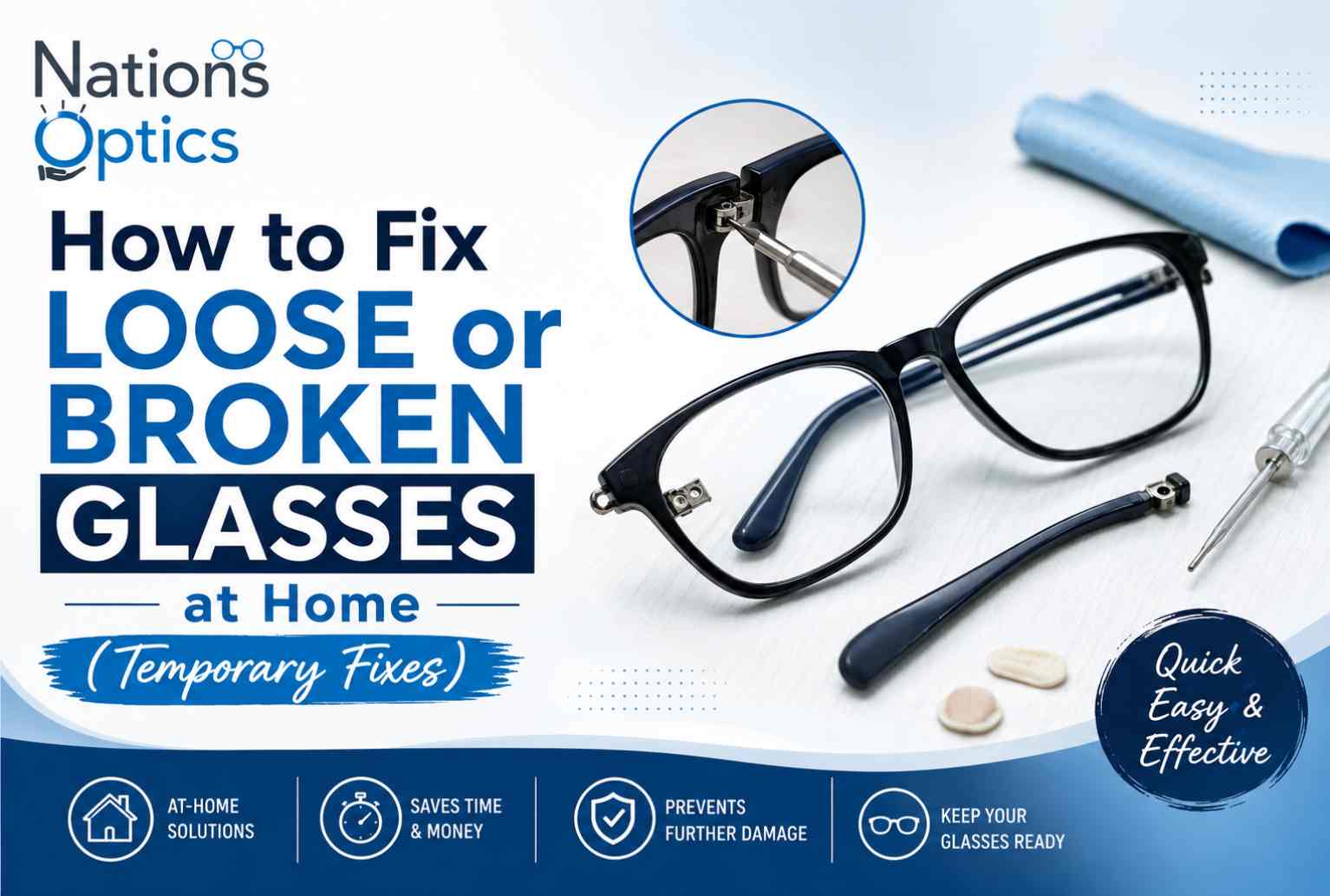
How to Fix Broken Glasses at Home: Temporary Fixes
Aug 24, 2026
By Rahul Jain
0 comment(s)
Quick Fixes & Repair
How to Fix Loose or Broken Glasses at Home (Temporary Fixes)
A loose screw or a snapped temple doesn't have to mean going without your glasses until you can see an optician. Here's what actually works — and what to avoid.
Glasses tend to break at the worst possible moment — a screw works loose right before a meeting, a nose pad falls off mid-commute, or a temple snaps and you're stuck without a backup pair. While a professional repair or replacement is always the best long-term fix, there are safe, temporary ways to get your glasses functional again until you can get proper help.
This guide covers the most common glasses problems, simple at-home fixes for each, and — just as importantly — what not to try, since some "quick fixes" can make the damage worse or even scratch your lenses.
Loose Screws
Broken Temples
Missing Nose Pads
Bent Frames
Temporary Repairs
A Basic At-Home Glasses Repair Kit
Most temporary fixes only need a few small, inexpensive items. Worth keeping these on hand if you wear glasses regularly:
Mini eyeglass screwdriver set
Small pair of tweezers
Clear tape
Superglue (for emergencies only)
A spare screw or two
Microfiber cloth
Paperclip
A mini screwdriver set is the single most useful thing to own — most loose-hinge problems are solved with a two-second turn of the right tiny screwdriver.
Common Problems and Temporary Fixes
1
Loose or Wobbly Hinge Screws
The most common glasses problem, and the easiest to fix.
- Use a mini eyeglass screwdriver to gently tighten the hinge screw on each side.
- Turn clockwise in small increments — don't overtighten, which can strip the tiny threads.
- If the screw keeps loosening on its own, add a tiny dot of clear nail polish to the threads before the final tightening — it acts as a mild thread-locker.
Don't use a regular screwdriver — it's too large and will strip the screw head instantly.
2
Missing Screw
If a screw has fallen out entirely and you don't have a replacement on hand:
- Straighten a small paperclip and cut it slightly longer than the missing screw.
- Thread it carefully through the hinge hole by hand.
- Bend the excess length flat against the frame so it doesn't catch or scratch you.
This is purely a stopgap — replace it with an actual eyeglass screw as soon as possible, since a paperclip won't hold as securely over time.
3
Broken or Snapped Temple (Arm)
A cracked or fully snapped temple is trickier, but wearable in the short term:
- Clean both broken surfaces gently with a dry cloth to remove any dust or oil.
- Apply a small amount of superglue to one broken edge only.
- Hold the two pieces together firmly for the full cure time listed on the glue (usually 30–60 seconds), then leave undisturbed for several hours before wearing.
- Reinforce the glued area with a small wrap of clear tape once fully cured, for extra hold.
Don't use superglue near the lenses or hinge mechanism — it can fog or damage lens coatings and gum up moving parts.
4
Missing or Loose Nose Pad
A missing nose pad affects comfort and how the glasses sit on your face:
- Check whether the nose pad arm itself is intact — if so, a replacement silicone nose pad (widely available cheaply) simply clips or screws on.
- If the pad arm is bent out of position, gently bend it back by hand in small increments until it sits evenly.
- As a temporary comfort fix with no pad available, a small folded piece of soft fabric or a silicone earbud tip can be wedged onto the pad arm.
5
Bent Frame or Uneven Fit
If your glasses sit crooked or one side rides higher than the other:
- For metal frames, gently and slowly bend the misaligned section back into place with both hands, working in very small adjustments.
- For plastic or acetate frames, briefly warm the bent area with a hairdryer on low heat from a safe distance, which makes the material slightly more flexible, then carefully reshape it and hold until it cools.
- Check both temples against a flat surface (a table) to see whether they sit level — this makes it easier to spot exactly where the misalignment is.
Don't use direct heat sources like a stove or lighter — acetate can warp permanently or scorch within seconds.
6
Light Lens Scratches
Deep scratches generally can't be fixed at home, but very light surface marks sometimes respond to gentle treatment:
- Clean the lens thoroughly first with a lens-safe solution and microfiber cloth — what looks like a scratch is sometimes just residue.
- If a faint mark remains, a small amount of white non-gel toothpaste rubbed gently in a circular motion for a few seconds, then rinsed off immediately, can sometimes reduce the visibility of very shallow scratches.
This works only on light, shallow surface marks — it won't fix scratches through a coated lens and can make matters worse if overused.
What Not to Do
- Don't use super glue on or near lenses
- Don't apply direct flame or stove heat to frames
- Don't over-tighten tiny screws
- Don't use duct tape as a long-term fix
- Don't force a badly bent frame back quickly
- Don't ignore a fix that keeps failing repeatedly
- Don't use household glass cleaner on lenses
- Don't wear glasses with a cracked lens for long periods
When a Temporary Fix Isn't Enough
At-home fixes are meant to buy you time, not replace a proper repair. Get professional help if:
- The frame keeps coming apart despite repeated fixes
- A lens has cracked or chipped, not just scratched
- The hinge mechanism itself is damaged, not just the screw
- The frame no longer sits evenly even after adjustment attempts
- You notice new discomfort, headaches, or pressure points after a repair
- The glasses are your only pair and you rely on them daily
Worth knowing: Many opticians will do minor adjustments — tightening screws, realigning frames, replacing nose pads — free or at very low cost, even if you didn't buy the glasses from them. It's often worth a quick visit before attempting a bigger DIY fix on a frame you want to keep long-term.
Preventing Future Breakages
- Always store glasses in a hard case when not wearing them
- Use both hands when putting on or removing glasses
- Avoid placing glasses lens-down on any surface
- Check and tighten screws every few weeks as routine maintenance
- Keep glasses away from extreme heat, including car dashboards
- Clean regularly to prevent buildup that stresses hinges and pads
Frequently Asked Questions
Can I fix a broken glasses temple myself?
A clean break can often be temporarily repaired with superglue and reinforced with clear tape, but this is a short-term fix — a professional repair or replacement is recommended for long-term use.
What do I do if my glasses screw keeps falling out?
Tighten it with a proper mini eyeglass screwdriver, and consider a small dot of clear nail polish on the threads to help it hold. If it keeps loosening, the threads may be worn and need a replacement screw.
Is superglue safe to use on glasses?
It can work for a temple break in a pinch, but should never be used near lenses or hinge mechanisms, since it can damage coatings or gum up moving parts.
How do I fix glasses that sit crooked on my face?
Metal frames can often be gently bent back into alignment by hand; acetate frames may need brief, gentle heat from a hairdryer to become flexible enough to reshape safely.
Can toothpaste really remove scratches from lenses?
It can sometimes reduce the visibility of very light, shallow surface marks, but it won't fix deeper scratches and isn't a reliable general repair method.
When should I stop trying a DIY fix and see a professional?
If the problem keeps recurring, involves a cracked lens or damaged hinge mechanism, or the glasses are your only daily pair, it's worth getting proper professional repair rather than continuing to patch it yourself.
Sometimes a Quick Fix Isn't Enough
If your glasses need more than a temporary patch, Nations Optics can help with proper repairs, replacement parts, or a new pair built to last.
- Professional frame adjustments and repairs
- Replacement nose pads, screws & parts
- Durable frame material options
- Guidance on repair vs replacement
- A wide range of frames if it's time for a new pair
A loose screw, a missing nose pad, or even a cracked temple doesn't have to mean going without your glasses. With a few basic tools and a little patience, most common problems can be temporarily fixed at home well enough to get you through until you can have them properly repaired or replaced.
Just remember: these are stopgap solutions, not permanent ones. If a fix keeps failing, or the damage is more serious than a loose screw or a clean break, it's time to see a professional rather than keep patching the same problem.
Exclusive Offers
Sitewide
33%
OFF
Flat 33% off on all products
Already applied on every price · no coupon needed
Auto-applied
10%
OFF
On orders ₹1,200 – ₹1,799
No coupon needed · saves automatically
Auto-applied
15%
OFF
On orders ₹1,800 – ₹3,199
No coupon needed · saves automatically
Best Deal 🔥
20%
OFF
On orders above ₹3,200
No coupon needed · saves automatically
Pay Advance
₹50
SAVED
Pay advance amount at checkout
Flat ₹50 off · pay balance on delivery
Pay Full ✓
₹100
SAVED
Pay full amount at checkout
Maximum saving · instant confirmation
N
Nations Optics Assistant
● Online
👋 Hi! I'm your Nations Optics assistant. Ask me anything about lenses, frames, or prescriptions!