
Why New Glasses Feel Weird at First & How Long Adjustment Takes
Jun 18, 2026
By Rahul Jain
0 comment(s)
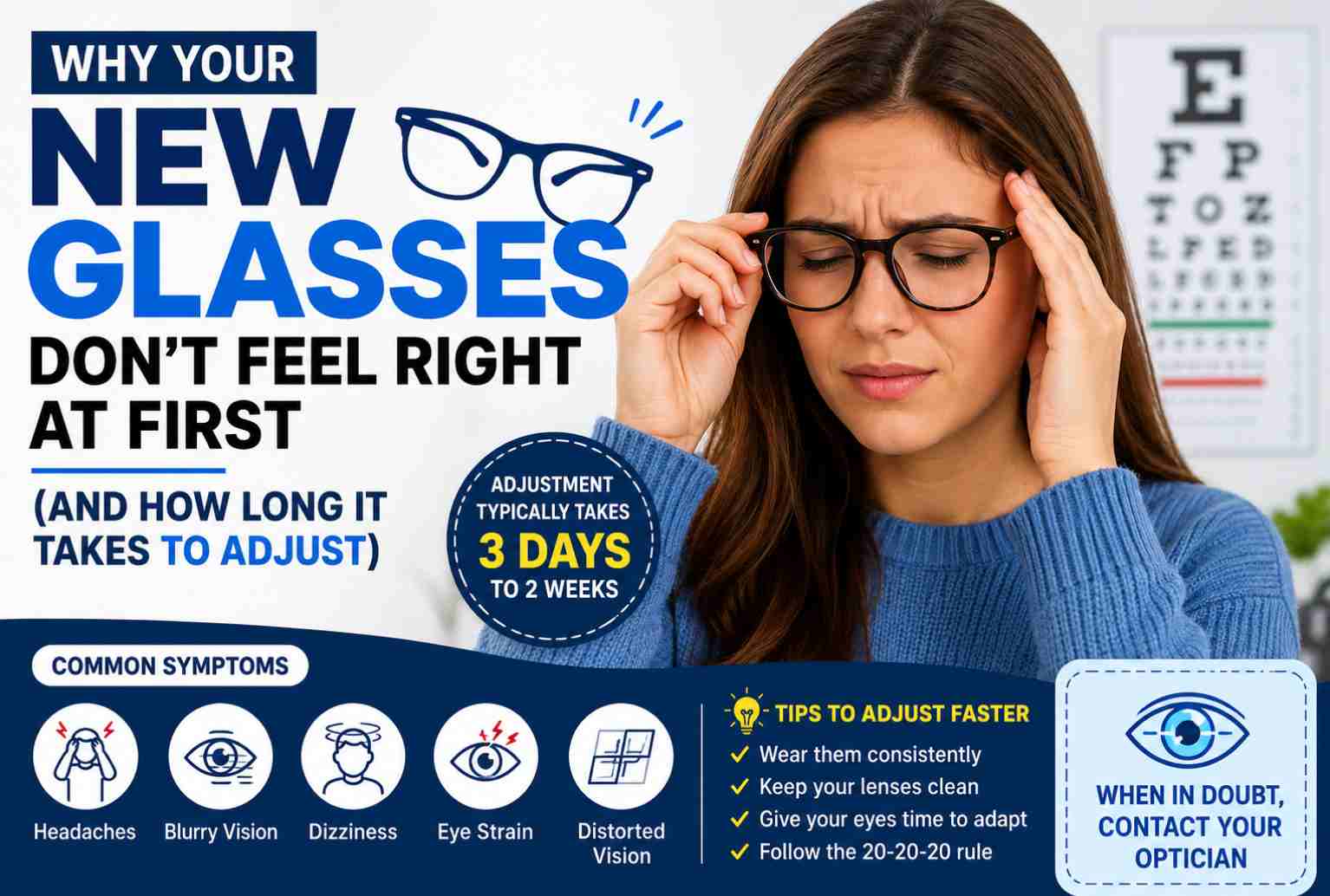
Why Your New Glasses Don't Feel Right at First (And How Long It Takes to Adjust)
Understanding the new glasses adjustment period, common symptoms, and expert tips to adapt comfortably and confidently.
Getting a new pair of prescription glasses should make your vision clearer and more comfortable. However, many people are surprised when their new glasses initially feel strange. Some experience mild headaches, dizziness, blurry vision, eye strain, or even a sensation that the floor is slanted. If you've recently purchased prescription eyewear and are wondering why things don't feel quite right, you're not alone.
The good news is that in most cases, these symptoms are completely normal and temporary. Your eyes and brain need time to adapt to the updated prescription, lens design, or frame positioning. Understanding this adjustment process can help you avoid unnecessary worry and make the transition much smoother.
Why Do New Glasses Feel Different?
Your eyes and brain work together as a visual team. When you receive a new prescription, the information reaching your eyes changes. Even if the prescription change is small, your brain must learn to process visual information differently.
This is especially common when:
- You have a stronger or weaker prescription than before.
- You are wearing glasses for the first time.
- You switched from single vision lenses to progressive lenses.
- Your astigmatism correction has changed.
- You changed lens materials or lens coatings.
- Your frames sit differently on your face.
Important: Feeling unusual during the first few days does not necessarily mean there is a problem with your prescription. Most people simply need time to adjust.
Common Symptoms During the New Glasses Adjustment Period
1. Mild Headaches
Headaches are one of the most common complaints after getting new prescription glasses. Your eye muscles may be working differently as they adapt to the updated correction. These headaches are usually temporary and improve within a few days.
2. Slight Blurriness
Objects may appear slightly blurry or distorted initially, especially when looking at the edges of your lenses. Your brain needs time to interpret visual information through the new prescription.
3. Dizziness or Lightheadedness
Changes in lens power can affect depth perception and balance. Some people report feeling dizzy or slightly off-balance during the first few days.
4. Eye Strain
Your eyes may feel tired more quickly than usual. This happens because they are learning to focus using a different prescription.
5. Distorted Peripheral Vision
This is particularly common with progressive lenses and higher prescriptions. Objects near the edge of your vision may initially seem curved or distorted.
How Long Does It Take to Adjust to New Glasses?
The adjustment period varies depending on the type of prescription and individual visual habits. Most people adapt faster than they expect.
| Type of Glasses | Typical Adjustment Period |
|---|---|
| First-Time Glasses Wearers | 3 to 7 Days |
| Minor Prescription Changes | 1 to 5 Days |
| Strong Prescription Changes | 1 to 2 Weeks |
| Bifocal Lenses | 1 to 2 Weeks |
| Progressive Lenses | 2 to 4 Weeks |
While some users adapt within hours, others may need a couple of weeks. The key is consistency. Wearing your glasses regularly helps your brain adapt more quickly.
Why Progressive Lenses Usually Take Longer
Progressive lenses are designed to provide multiple viewing distances in one lens. Unlike traditional single vision lenses, progressives contain different prescription zones for distance, intermediate, and near vision.
Because your eyes must learn where each viewing zone is located, the adjustment process can take longer. During the first week, you may notice:
- A swimming effect while walking.
- Difficulty locating the reading zone.
- Slight distortion on the lens edges.
- The need to move your head more than your eyes.
These experiences are usually temporary and improve as your visual system becomes familiar with the lens design.
Tips to Adjust to New Glasses Faster
Wear Them Consistently
One of the biggest mistakes people make is switching back to their old glasses. Doing so can slow down the adaptation process. Wear your new glasses consistently unless advised otherwise by your optician.
Keep Them Clean
Smudges and fingerprints can make adjustment more difficult. Clean your lenses regularly using a microfiber cloth and lens cleaner.
Give Yourself Time
Avoid judging your new glasses after only a few hours. Most adaptation occurs gradually over several days.
Move Your Head, Not Just Your Eyes
This is especially helpful with progressive lenses. Turning your head toward objects instead of relying on peripheral vision can improve comfort during the adjustment period.
Take Regular Breaks
If you spend long hours using digital devices, follow the 20-20-20 rule: every 20 minutes, look at something 20 feet away for 20 seconds.
When New Glasses May Indicate a Problem
Although most adjustment symptoms are normal, some signs should not be ignored.
Contact your optician if:
- Symptoms persist beyond two weeks.
- You experience severe headaches.
- Double vision occurs.
- One eye sees significantly worse than the other.
- The glasses feel physically uncomfortable on your face.
- Vision remains consistently blurry.
Sometimes a prescription entry error, incorrect pupillary distance (PD), or lens manufacturing issue may require professional review.
Can Lens Material Affect Adaptation?
Yes. Different lens materials can slightly change how visual information reaches your eyes.
For example, Polycarbonate lenses are lightweight and impact-resistant, while CR39 lenses provide excellent optical clarity. If you are switching between lens materials, your eyes may notice subtle differences initially.
However, these differences are usually minor and become unnoticeable after a short adjustment period.
First-Time Glasses Wearers: What to Expect
If this is your first pair of prescription glasses, the experience may feel particularly unusual. Many first-time wearers notice:
- Sharper details than before.
- Objects appearing larger or smaller.
- Increased awareness of visual depth.
- Eye fatigue during the first few days.
These changes are signs that your vision correction is working. Your brain is simply learning to process a clearer visual image than it was receiving previously.
Frequently Asked Questions
Is it normal to feel dizzy with new glasses?
Yes. Mild dizziness is common during the first few days, especially with stronger prescription changes or progressive lenses.
Should I switch back to my old glasses?
Generally no. Consistent use of your new glasses helps your brain adapt faster.
Why do floors look tilted with my new glasses?
This often occurs with stronger prescriptions or progressive lenses and usually improves within a few days to weeks.
How long should I wait before contacting my optician?
If discomfort continues beyond two weeks or symptoms are severe, schedule a professional review.
Final Thoughts
Adjusting to new glasses is a normal part of improving your vision. Whether you're wearing glasses for the first time, updating your prescription, or switching to progressive lenses, temporary discomfort does not necessarily indicate a problem.
Most people adapt within a few days, while more significant prescription changes may require a couple of weeks. By wearing your glasses consistently and giving your eyes time to adjust, you'll soon enjoy the full benefits of clearer, more comfortable vision.
Need New Prescription Lenses or Expert Guidance?
At Nations Optics, we provide high-quality prescription lenses, progressive lenses, bifocals, and customized eyewear solutions designed for clear vision and long-term comfort. If you're unsure whether your glasses are adjusting normally, our eyewear experts are here to help.
Explore Prescription LensesExclusive Offers
Sitewide
33%
OFF
Flat 33% off on all products
Already applied on every price · no coupon needed
Auto-applied
10%
OFF
On orders ₹1,200 – ₹1,799
No coupon needed · saves automatically
Auto-applied
15%
OFF
On orders ₹1,800 – ₹3,199
No coupon needed · saves automatically
Best Deal 🔥
20%
OFF
On orders above ₹3,200
No coupon needed · saves automatically
Pay Advance
₹50
SAVED
Pay advance amount at checkout
Flat ₹50 off · pay balance on delivery
Pay Full ✓
₹100
SAVED
Pay full amount at checkout
Maximum saving · instant confirmation
N
Nations Optics Assistant
● Online
👋 Hi! I'm your Nations Optics assistant. Ask me anything about lenses, frames, or prescriptions!