
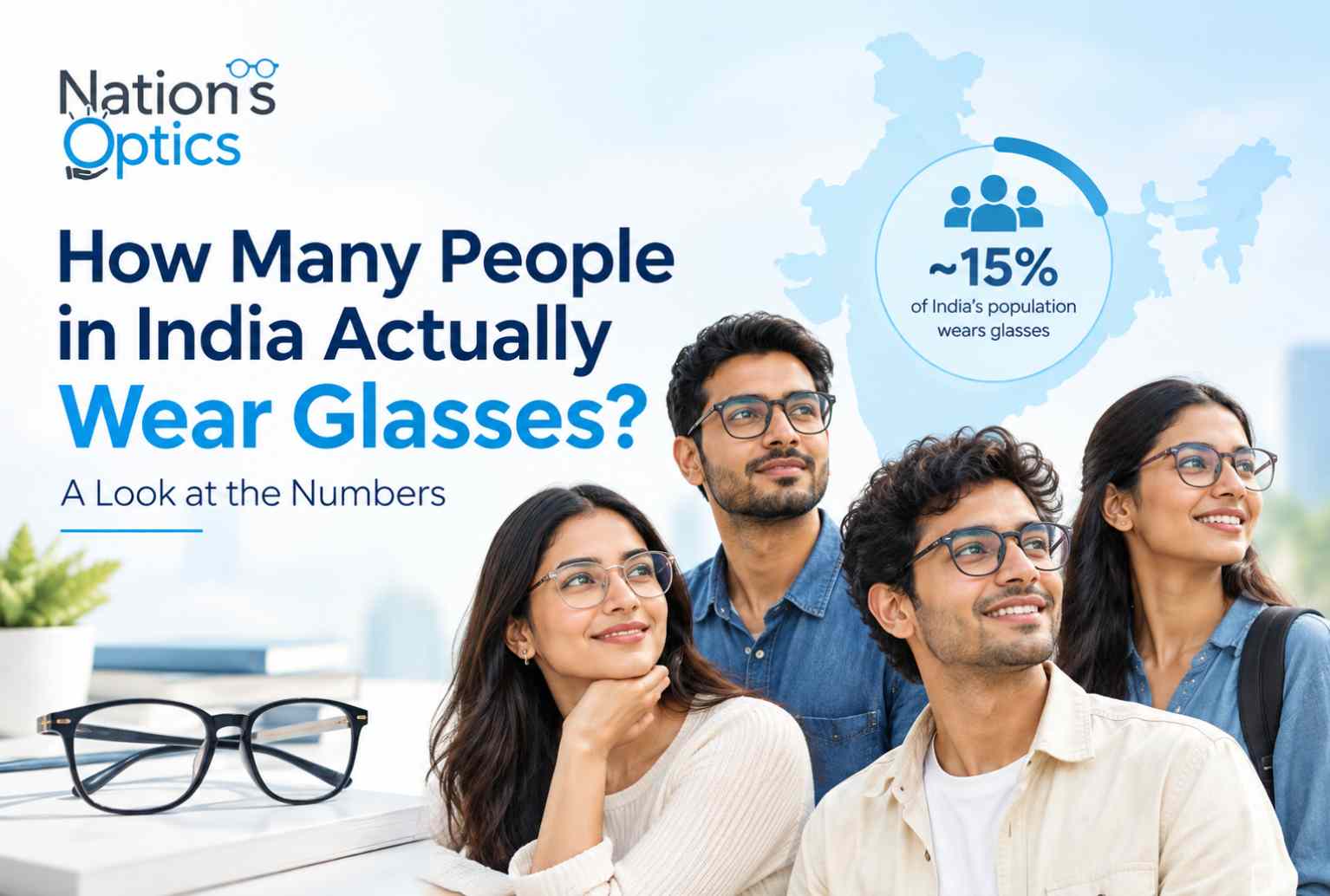
How Many People in India Actually Wear Glasses? A Look at the Numbers
Sep 16, 2026
By Rahul Jain
0 comment(s)
About the data in this post: Figures below are drawn from published market research, peer-reviewed studies, and survey data, cited at each point and summarized in the sources section near the end. Market size and prevalence estimates vary between research firms and are periodically revised — treat the numbers here as informed estimates, not exact counts, and check the original source for the latest figures.
Data & Trends
How Many People in India Actually Wear Glasses? A Look at the Numbers
India's eyewear market is worth billions — but the share of people who actually wear glasses tells a more complicated story.
Walk down any street in urban India and glasses seem to be everywhere — in classrooms, offices, and on nearly every third face on a crowded train. But how many people in India actually wear glasses, and how does that compare to the rest of the world? The numbers turn out to be more interesting, and more revealing about access and affordability, than a simple headcount.
Market Size Myopia Trends Global Comparison Children's Eye Health Access Gap
The Headline Numbers
~29%
of people in India wear glasses
Global vision correction data, 2025
$11.09B
size of India's eyewear market in 2025
IMARC Group market report
45.2%
of the eyewear market is spectacles
IMARC Group, 2025 product mix
7.5%
myopia prevalence in children aged 5–15 (4-decade average)
Meta-analysis, Indian Journal of Ophthalmology
Figures are estimates from different studies and time periods; see the sources section below for details.
How India Compares Globally
One widely cited estimate puts the share of people wearing glasses in India at around 29% — noticeably lower than many developed economies, despite similar or even higher rates of refractive error in the population.
Japan
73.9%
Belgium
70%
Switzerland
67.7%
United States
64%
Germany
63.5%
United Kingdom
59%
India
~29%
Share of population wearing prescription glasses, by country, based on published survey and industry estimates for 2025.
The gap isn't about need — it's about access. Refractive errors like myopia and hyperopia occur at broadly similar rates across populations worldwide. Lower glasses-wearing rates in countries like India generally reflect gaps in access, affordability, and awareness — not a lower underlying need for vision correction.
Why Isn't Everyone Who Needs Glasses Wearing Them?
A population-based study conducted in Andhra Pradesh offers a revealing window into this gap. Among people whose vision was significantly impaired without correction, only about a third were currently using the spectacles they needed.
1
Cost and Affordability
In the same study, being unable to afford a replacement pair after losing or breaking glasses was cited by roughly a third of urban respondents as a reason for not currently wearing them.
2
Incorrect Prescriptions
A meaningful share of non-use was attributed to glasses that no longer matched the person's actual prescription — a reminder that access to glasses and access to accurate, updated prescriptions are two different problems.
3
Comfort and Fit
Discomfort was another commonly cited reason for discontinuing use — a reminder that a correct prescription alone isn't enough if the frame itself doesn't fit well.
4
Awareness and Perceived Need
Some people, particularly in rural areas, reported not feeling a need to wear their glasses consistently — pointing to a broader awareness gap about the everyday benefits of consistent vision correction.
The Rise of Myopia in Indian Children
While overall glasses-wearing rates in India remain comparatively low, the trend among children tells a different and increasingly urgent story: myopia is climbing fast in urban India.
1999
4.44% myopia prevalence among urban children aged 5–15
2019
21.15% myopia prevalence among the same urban age group
2030
~38% projected regional (South Asia) myopia prevalence
2050
~48–53% projected myopia prevalence in urban India / South Asia
Sources: prediction modeling study on urban Indian children (1999–2019 data with projections to 2050); Holden et al. regional projections for South Asia.
Why This Trend Matters
Researchers link the sharp rise in childhood myopia to increased near-work — extended reading, screen time, and reduced outdoor activity. One North India study found children studying or reading more than 5 hours a day, watching over 2 hours of television daily, and playing video games were all significantly more likely to be myopic, while more time spent on outdoor play was associated with lower myopia risk.
The same study found only about a quarter of myopic children were wearing appropriate spectacles — highlighting that detecting myopia and correcting it with glasses remain two separate challenges.
Factors Linked to Higher Myopia Risk in Children
Studying/reading >5 hrs/dayTV viewing >2 hrs/dayVideo/mobile gamingPrivate school enrollmentFamily history of myopiaHigher socio-economic statusLimited outdoor playtimeUrban residence
Based on the North India Myopia Study (NIM Study), a school-based screening of nearly 9,900 children in Delhi.
India's Eyewear Market Is Growing Fast — Faster Than Wearing Rates Alone Explain
India's eyewear market was estimated at roughly $11.09 billion in 2025 and is projected to reach around $20.86 billion by 2034 — a compound annual growth rate of about 6.66%. Spectacles hold the largest share of the product mix at 45.2%, while the unisex segment leads gender-based purchasing at 35.6%, and North India represents the largest regional share at 32.5%.
This growth reflects more than just population increase — rising fashion consciousness, e-commerce expansion, digital eye strain awareness, and increasing adoption of premium lens coatings (photochromic, blue-light filtering, anti-reflective) are all cited as significant growth drivers, alongside the simple rise in diagnosed vision disorders.
Sources Referenced in This Post
- IMARC Group — India Eyewear Market Report, 2025 figures and forecast to 2034
- Global vision correction data compilation, 2025 (country-level glasses-wearing percentages)
- Population-based study of spectacles use in Southern India, Indian Journal of Ophthalmology, 2002
- Meta-analysis of myopia prevalence in Indian school children across four decades (1980–2020), PLOS One
- Time trends and 2050 prediction model for urban Indian childhood myopia, published study (1999–2019 data)
- North India Myopia Study (NIM Study), Delhi school screening of ~9,884 children
- Holden et al., regional myopia projections for South Asia, Ophthalmology journal
Frequently Asked Questions
What percentage of people in India wear glasses?
Estimates put the figure at around 29%, based on global vision correction survey data — lower than many developed economies despite comparable rates of refractive error.
Why is India's glasses-wearing rate lower than countries like Japan or the US?
The gap is generally attributed to access, affordability, and awareness factors rather than a lower underlying need for vision correction — refractive errors occur at broadly similar rates across populations.
Is myopia increasing among children in India?
Yes, significantly in urban areas. One study found myopia prevalence in urban Indian children aged 5–15 rose from 4.44% in 1999 to 21.15% in 2019, with projections suggesting continued increases in the coming decades.
How big is India's eyewear market?
Estimated at approximately $11.09 billion in 2025, with projected growth to around $20.86 billion by 2034 according to market research from IMARC Group.
What's the most common reason people don't wear glasses they need?
Research points to a mix of factors, including cost and affordability, incorrect or outdated prescriptions, discomfort, and in some cases not perceiving a strong need to wear them consistently.
What increases a child's risk of myopia in India?
Studies link higher myopia risk to extended near-work (reading, screens), limited outdoor playtime, private school enrollment, family history, and higher socio-economic status, among other factors.
Closing the Gap, One Pair at a Time
At Nations Optics, we believe access to an accurate prescription and comfortable eyewear shouldn't be complicated or unaffordable.
- Accurate, professionally guided prescriptions
- A wide range of frames across budgets
- Kids' eyewear built for comfort and durability
- Guidance on lens options for growing prescriptions
- Support for regular prescription updates
India's eyewear story is really two stories at once: a market growing quickly on the back of rising incomes, fashion awareness, and digital lifestyles, and a persistent access gap where a meaningful share of people who need vision correction still aren't getting it — especially among children, where myopia rates are climbing fastest.
Closing that gap starts with the basics: regular eye exams, accurate prescriptions, and glasses people can actually afford and want to wear every day.
Exclusive Offers
Sitewide
33%
OFF
Flat 33% off on all products
Already applied on every price · no coupon needed
Auto-applied
10%
OFF
On orders ₹1,200 – ₹1,799
No coupon needed · saves automatically
Auto-applied
15%
OFF
On orders ₹1,800 – ₹3,199
No coupon needed · saves automatically
Best Deal 🔥
20%
OFF
On orders above ₹3,200
No coupon needed · saves automatically
Pay Advance
₹50
SAVED
Pay advance amount at checkout
Flat ₹50 off · pay balance on delivery
Pay Full ✓
₹100
SAVED
Pay full amount at checkout
Maximum saving · instant confirmation
N
Nations Optics Assistant
● Online
👋 Hi! I'm your Nations Optics assistant. Ask me anything about lenses, frames, or prescriptions!