
How to Spot Fake or Low-Quality Glasses Online: Buyer's Guide
Sep 18, 2026
By Rahul Jain
0 comment(s)
Smart Buying Guide
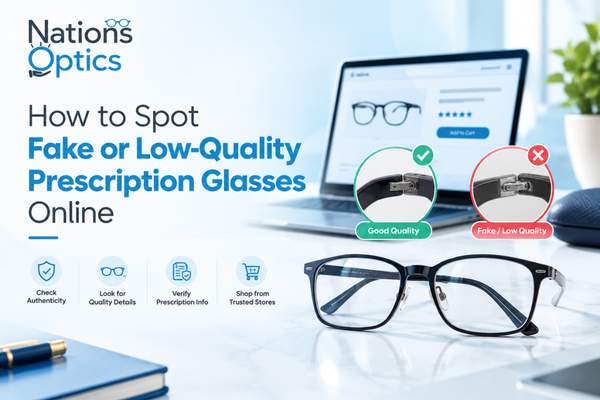
How to Spot Fake or Low-Quality Prescription Glasses Online
A great-looking product photo doesn't guarantee an accurate lens or a durable frame. Here's how to tell the difference before you buy.
Buying prescription glasses online is more convenient than ever, but it also means judging quality entirely through a screen — no trying the frame on, no feeling the material, no way to check the lens by eye before it arrives. Most online eyewear sellers are legitimate, but the space does include listings with vague specifications, inflated quality claims, and lenses that don't actually match the prescription submitted.
This guide covers the practical warning signs worth checking before you buy, what to look for once your glasses arrive, and how to protect yourself if something isn't right.
Seller Red Flags Lens Verification Frame Quality Checks Return Policies Prescription Accuracy
Why This Matters More Than It Might Seem
Unlike most online purchases, prescription glasses are a medical device you wear on your face for hours a day. A frame that's slightly lower quality than advertised is an inconvenience. A lens that's inaccurately ground to your prescription can cause genuine headaches, eye strain, and discomfort — and you may not immediately realize the glasses themselves are the cause.
Red Flags to Watch For Before You Buy
1
No Specific Material Information
Listings that describe a frame only as "premium quality" or "durable material" without naming the actual material (acetate, TR90, stainless steel, titanium) are a warning sign. Legitimate sellers can tell you exactly what a frame is made of.
2
No Clear Return or Exchange Policy
A seller unwilling to accept returns on a prescription mismatch or fit issue is asking you to take on all the risk of an online purchase — a policy worth checking before you order, not after a problem shows up.
3
Prices That Seem Disconnected From Any Real Cost
An extremely low price on a "designer" frame, especially one using a well-known brand name, is one of the clearest signs of a counterfeit or unlicensed product. Genuine branded eyewear carries real licensing costs that a deeply discounted price usually can't reflect.
4
No Way to Verify the Seller
Look for a real business address, contact information, and some form of business registration or GST details on an Indian site. A storefront with no verifiable identity is harder to hold accountable if something goes wrong.
5
No Option to Submit or Verify Your Prescription Properly
A legitimate prescription eyewear seller should have a clear, structured way to enter or upload your prescription (SPH, CYL, AXIS, ADD, PD) — not just a generic size selector with no prescription fields at all.
6
Reviews That Feel Generic or Suspiciously Uniform
A wall of five-star reviews using near-identical phrasing, with no mention of specific details (fit, prescription accuracy, delivery time), can be a sign of manipulated or purchased reviews rather than genuine customer feedback.
Counterfeit "Designer" Frames: What to Check
Signs of a Genuine Branded Frame
- Price consistent with the brand's known retail range
- Clear, crisp branding and engraving, not blurry or uneven
- Sold by an authorized retailer or the brand's own platform
- Comes with proper packaging, authenticity card, or documentation
- Model name/number matches the brand's official catalog
Signs of a Counterfeit
- Price dramatically below the brand's typical range
- Logo slightly misspelled, misaligned, or inconsistently placed
- Sold through an unverified third-party marketplace listing
- No authenticity documentation or generic packaging
- Seller cannot answer specific questions about the model
Once Your Glasses Arrive: What to Check
Compare the Prescription
Hold your original prescription next to the order confirmation and check that SPH, CYL, AXIS, and ADD values match exactly — a simple data-entry error is more common than most people expect.
Check Vision Clarity
Wear the glasses for a short period in different lighting. Persistent blur, distortion, or discomfort beyond a normal brief adjustment period is worth flagging to the seller.
Inspect the Lens Surface
Look for visible waviness, bubbles, or inconsistent thickness across the lens — these usually indicate a poor-quality lens blank or rushed manufacturing.
Test the Hinges
Open and close the temples a few times. They should move smoothly with slight resistance — not feel loose, floppy, or stiff and scratchy.
Check the Frame Finish
Run a finger along the edges for rough spots, uneven paint, or visible mold lines — signs of lower manufacturing quality control.
Verify Branding Details
For a branded frame, compare the logo, engraving, and any serial numbers against official images from the brand's own website.
When to Contact the Seller Immediately
- The prescription values don't match what you submitted
- Vision remains significantly blurry beyond a normal adjustment period
- The lens shows visible defects, waviness, or bubbles
- The frame arrived damaged, warped, or with a broken hinge
- Branding details don't match the brand's official references
- The item received doesn't match what was ordered
How to Protect Yourself When Buying Online
1
Buy from sellers with a verifiable business identity — a real address, contact details, and ideally business registration information available on the site.
2
Read the return and warranty policy before ordering, not after a problem appears — know exactly what's covered and for how long.
3
Keep your original prescription and order confirmation so you can compare them directly against what arrives.
4
Pay through trackable, protected methods where possible, which typically offer more recourse than direct bank transfers to unfamiliar sellers.
5
Take clear photos immediately upon arrival, especially if you notice any defect, so you have documentation if a dispute becomes necessary.
A quick gut check: If a listing can't clearly answer basic questions — what the frame is made of, what the return policy covers, how prescription accuracy is verified — that's often a more reliable signal than the price or the product photos alone.
Frequently Asked Questions
How can I tell if online prescription glasses are legitimate before buying?
Check for specific material information, a clear return policy, verifiable seller/business details, and a proper prescription entry process — vague listings and unusually low prices on "designer" items are common warning signs.
How do I know if my glasses arrived with the correct prescription?
Compare the SPH, CYL, AXIS, and ADD values on your order confirmation directly against your original prescription. If vision remains significantly blurry beyond a normal short adjustment period, contact the seller.
How can I spot a counterfeit designer frame?
Check for a price consistent with the brand's known range, crisp and correctly placed branding, purchase through an authorized retailer, and proper packaging or authenticity documentation.
What should I check on the physical frame when it arrives?
Test the hinges for smooth movement, inspect the frame finish for rough edges or mold lines, and check the lens surface for waviness, bubbles, or inconsistent thickness.
Is a very low price always a sign of a fake or low-quality product?
Not always, but it's a signal worth combining with other checks — especially for branded items, where a price far below the typical retail range is one of the strongest indicators of a counterfeit.
What should I do if my glasses don't match what I ordered?
Contact the seller immediately with photos and your original order details, and refer to the return or warranty policy you reviewed before purchasing.
Buy With Confidence, Not Guesswork
At Nations Optics, we believe in transparency — clear material information, verified prescriptions, and a straightforward warranty on every pair.
- Clear, specific frame material information
- Structured prescription entry & verification
- 6-month warranty on every order
- Verifiable business details & GST registration
- Responsive support for any order issue
Most online eyewear sellers are honest, and buying glasses online is genuinely convenient once you know what to check. The goal isn't to be suspicious of every listing — it's to know the handful of signals that reliably separate a trustworthy seller from a risky one, and to check your glasses carefully the moment they arrive rather than assuming everything matches what you ordered.
A little diligence upfront — reading the return policy, checking material specifics, comparing your prescription line by line — takes a few minutes and can save you from weeks of discomfort or a difficult refund process later.
Exclusive Offers
Sitewide
33%
OFF
Flat 33% off on all products
Already applied on every price · no coupon needed
Auto-applied
10%
OFF
On orders ₹1,200 – ₹1,799
No coupon needed · saves automatically
Auto-applied
15%
OFF
On orders ₹1,800 – ₹3,199
No coupon needed · saves automatically
Best Deal 🔥
20%
OFF
On orders above ₹3,200
No coupon needed · saves automatically
Pay Advance
₹50
SAVED
Pay advance amount at checkout
Flat ₹50 off · pay balance on delivery
Pay Full ✓
₹100
SAVED
Pay full amount at checkout
Maximum saving · instant confirmation
N
Nations Optics Assistant
● Online
👋 Hi! I'm your Nations Optics assistant. Ask me anything about lenses, frames, or prescriptions!