
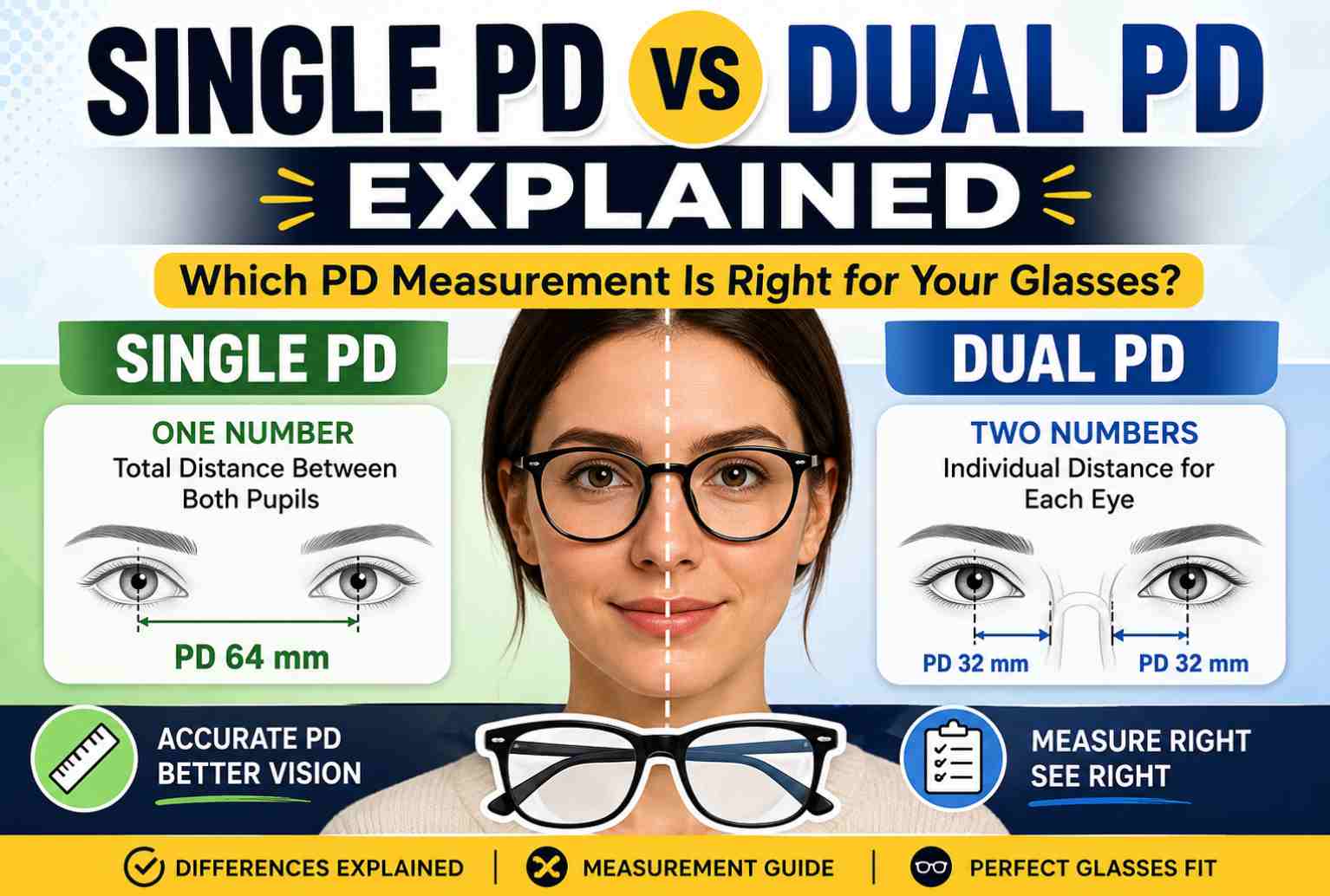
Single PD vs Dual PD Explained | Which PD Is Right?
Jun 29, 2026
By Rahul Jain
0 comment(s)
Lens & Prescription Guide
Single PD vs Dual PD: Which Measurement Is Right for Your Glasses?
A single number on one prescription, two on another. Here's what Pupillary Distance really means, when each type is used, and how the right measurement keeps your vision sharp and comfortable.
If you're ordering prescription glasses online, you've probably come across the terms single PD vs dual PD and wondered what they mean. Many people feel confused when they see a single number on one prescription and two separate numbers on another. Understanding these measurements matters, because your Pupillary Distance (PD) plays a major role in how accurately your lenses sit in front of your eyes.
Whether you're buying everyday prescription glasses, reading glasses, or progressive lenses, knowing the difference helps you avoid blurry vision, eye strain, and discomfort. An incorrect PD can affect how your lenses perform even when your prescription is perfectly accurate.
01What Is Pupillary Distance (PD)?
Before comparing the two types, it helps to understand what Pupillary Distance actually is.
Pupillary Distance (PD) is the distance, measured in millimetres, between the centres of your pupils. It tells the optical lab exactly where to place the optical centre of each lens so it aligns perfectly with your eyes.
How PD is measured
e.g. 64 mmThe distance between the centres of both pupils, measured in millimetres.
When your PD is measured correctly, light enters your eyes through the ideal part of the lens for the sharpest, most comfortable vision. If it's off, even by a few millimetres, your glasses can cause:
Eye strainBlurred visionHeadachesDifficulty focusingPoor depth perceptionGeneral discomfort
That's why PD is considered just as important as your prescription power when ordering eyewear.
02Why PD Matters for Prescription Glasses
Many people assume their prescription alone is enough, but that's only part of the equation.
Your prescription determines how strong your lenses need to be. Your PD determines where those lenses should be positioned. Without an accurate PD, even the best-quality lenses can't deliver their full performance.
- Improves visual clarity
- Reduces eye fatigue
- Ensures comfortable long-term wear
- Improves lens alignment
- Enhances overall vision quality
This is especially important when buying online, where the lab relies entirely on the measurements you provide.
03What Is Single PD?
A Single PD is one number that represents the total distance between the centres of both pupils.
It assumes both eyes sit symmetrically, so each lens centre is placed equally from the bridge of the frame.
Single PD = 64 mmSingle PD is the most commonly used measurement for:
- Single vision glasses
- Distance prescription glasses
- Reading glasses
- Everyday eyewear and standard lenses
How Single PD Is Measured
An optician measures from the centre of one pupil directly to the centre of the other using a PD ruler or a digital pupillometer. Some online tools let you measure your own PD with a smartphone camera or printable ruler, though professional measurements are generally more accurate.
54–74 mmTypical adult range
43–58 mmTypical child range
The exact figure varies with each person's facial structure and eye position.
When Single PD Is Used
Single PD works well for many people because it's a quick, accurate measurement for standard glasses. It's commonly recommended for daily-wear glasses, computer glasses, reading glasses, distance correction, and basic prescription lenses.
If your eyes are evenly positioned relative to the centre of your nose, Single PD often gives excellent results. Some individuals have slight facial asymmetry, however, and a single number may not centre each lens perfectly, which is why many opticians prefer Dual PD for higher-precision eyewear.
Benefits of Single PD
- Easy to measure and simple to understand
- Widely accepted by online eyewear retailers
- Suitable for most single-vision prescriptions
- Accurate for everyday prescription glasses
- Faster ordering process
A Common Misconception
Many people believe Single PD is less accurate than Dual PD, but that's not always true. For standard prescriptions and everyday eyewear, Single PD delivers excellent results when measured correctly. The important factor isn't which type you use, it's whether the measurement itself is accurate.
04Single PD vs Dual PD at a Glance
| Single PD | Dual PD | |
|---|---|---|
| Format | One total number (e.g. 64 mm) | Two numbers, one per eye (e.g. 32 / 32) |
| Assumes | Eyes are symmetrical | Accounts for facial asymmetry |
| Best for | Single-vision & everyday glasses | Progressives & high-precision lenses |
| Measurement | Pupil centre to pupil centre | Each pupil to the centre of the nose |
| Ease | Quick and simple | More precise, slightly more involved |
Not sure of your PD?
Use the Nations Optics AI face-measurement tool to capture your PD accurately from your phone, no ruler required.
Measure My PDExclusive Offers
Sitewide
33%
OFF
Flat 33% off on all products
Already applied on every price · no coupon needed
Auto-applied
10%
OFF
On orders ₹1,200 – ₹1,799
No coupon needed · saves automatically
Auto-applied
15%
OFF
On orders ₹1,800 – ₹3,199
No coupon needed · saves automatically
Best Deal 🔥
20%
OFF
On orders above ₹3,200
No coupon needed · saves automatically
Pay Advance
₹50
SAVED
Pay advance amount at checkout
Flat ₹50 off · pay balance on delivery
Pay Full ✓
₹100
SAVED
Pay full amount at checkout
Maximum saving · instant confirmation
N
Nations Optics Assistant
● Online
👋 Hi! I'm your Nations Optics assistant. Ask me anything about lenses, frames, or prescriptions!