Off-the-Shelf Readers vs. Prescription Glasses: Full Power Guide | Nations Optics
Sep 28, 2026
By Rahul Jain
0 comment(s)
Buying Guide
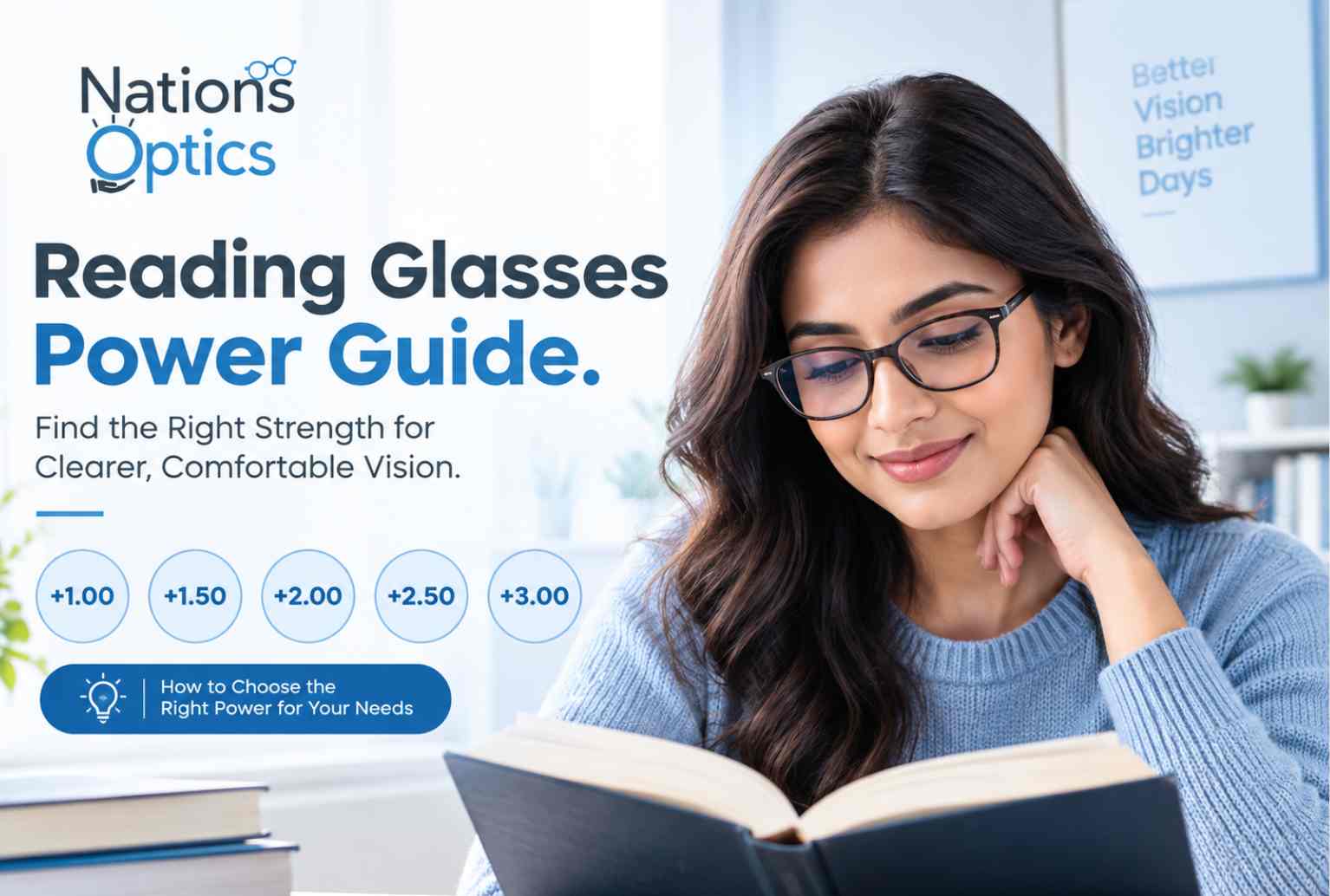
Reading Glasses Power Guide: Can You Really Buy Off-the-Shelf Readers Instead of a Prescription?
Pharmacy "readers" are cheap, instant, and everywhere. But are they actually the same as a proper prescription — and when do they stop being a safe shortcut?
If you've started holding your phone a little further away or squinting at restaurant menus, you've probably noticed the racks of pre-packaged reading glasses near pharmacy checkout counters — usually labeled with a simple number like +1.00, +1.50, or +2.50. They're inexpensive, need no appointment, and you can try them on right there in the store.
That convenience raises an obvious question: do you actually need a proper eye examination and a prescription, or can off-the-shelf readers do the job just as well? The honest answer is: it depends on what's causing your near-vision difficulty — and off-the-shelf readers are a reasonable fit for some people, but not for everyone.
Presbyopia Off-the-Shelf Readers Prescription Glasses Buying Guide
What Off-the-Shelf Reading Glasses Actually Are
Off-the-shelf readers are mass-produced glasses with a single, uniform lens power in both lenses — labeled with numbers like +1.00 through +3.50. They're designed to magnify close-up text and objects, which is why they're commonly used by people experiencing presbyopia, the natural, age-related decline in the eye's ability to focus on nearby objects that typically begins in the 40s.
Because both lenses carry the exact same power, they work only if your two eyes need roughly the same amount of correction for near vision, and if you have no other underlying vision issues that also need correcting.
Off-the-Shelf Readers vs. Prescription Reading Glasses
Convenient, Limited
Off-the-Shelf Readers
- Same power in both lenses
- No eye exam required to purchase
- Only corrects magnification for near vision
- Does not correct astigmatism
- Cannot account for different prescriptions between your two eyes
- Low cost, widely available, easy to replace
Accurate, Personalized
Prescription Reading Glasses
- Individual power for each eye, matched to your exact measurements
- Based on a comprehensive eye examination
- Can correct astigmatism alongside near-vision power
- Accounts for your specific pupillary distance (PD) for visual comfort
- Can catch underlying eye-health issues during the exam
- Costs more but is tailored to your eyes specifically
When Off-the-Shelf Readers Are a Reasonable Choice
1
Your Eyes Need Similar Correction
If both eyes need roughly the same amount of magnification for near tasks and you don't have astigmatism, a uniform-power reader can work reasonably well.
2
You Want a Backup Pair
Many people keep an inexpensive pair of readers at their desk, in the car, or in a bag as a convenient backup to their primary prescription glasses.
3
Occasional, Short-Term Use
For occasional tasks — reading a menu, checking a label — off-the-shelf readers can be a practical, low-commitment option.
When off-the-shelf readers are not a good substitute:
- If you have astigmatism, which off-the-shelf readers cannot correct
- If your two eyes need noticeably different powers
- If you also have a distance-vision prescription (nearsightedness or farsightedness) that needs correcting alongside near vision
- If you experience persistent headaches, eye strain, or blurred vision even after trying different reader strengths
- If you haven't had an eye examination recently and your symptoms could reflect an underlying eye-health issue rather than simple presbyopia
How to Choose a Reader Power (If You Go Off-the-Shelf)
Reading-glasses power is usually chosen through trial and error at the point of purchase — trying on a few strengths and picking the one that lets you read comfortably at a normal distance. As a general reference point, many people in their 40s start around +1.00 to +1.50, while those in their 60s and beyond often need +2.00 to +2.50 or higher. This varies significantly from person to person, so treat any general chart as a starting point, not a rule.
| Approximate Age Range | Commonly Used Starting Power* |
|---|---|
| 40–45 | +1.00 to +1.25 |
| 46–50 | +1.50 |
| 51–55 | +1.75 to +2.00 |
| 56–60 | +2.25 |
| 61+ | +2.50 and above |
*Approximate and for general reference only — individual needs vary. An eye examination gives you an accurate, personalized power.
A simple in-store test: Hold reading material at your normal, comfortable reading distance and try a few powers until text looks sharp without eye strain or headache. If nothing feels comfortable, or you need a much stronger power than expected, that's a signal to get a proper eye exam rather than keep guessing.
Why a Proper Eye Exam Still Matters
Even if off-the-shelf readers seem to work fine for you, a comprehensive eye examination does more than just determine a lens power. It can detect early signs of conditions like glaucoma, cataracts, or macular degeneration — many of which don't cause obvious symptoms in their early stages. Presbyopia is extremely common and generally not a serious condition on its own, but it's still worth ruling out other causes when your near vision changes, especially if the change feels sudden or significant.
An eye exam also gives you your correct pupillary distance (PD) and confirms whether your two eyes actually need the same power — details that off-the-shelf readers simply can't account for.
Frequently Asked Questions
Can wearing the wrong reader power damage my eyes?
Wearing an incorrect power is unlikely to cause permanent damage, but it can cause discomfort, headaches, or eye strain. If a power doesn't feel right, try a different strength or consult an eye-care professional rather than pushing through discomfort.
Why do off-the-shelf readers sometimes cause headaches?
This can happen if the power doesn't match your actual near-vision need, if your two eyes need different powers, if you have uncorrected astigmatism, or if the frame's pupillary distance doesn't align well with your own — all things a proper prescription accounts for.
Can I use off-the-shelf readers if I already wear prescription glasses for distance?
Generally, off-the-shelf readers aren't a good fit here, since you'd need both your distance correction and near correction addressed together — usually through bifocals, progressives, or a dedicated prescription reading pair.
At what age do most people start needing reading glasses?
Presbyopia commonly becomes noticeable in the early-to-mid 40s for most people, though the exact age varies. It typically continues to progress gradually into your 60s.
Is it bad to keep using the same reader power for years?
Since presbyopia tends to progress gradually, most people need to increase their reading power every few years. If your current readers no longer feel sharp, it's worth checking whether you need a stronger power or a full eye exam.
The Bottom Line
Off-the-shelf reading glasses can be a genuinely useful, low-cost option for straightforward, symmetrical presbyopia with no other complicating factors. But they're a general approximation, not a personalized solution — and they can't correct astigmatism, differing prescriptions between your eyes, or any underlying eye-health concern. If your near-vision difficulty is new, worsening, or not fully resolved by trying a few off-the-shelf powers, a comprehensive eye exam and a proper prescription are the more reliable path.
Get Reading Glasses Made for Your Exact Prescription
Upload your prescription and find reading glasses fitted to your specific power, PD, and frame preference at Nations Optics.
Shop Prescription Reading GlassesExclusive Offers
Sitewide
33%
OFF
Flat 33% off on all products
Already applied on every price · no coupon needed
Auto-applied
10%
OFF
On orders ₹1,200 – ₹1,799
No coupon needed · saves automatically
Auto-applied
15%
OFF
On orders ₹1,800 – ₹3,199
No coupon needed · saves automatically
Best Deal 🔥
20%
OFF
On orders above ₹3,200
No coupon needed · saves automatically
Pay Advance
₹50
SAVED
Pay advance amount at checkout
Flat ₹50 off · pay balance on delivery
Pay Full ✓
₹100
SAVED
Pay full amount at checkout
Maximum saving · instant confirmation
N
Nations Optics Assistant
● Online
👋 Hi! I'm your Nations Optics assistant. Ask me anything about lenses, frames, or prescriptions!