
Have you ever found yourself holding your smartphone further away from your face just to read a text message? Or noticed that reading a restaurant menu in dim lighting has suddenly become a guessing game?
If you are over 40, you are not alone. This is a completely natural part of aging called presbyopia—the gradual loss of your eyes' ability to focus on objects up close.
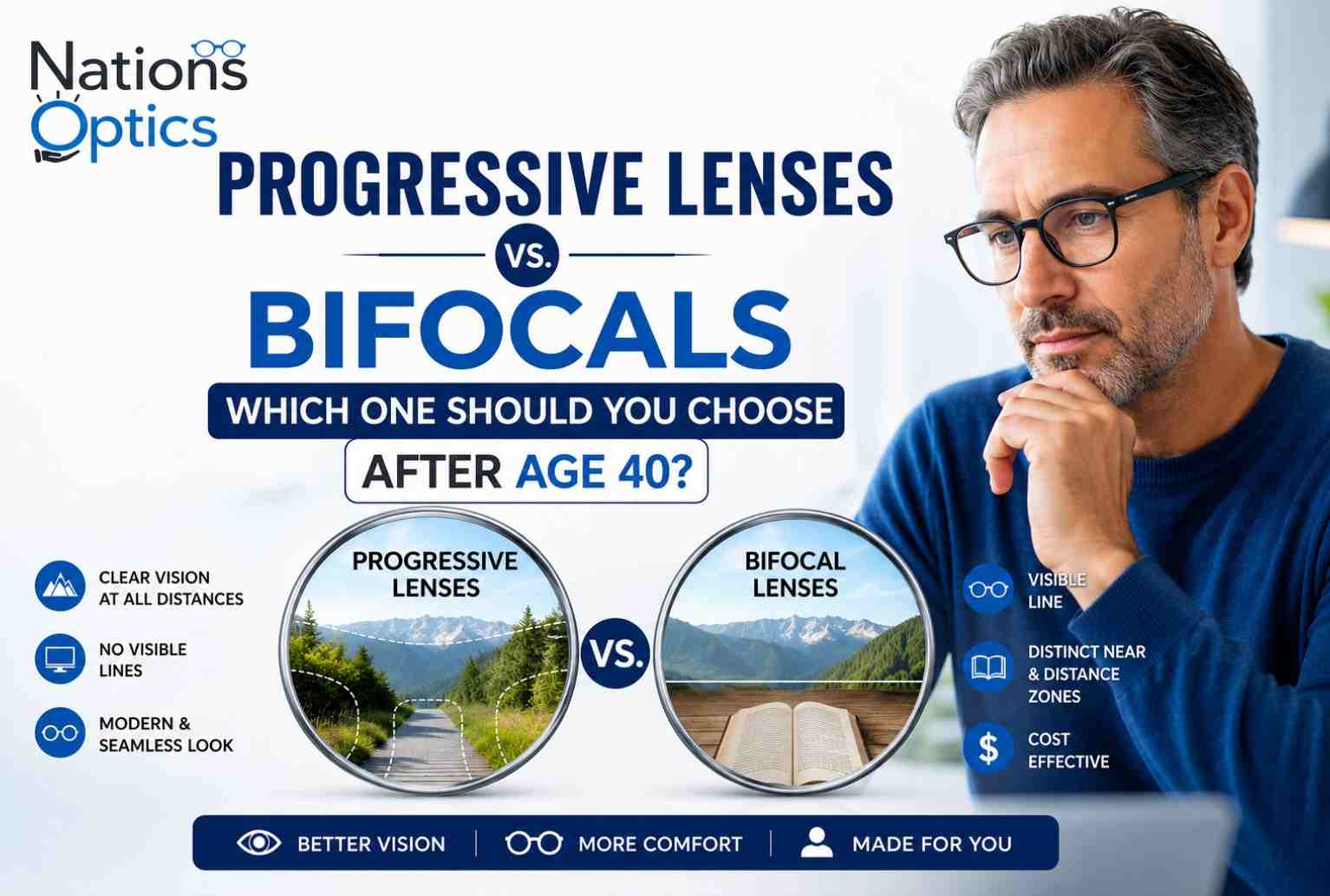
When this happens, wearing standard single-vision glasses isn't enough anymore. You either need separate glasses for reading and driving, or a multi-focus lens that handles both. This brings you to the classic optical debate: Should you choose traditional bifocals or modern progressive lenses?
As a certified optometrist with over 35 years of experience at Nations Optics, I help patients make this exact choice every single day. Let's break down the differences, pros, cons, and which one is right for your daily lifestyle.
1. Understanding Bifocals: The Traditional Choice
Invented centuries ago, bifocals are designed with two distinct optical zones separated by a visible dividing line.
- Top Half: Set to your distance prescription (for driving, watching TV, or walking around).
- Bottom Half: Set to your reading prescription (for close-up tasks like reading books, phones, or sewing).
Pros of Bifocals:
- Clear, Instant Separation: Zero guesswork between distance and reading zones.
- Affordable: Generally more budget-friendly to manufacture.
- Short Adjustment Period: Most people adapt within a day or two.
Cons of Bifocals:
- The Visible Line: The stark line across the lens instantly reveals your age.
- "Image Jump": When your eyes cross the line, the image abruptly shifts, which can be disorienting when walking down stairs.
- No Intermediate Vision: Does not help with computer screens or laptop distances.
2. Understanding Progressive Lenses: The Modern No-Line Solution
Progressive lenses (often called "no-line bifocals") are a technological marvel in modern optics. From the outside, they look exactly like normal single-vision glasses with no visible lines or segments.
The lens power changes seamlessly and gradually from top to bottom:
- Top Area: Distance vision.
- Middle Area: Intermediate vision (perfect for computer screens, laptops, and dashboard displays).
- Bottom Area: Near vision (reading and smartphones).
Pros of Progressive Lenses:
- Natural, Youthful Look: No ugly lines—looks like standard single-vision glasses.
- All-in-One Vision: Smooth transition across all distances without swapping pairs.
- No Image Jump: Gradual power graduation eliminates abrupt visual snap.
Cons of Progressive Lenses:
- Adjustment Period: Peripheral blur requires 3 to 14 days for your brain to adapt.
- Cost: Often expensive at traditional retail stores, though Nations Optics offers them starting at ₹1,499.
3. Head-to-Head Comparison Table
| Feature | Bifocals | Progressive Lenses |
|---|---|---|
| Visual Appearance | Visible dividing line | Seamless (No-Line) |
| Intermediate Vision | None (Blurry screen distance) | Excellent (Smooth transition) |
| Adjustment Time | 1–2 days | 3–14 days |
| Image Jump | Yes (Abrupt shift) | None (Smooth graduation) |
| Best Suited For | Traditional preference / Budget | Professionals, screen users, multi-taskers |
4. Optometrist's Verdict: Which Should You Choose?
Choose Bifocals if: You are on a strict budget, prefer traditional simplicity, and don't spend hours daily working on computers.
Choose Progressive Lenses if: You work on computers or laptops daily, want a modern youthful look without visible lines, and are willing to give your eyes a few days to adapt.
Get Certified Optical-Grade Lenses at Nations Optics
Meticulously crafted under optometrist supervision with transparent pricing starting at just ₹1,499 and zero fitting charges.
Explore Progressive & Bifocal Collection