
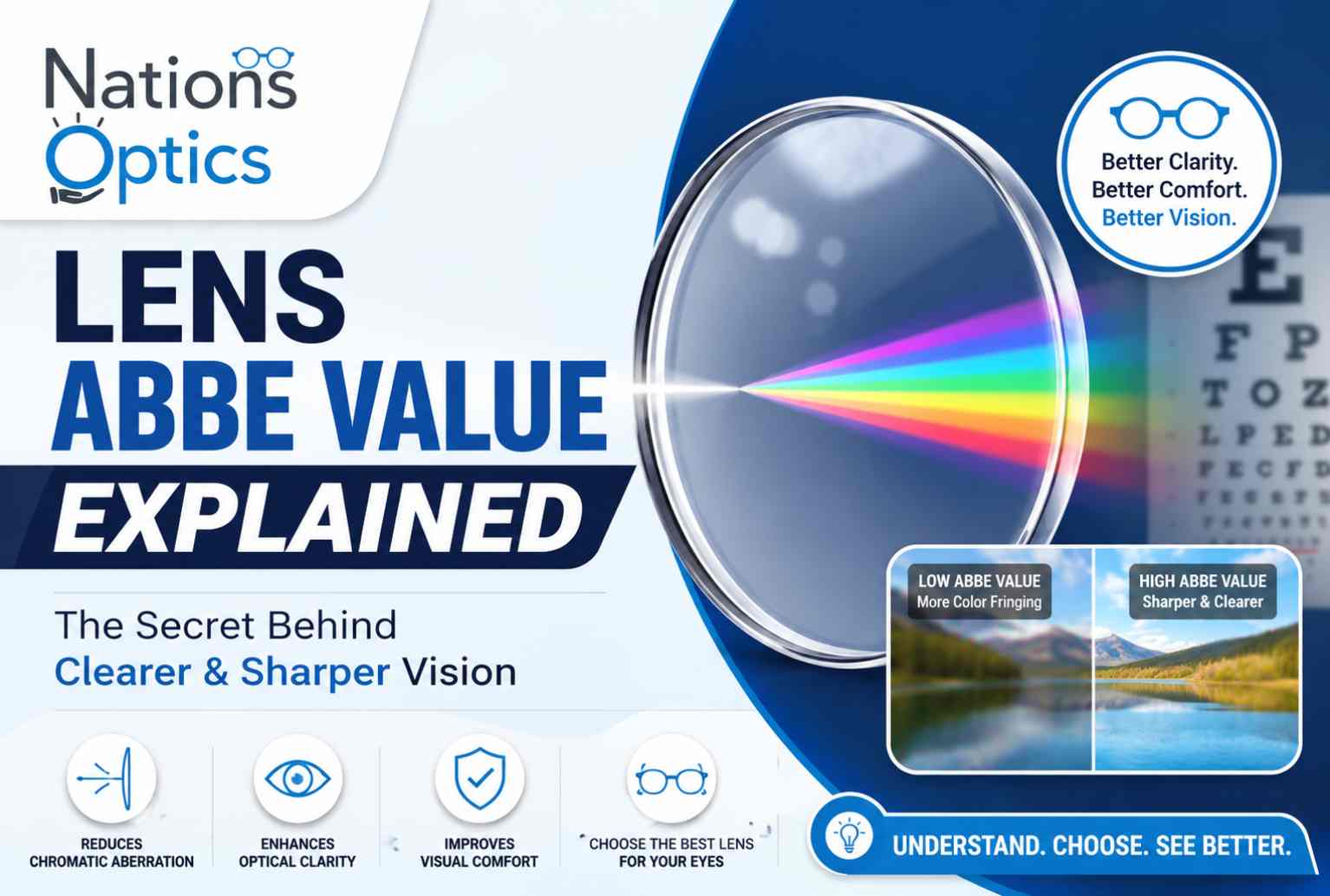
Lens Abbe Value Explained | Better Optical Clarity Guide
Jul 9, 2026
By Rahul Jain
0 comment(s)
Lens Science Guide
Lens Abbe Value Explained: Why It Matters for Clear, Comfortable Vision
Most people shop for lenses by thickness, coating, or price. Abbe Value is the overlooked spec that quietly shapes how sharp, natural, and comfortable your vision actually feels.
When shopping for prescription glasses, most people focus on lens thickness, coatings, or frame style. But one important optical property is often overlooked, Abbe Value. Understanding this specification helps you choose lenses that deliver sharper vision, less colour distortion, and greater visual comfort.
This guide covers what Abbe Value means, why it matters, how it affects your eyesight, and which lens materials offer the best optical performance.
01What Is Abbe Value in Lenses?
Abbe Value (also called the Abbe Number) measures how much a lens material disperses light. In simple terms, it tells you how well a lens keeps different colours of light focused together.
When white light enters a lens, it separates into different colours, just like a rainbow passing through a prism. A material with a low Abbe Value spreads those colours further apart, causing slight colour fringing and reduced sharpness. A higher Abbe Value means less dispersion and clearer vision.
Higher Abbe ValueBetter optical clarity, less colour fringing
Lower Abbe ValueMore chromatic aberration, softer edges
Although many wearers never hear about this specification, opticians consider it an important factor when recommending lens materials.
02Understanding Chromatic Aberration
Light consists of multiple colours, and each bends slightly differently passing through a lens. If the material disperses light excessively, the colours fail to focus at exactly the same point.
How light disperses through a lens
HIGH ABBE VALUE colours focus together LOW ABBE VALUE colours spread apart Sharp Fringed Fringed FringedLow Abbe materials scatter colours, producing purple or blue fringing around edges.
Signs of chromatic aberration
Purple edges
Blue or yellow outlines
Slight image distortion
Reduced sharpness
Rainbow-like fringing
Blurry peripheral vision
03Why Does Abbe Value Matter?
Vision quality depends on far more than prescription power. A lens with excellent optical design but poor dispersion may produce subtle distortions, especially toward the lens edges. Higher Abbe Values reduce colour fringing, rainbow-like edges, blurry peripheral vision, eye fatigue, and lost contrast.
These improvements become more noticeable for people who:
Have stronger prescriptionsSpend long hours on computersDrive frequentlyDo detailed visual workWear glasses all day
04How Abbe Value Affects Vision
Sharper visionObjects appear better defined with improved edge-to-edge clarity.
Better contrastFine details become easier to distinguish.
Reduced eye strainLess colour distortion means your eyes work less to focus.
More natural visionColours stay accurate without noticeable rainbow effects.
Improved peripheral visionSide vision feels more comfortable with reduced distortion.
Prescription accuracy remains the most important factor, but Abbe Value contributes significantly to overall visual comfort.
05Abbe Values of Popular Lens Materials
| Lens Material | Approximate Abbe Value | Optical Quality |
|---|---|---|
| CR-39 | Excellent | |
| 1.61 High Index | Excellent | |
| 1.56 Index Resin | Very Good | |
| 1.74 High Index | Good | |
| 1.67 High Index | Good | |
| Polycarbonate | Good |
CR-39 provides one of the highest Abbe Values among commonly used prescription lens materials.
06Which Is the High Abbe Value Material?
When people ask which material offers the clearest possible vision, CR-39 is often considered one of the best options for optical clarity, offering excellent image quality, minimal chromatic aberration, high transparency, comfortable everyday vision, and affordable pricing.
That said, material selection should always weigh durability, prescription strength, weight, and frame style, not Abbe Value alone.
07Is a Higher Abbe Value Always Better?
Generally yes, but there are trade-offs. A higher Abbe Value improves clarity, while other properties matter just as much: impact resistance, lens thickness, weight, UV protection, scratch resistance, and frame compatibility.
For example, polycarbonate has a lower Abbe Value than CR-39 but outstanding impact resistance, making it ideal for children, sports eyewear, and rimless frames. The best choice depends on your lifestyle and prescription needs.
08Best Lens Material for Optical Clarity
CR-39Abbe 58 · Clarity king
Excellent optical performance with one of the highest Abbe Values available.
Everyday prescription glassesReading glassesOffice wearModerate prescriptions
PolycarbonateAbbe 30 · Toughest
Lower Abbe Value, but extremely durable and impact-resistant.
Rimless glassesChildren's eyewearSafety glassesActive lifestyles
High-Index LensesThinnest profile
Designed for stronger prescriptions while staying thin. Some high-index materials have lower Abbe Values, but modern manufacturing significantly improves overall visual quality.
Strong prescriptionsThinner lensesLighter weight
09Does Prescription Power Change Its Importance?
Absolutely. The stronger your prescription, the more noticeable chromatic aberration becomes. Higher-prescription wearers often experience increased edge distortion, peripheral colour fringing, and more visible rainbow effects. Choosing an appropriate material becomes increasingly important as prescription strength increases, and an experienced optician can recommend the right balance between thinness and optical clarity.
10Can Lens Coatings Improve Abbe Value?
No, and this is a common misconception
Anti-reflective, scratch-resistant, UV, and blue light coatings do not change the Abbe Value. It's a property of the lens material itself. Premium coatings still improve overall visual comfort by reducing glare and reflections, they just work on a different problem.
11Choosing the Right Lens Material
Rather than choosing on Abbe Value alone, ask yourself:
Five questions to guide your choice
How strong is your prescription?Higher prescriptions may benefit from thinner materials.
What type of frame are you wearing?Some frame styles require specific lens materials.
Do you need impact resistance?Active users may prefer polycarbonate.
Is maximum optical clarity your priority?CR-39 remains an excellent option for everyday visual quality.
How often do you wear glasses?Full-time wearers appreciate the comfort of higher optical clarity.
12Myths About Abbe Value
✕Higher Abbe Value means better lens quality
Not necessarily. Lens quality also depends on manufacturing precision, coatings, prescription accuracy, and fitting.
✕Everyone notices low Abbe Values
Many don't. Slight chromatic aberration often goes unnoticed, especially with mild prescriptions.
✕Thin lenses always provide better vision
No. Thinner lenses may improve appearance but don't automatically deliver better optical clarity.
✕Expensive lenses always have higher Abbe Values
Price is a poor proxy. It reflects coatings, technology, brand, and manufacturing, not just Abbe Value.
13Which Lens Material Is Right for You?
If you value crystal-clear everyday vision, higher Abbe Value materials are an excellent choice. If durability is your priority, impact-resistant materials may serve you better. The ideal lens balances:
Prescription accuracy
Comfort
Safety
Durability
Optical clarity
Budget
A qualified optician can help determine the most suitable option for your specific needs.
Why optical clarity matters every day
Your glasses go everywhere with you, working at a computer, reading, driving, enjoying the outdoors. Sharper optics improve reading comfort, screen use, driving visibility, colour accuracy, and overall visual confidence. Even small improvements in optical performance make long-term wear more comfortable.
14Frequently Asked Questions
What is Abbe Value in lenses?
It measures how much a lens material disperses light. Higher values generally provide better optical clarity and less colour fringing.
What is considered a good Abbe Value?
Above 40 is generally considered very good, while values around 58 offer excellent optical clarity.
Which lens material has the highest Abbe Value?
CR-39 is widely recognised for having one of the highest Abbe Values among common prescription lens materials.
Does polycarbonate have a lower Abbe Value?
Yes. It's lower than CR-39, but polycarbonate offers excellent impact resistance and durability.
Does Abbe Value affect blurry vision?
It doesn't change your prescription, but it can reduce chromatic aberration and improve perceived image sharpness.
Is Abbe Value important for high prescriptions?
Yes. Stronger prescriptions make chromatic aberration more noticeable, so material selection matters more.
Can lens coatings increase Abbe Value?
No. Coatings improve glare reduction and durability but don't change the material's Abbe Value.
How do I choose the best lens material?
Consider your prescription, lifestyle, frame type, durability needs, and desired clarity. An experienced optician ensures the best fit for your vision.
15Conclusion
Abbe Value is an often-overlooked specification that plays a real role in lens performance. Knowing what it means lets you evaluate different materials instead of focusing only on thickness or price. It affects optical clarity, colour accuracy, and visual comfort by reducing chromatic aberration.
While high Abbe Value materials generally deliver clearer vision, the ideal lens also depends on your prescription, lifestyle, and frame choice. Compare visual quality, durability, thickness, and everyday usage before deciding. The right combination of lens material and professional fitting helps you enjoy comfortable, sharp vision for years to come.
Find the right lens for your eyes
From clarity-first CR-39 to impact-resistant polycarbonate and thin high-index, explore lenses matched to your prescription and lifestyle.
Shop Prescription LensesExclusive Offers
Sitewide
33%
OFF
Flat 33% off on all products
Already applied on every price · no coupon needed
Auto-applied
10%
OFF
On orders ₹1,200 – ₹1,799
No coupon needed · saves automatically
Auto-applied
15%
OFF
On orders ₹1,800 – ₹3,199
No coupon needed · saves automatically
Best Deal 🔥
20%
OFF
On orders above ₹3,200
No coupon needed · saves automatically
Pay Advance
₹50
SAVED
Pay advance amount at checkout
Flat ₹50 off · pay balance on delivery
Pay Full ✓
₹100
SAVED
Pay full amount at checkout
Maximum saving · instant confirmation
N
Nations Optics Assistant
● Online
👋 Hi! I'm your Nations Optics assistant. Ask me anything about lenses, frames, or prescriptions!