
Best Lens Coatings for Glasses – Which One Is Right for You? | NationsOptics
Apr 10, 2026
By Saksham Dhiman
0 comment(s)
Eye Care GuideWhy Do New Glasses Feel Weird?
Why Do New Glasses Feel Weird?
Eye Adjustment Guide
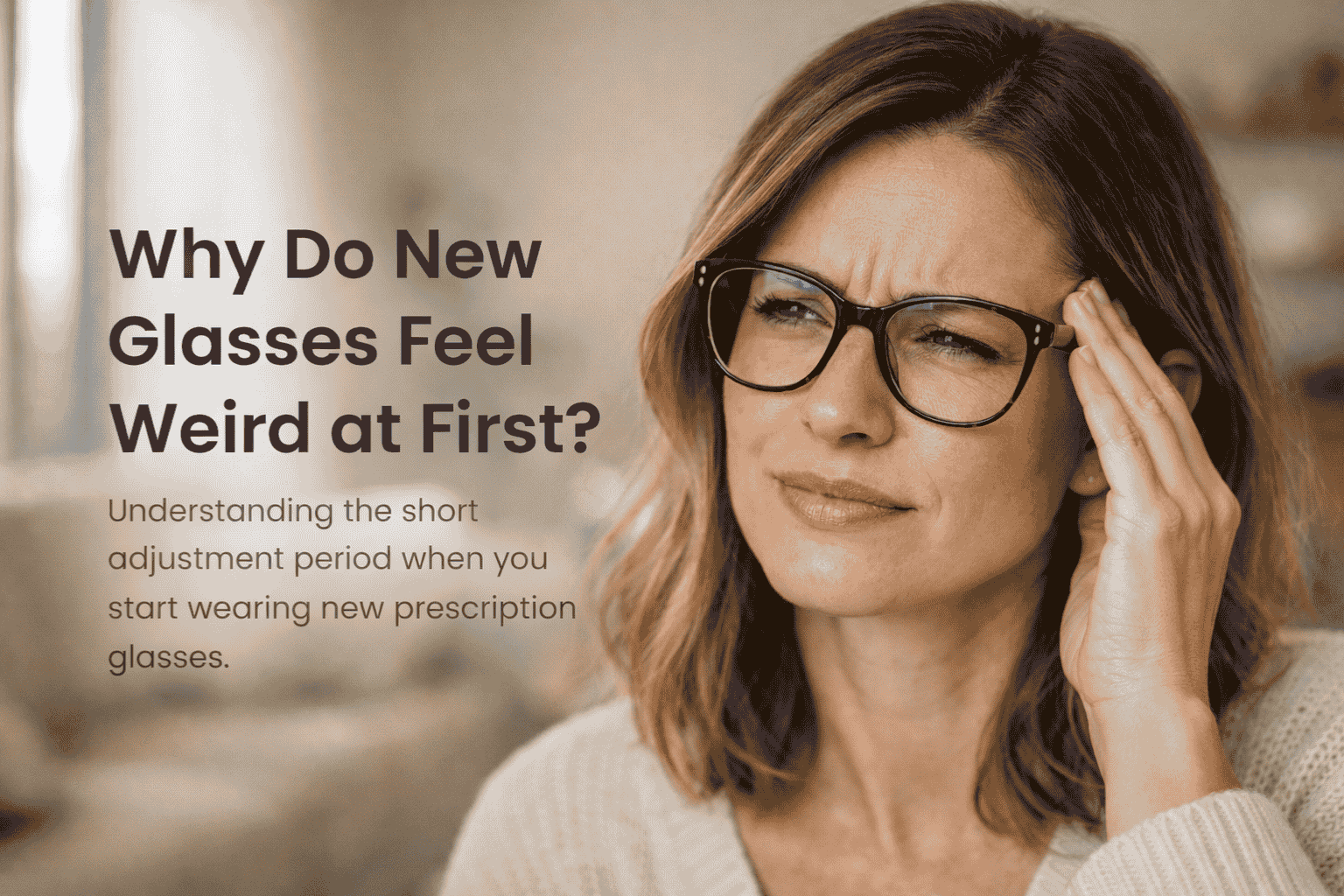
You've just unboxed a brand-new pair of glasses from NationsOptics — and instead of the crystal-clear vision you expected, things look a bit off. Objects seem slightly bent at the edges. Your depth perception feels strange. Maybe you're even a little dizzy. What's going on?
This is completely normal. Almost every first-time glasses wearer — and even seasoned wearers switching to a new prescription — experiences this disorientation. Let's break down exactly what's happening and how long it takes to feel right.
Why Does Vision Feel Different With New Glasses?
Your brain has been interpreting the world through your old (or uncorrected) vision for months or years. When new lenses suddenly change how light reaches your retina, your visual cortex needs time to recalibrate. This isn't a sign that something is wrong with your glasses — it's your brain doing its job.
Common things people notice:
- Barrel or pincushion distortion — straight lines look slightly curved, especially with high-power prescriptions.
- Fishbowl effect — the world looks slightly rounded or "bent" near the edges of the lenses.
- Depth perception changes — steps, kerbs, and distances feel misjudged.
- Headaches or eye strain — your eye muscles are working harder than usual to process the new optical input.
- Everything looks too sharp or too bright — especially with anti-reflective coatings, which cut out distracting reflections.
Why This Happens
Your brain built a "visual model" of the world using your old, uncorrected sight. New lenses change the angle, size, and position of everything your eyes receive. The brain must update its model — and that process takes a few days.Adjustment Timeline: What to Expect Day by Day
The adjustment period varies depending on your prescription strength, lens type, and individual brain plasticity. Here's a general guide:
- Day 1–2: Initial Shock Everything is sharper but may feel distorted. Mild headaches and dizziness are common. Wear your glasses as much as possible — resisting the urge to take them off helps your brain adapt faster.
- Day 3–5: Rapid Adaptation Most people notice significant improvement. Distortion fades, depth perception normalises. Headaches should reduce noticeably.
- Week 1–2: Full Comfort for Most Wearers For standard single-vision lenses, the adjustment is usually complete by day 7–10. You should feel comfortable wearing your glasses for full days.
- Week 2–4: Progressive Lens Adaptation Progressive (multifocal) lenses take longer — typically 2 to 4 weeks. You'll need to learn to move your head rather than just your eyes to access different focal zones.
| Lens Type | Typical Adjustment Period | Key Tips |
|---|---|---|
| Single Vision | 3–7 days | Wear consistently; avoid switching back to old pair |
| Bifocal | 1–2 weeks | Tilt head down slightly to use reading zone |
| Progressive / Multifocal | 2–4 weeks | Move your head, not just your eyes; be patient |
| High-Power Prescription (±4.00 and above) | Up to 4 weeks | Thinner lens options reduce distortion significantly |
Tips to Speed Up the Adjustment Process
- Wear your glasses all day — even if they're uncomfortable. Removing them resets your brain's adaptation progress.
- Don't switch between old and new glasses — your brain can't adapt if it keeps getting conflicting input.
- Take short breaks if headaches are intense — rest your eyes, but keep the glasses on when you're active.
- Look through the centre of the lens — especially with progressives. Avoid using the peripheral zones until you're comfortable.
- Adjust the fit — glasses that are sitting too low or are tilted will cause unnecessary distortion. Visit an optician or use NationsOptics' free frame adjustment guide.
When Should You See an Optician?
⚠ See Your Optician If...
- Symptoms don't improve after 2 weeks of consistent wear
- You experience double vision at any point
- Headaches are severe or persistent beyond the first 3 days
- One eye feels significantly worse than before
- The prescription feels clearly stronger or weaker than your actual vision needs
These symptoms may indicate a prescription error, an incorrect PD (pupillary distance) measurement, or a lens that wasn't fabricated to your exact specification. At NationsOptics, our prescription verification process reduces these errors — but if you have any concern, our customer support team is always available.
A Quick Note on Frame Fit
Sometimes the "weird" feeling isn't the lenses at all — it's the frame. If your glasses are sitting too low on your nose, tilted to one side, or too far from your eyes, the optical centre of the lens won't align with your pupils. This causes unnecessary distortion and can make even a perfect prescription feel wrong.
Ensure your glasses fit correctly: the frame should rest comfortably on your nose bridge, with your pupils centred horizontally and sitting in the upper third of the lens when looking straight ahead.
Conclusion
New glasses feeling weird is a perfectly normal and temporary experience. For most people, the discomfort resolves within one to two weeks. The key is to wear your glasses consistently and resist the urge to go back to your old pair. If symptoms persist beyond two weeks or are severe, consult your optician.
At NationsOptics, every lens is crafted to your exact prescription with quality optical-grade materials. If you ever feel uncertain about your order, our team of certified opticians is here to help.
Need Help With Your New Glasses?
Our certified opticians are ready to assist with fitting, prescription queries, and lens upgrades.
CONTACT NATIONSOPTICS