How Lens Cost Varies with Your Prescription | Nations Optics
Apr 3, 2026
By Rahul Jain
0 comment(s)
Vision Care Guide · Nations Optics
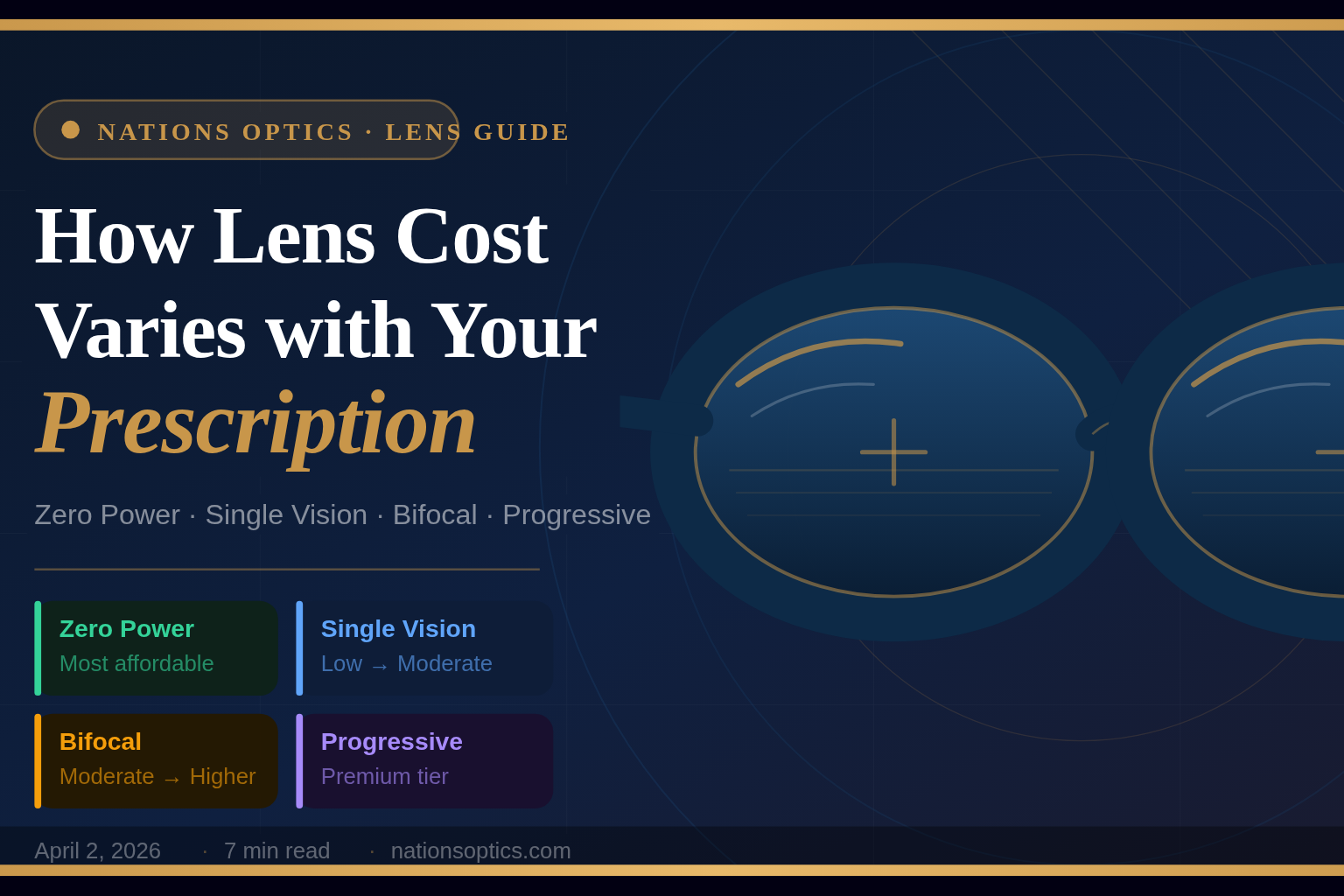
How Lens Cost Varies
with Your Prescription
A complete, honest breakdown — from zero power to high prescription lenses — so you always know what you're paying for.
Ever wondered why two customers walk into the same optical store, pick similar-looking frames, but pay very different prices for their lenses? The answer almost always lies in the prescription. Here's everything you need to know — and you can explore our full lens collection once you know what suits your needs.
Understanding the Basics
What Actually Makes a Lens Cost More?
Lens pricing isn't arbitrary. Several clear, logical factors determine the final cost. Understanding these helps you make smarter decisions when ordering your next pair.
Power Range
Higher prescriptions (beyond ±4.00 SPH) require more complex grinding and thicker lens blanks, raising the price significantly.
Cylinder (CYL)
Astigmatism correction (CYL value) adds an extra optical dimension. Lenses with CYL need toric surfacing, which adds cost.
Lens Type
Single vision, bifocal, and progressive lenses each have different manufacturing complexity — progressive being the most involved.
Lens Material
CR-39 plastic is the most affordable. Polycarbonate is lighter and impact-resistant, commanding a higher price point.
Coatings & Tints
Blue block, photochromic (Photo Grey), and tinted coatings each add a layer of function — and cost — on top of the base lens.
Different Eye Powers
When both eyes have different prescriptions, each lens must be custom-surfaced independently, which costs more than same-power pairs.
Lens Category Breakdown
The Three Lens Types & How Prescription Affects Each
Nations Optics offers lenses across three main vision categories. Here's how pricing ladders up within each one based on your prescription complexity.
Zero Power Lenses (No Prescription)
For fashion frames, screen protection & blue light filtering only
Typical Price Range Lowest Cost
Zero power lenses are the entry point. Since no prescription grinding is required, these are the most affordable option. They're ideal for anyone who wants stylish frames or digital eye protection without any vision correction.
CR-39 Clear Most affordable, basic protection
CR-39 Blue Block Filters blue light from screens
CR-39 Photo Grey Auto-darkening, outdoor protection
CR-39 Blue Block Photo Grey Best protection, premium price
No CYL, no power variation — pricing is flat and predictable. Great for gifting frames or fashion use. Browse our full range of full rim frames and rimless frames to pair with zero-power lenses.
Single Vision Lenses
One focal power — for distance, reading, or intermediate vision
Typical Price Range Low → Moderate
Single vision lenses correct one field of vision. Cost starts low but rises based on power strength, CYL, material, and coatings. Here's how prescription complexity adds up:
Standard Power, No CYL, Same Eyes Most affordable single vision
Standard Power, With CYL Astigmatism adds moderate cost
High Power, With CYL Most expensive single vision tier
Blue Block / Photo Grey Add functional coating cost
Polycarbonate Standard Power Lightweight, impact-resistant option
Polycarbonate Blue Block Premium screen protection
| Power Level | CYL | Both Eyes Same? | Cost Tier |
|---|---|---|---|
| Standard | No | Same | Lowest |
| Standard | Yes | — | Moderate |
| Standard | No | Different | Moderate |
| High (beyond ±4.00) | No | Same | Higher |
| High | Yes | — | Premium |
Add Blue Block, Photo Grey, or tints and each tier steps up slightly. Polycarbonate single vision lenses cost more than CR-39 single vision lenses at every tier.
Multi Vision Lenses — Bifocal & Progressive
Two or more focal zones — for presbyopia & age-related vision needs
Typical Price Range Moderate → Premium
Multi vision lenses are the most complex to manufacture and therefore the most expensive category. Nations Optics offers two types — Bifocal (two zones: near + far) and Progressive (seamless gradual zone transition) — in both CR-39 and Polycarbonate materials.
Bifocal vs Progressive: What Costs More?
Progressive lenses are generally priced higher than bifocals at equivalent power and material levels because they require advanced freeform surfacing technology to create a seamless transition zone — there's no visible line but significantly more precision involved in manufacturing.
| Lens Type | Material | Power | CYL | Eye Variation | Cost Tier |
|---|---|---|---|---|---|
| Bifocal | CR-39 | Standard | No | Same | Entry |
| Bifocal | CR-39 | Standard | Yes | — | Moderate |
| Bifocal | CR-39 | High | Yes | — | Higher |
| Progressive | CR-39 | Standard | No | Same | Moderate |
| Progressive | CR-39 | High | Yes | Different | Higher |
| Bifocal | Polycarbonate | Standard | Yes | — | Higher |
| Progressive | Polycarbonate | High | Yes | Different | Premium |
Coatings Add a Further Step Up
Across both Bifocal and Progressive types, adding coatings increases the price in this rough order:
Clear (No Coating) Base price — no extras
Light Tinted Grey Subtle shade, mild premium
Medium Tinted Grey Moderate shade premium
Blue Block Digital eye strain filter
Photo Grey Auto-darkening outdoors
Blue Block + Photo Grey Highest coating premium
Smart Shopping
5 Ways to Get the Best Value on Your Lenses
- 1
Know your power range before you shop. If your prescription is within standard power (generally up to ±4.00 SPH), you'll always pay less. Ask your optician if you're on the borderline — sometimes a minor adjustment keeps you in the standard tier. Start with our standard power CR-39 lenses as your baseline.
- 2
Only add coatings you'll actually use. Blue block is worth it if you spend 6+ hours on screens. Photo grey is ideal if you move between indoors and outdoors frequently. Paying for both when you only need one adds unnecessary cost.
- 3
Consider CR-39 unless you have a specific reason for Polycarbonate. Polycarbonate is superior for children's eyewear, sports, and rimless frames — but for regular everyday use in full rim frames, CR-39 delivers excellent optics at a lower price.
- 4
Bifocal vs Progressive: try bifocal first if you're new to multifocals. Bifocal lenses cost less and have a shorter adaptation period. Many wearers find them perfectly adequate for their daily needs. If you're ready to upgrade, explore our progressive lenses for a seamless experience.
- 5
Order both eyes together. "Same power both eyes" configurations are sometimes priced lower than mixed prescriptions. If your eyes are close in power, confirm with your optometrist whether a standardised prescription is appropriate for you. See our full lens collection to compare options side by side.
CYL Explained Simply
CYL stands for Cylinder — it corrects astigmatism, a common condition where the eye's curve isn't perfectly round. If your prescription has a CYL value (anything other than 0.00), your lenses need toric surfacing — an extra manufacturing step — which is why "With CYL" lenses cost more than "No CYL" versions at every power and material tier. Browse our CYL-compatible single vision lenses or CYL-compatible bifocal lenses to find your match.
Ready to Find Your Perfect Lenses?
Browse Nations Optics' full range of single vision, bifocal, and progressive lenses — with transparent pricing at every prescription level.
Shop Lenses at Nations Optics →
Exclusive Offers
Sitewide
33%
OFF
Flat 33% off on all products
Already applied on every price · no coupon needed
Auto-applied
10%
OFF
On orders ₹1,200 – ₹1,799
No coupon needed · saves automatically
Auto-applied
15%
OFF
On orders ₹1,800 – ₹3,199
No coupon needed · saves automatically
Best Deal 🔥
20%
OFF
On orders above ₹3,200
No coupon needed · saves automatically
Pay Advance
₹50
SAVED
Pay advance amount at checkout
Flat ₹50 off · pay balance on delivery
Pay Full ✓
₹100
SAVED
Pay full amount at checkout
Maximum saving · instant confirmation
N
Nations Optics Assistant
● Online
👋 Hi! I'm your Nations Optics assistant. Ask me anything about lenses, frames, or prescriptions!