
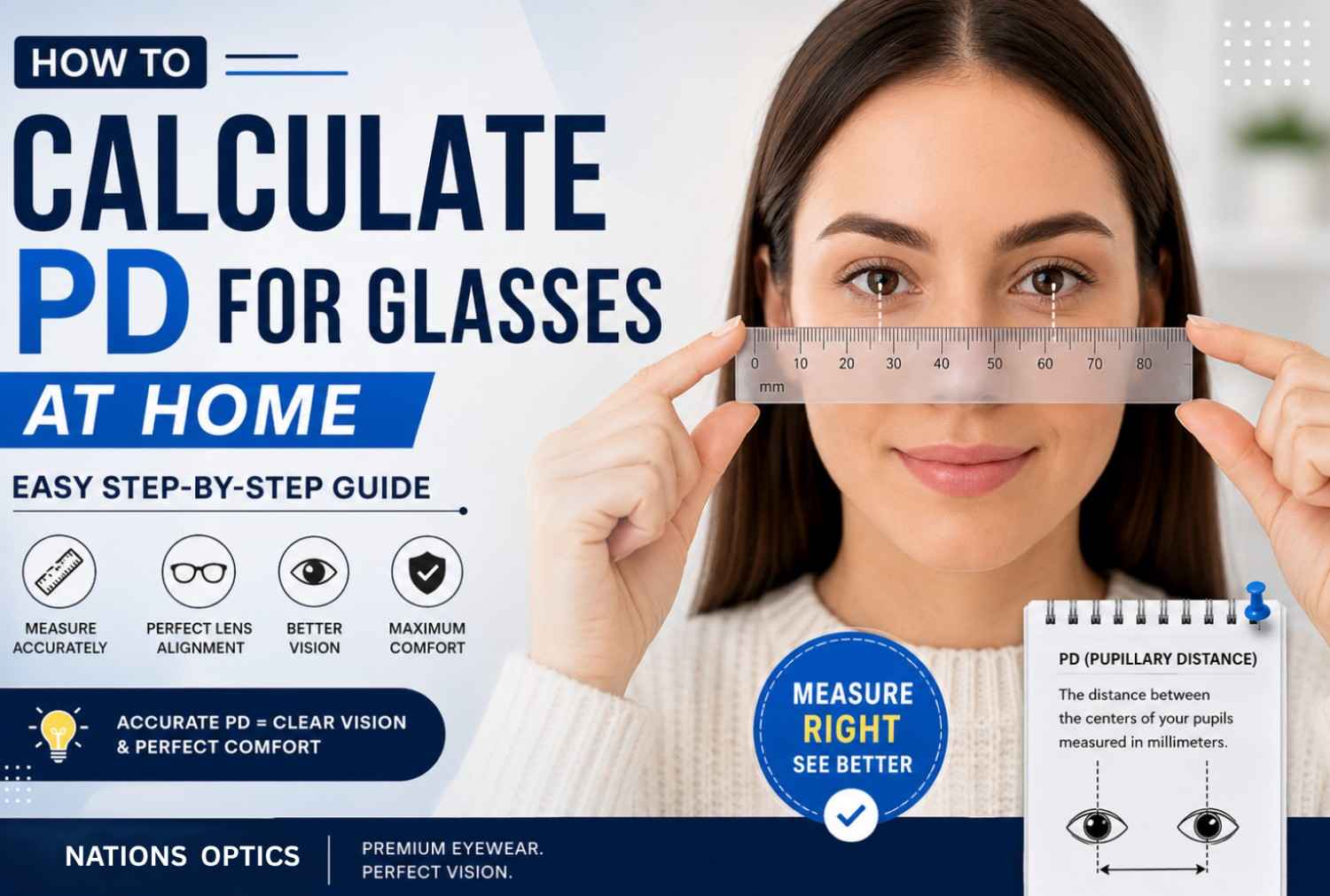
When ordering prescription glasses online, most people focus only on their lens power and frame style. However, one small but extremely important measurement often gets ignored — PD, also known as Pupillary Distance.
Your PD measurement ensures that the optical center of your lenses aligns perfectly with your eyes. An incorrect PD can affect visual clarity, create eye strain, and reduce overall comfort while wearing glasses.
What is PD in Glasses?
PD stands for Pupillary Distance, which is the distance between the centers of your pupils measured in millimeters. It helps lens manufacturers place the optical center of the lenses exactly where your eyes naturally focus.
Sharper Vision
Accurate PD ensures crystal-clear vision and better lens alignment for daily comfort.
Reduced Eye Strain
Correct lens positioning minimizes headaches, dizziness, and visual discomfort.
Better Lens Performance
Premium lenses like blue cut and anti-glare work best with precise PD measurement.
Why is PD Important?
Without the correct PD measurement, even high-quality prescription glasses may feel uncomfortable. Proper PD helps your eyes focus naturally through the center of the lenses.
| Benefits of Correct PD | Problems with Incorrect PD |
|---|---|
| Clear and sharp vision | Blurry vision |
| Comfortable daily wear | Eye strain |
| Better focusing | Headaches |
| Proper lens alignment | Dizziness |
How to Measure PD at Home
1
Use a Millimeter Ruler
Always use a ruler with millimeter markings for the most accurate measurement possible.
2
Stand in Front of a Mirror
Position yourself about 8–10 inches away from the mirror in a well-lit room.
3
Align the Ruler
Place the ruler against your forehead and align the zero mark with the center of one pupil.
4
Measure Carefully
Look straight ahead and measure the distance to the center of the second pupil.
5
Repeat for Accuracy
Measure at least 2–3 times to ensure consistency and precision.
Professional-quality prescription glasses require highly accurate PD measurements for the best optical performance and comfortable vision experience.
Average PD Range
PD values vary depending on age and facial structure. Below are average PD ranges:
| Category | Average PD |
|---|---|
| Adult Women | 54mm – 68mm |
| Adult Men | 58mm – 72mm |
| Children | 41mm – 55mm |
Common Mistakes While Measuring PD
- Using an inch ruler instead of millimeters
- Tilting your head while measuring
- Taking measurements in poor lighting
- Not looking straight ahead
- Rushing the process
- Not repeating measurements multiple times
Frequently Asked Questions
Can I measure PD myself?
Yes, you can easily measure PD at home using a ruler and mirror by following the correct method.
What if my PD is wrong?
Incorrect PD may cause blurry vision, headaches, discomfort, and eye strain while wearing glasses.
Is PD included in prescriptions?
Some eye prescriptions include PD measurements, but many opticians provide it separately.
Order Premium Prescription Glasses Online
Now that you know how to calculate your PD accurately, explore stylish and premium prescription eyewear collections at Nations Optics for crystal-clear vision and unmatched comfort.
SHOP NOW