
How Prescription Lenses Are Made | Nations Optics Guide
Jul 4, 2026
By Rahul Jain
0 comment(s)
Behind the Lens
How Prescription Lenses Are Made: A Complete Guide to the Manufacturing Process
A pair of glasses looks simple, but every lens is custom-built with optical science, computer-controlled machinery, and strict quality control. Here's the full journey, from prescription to finished pair.
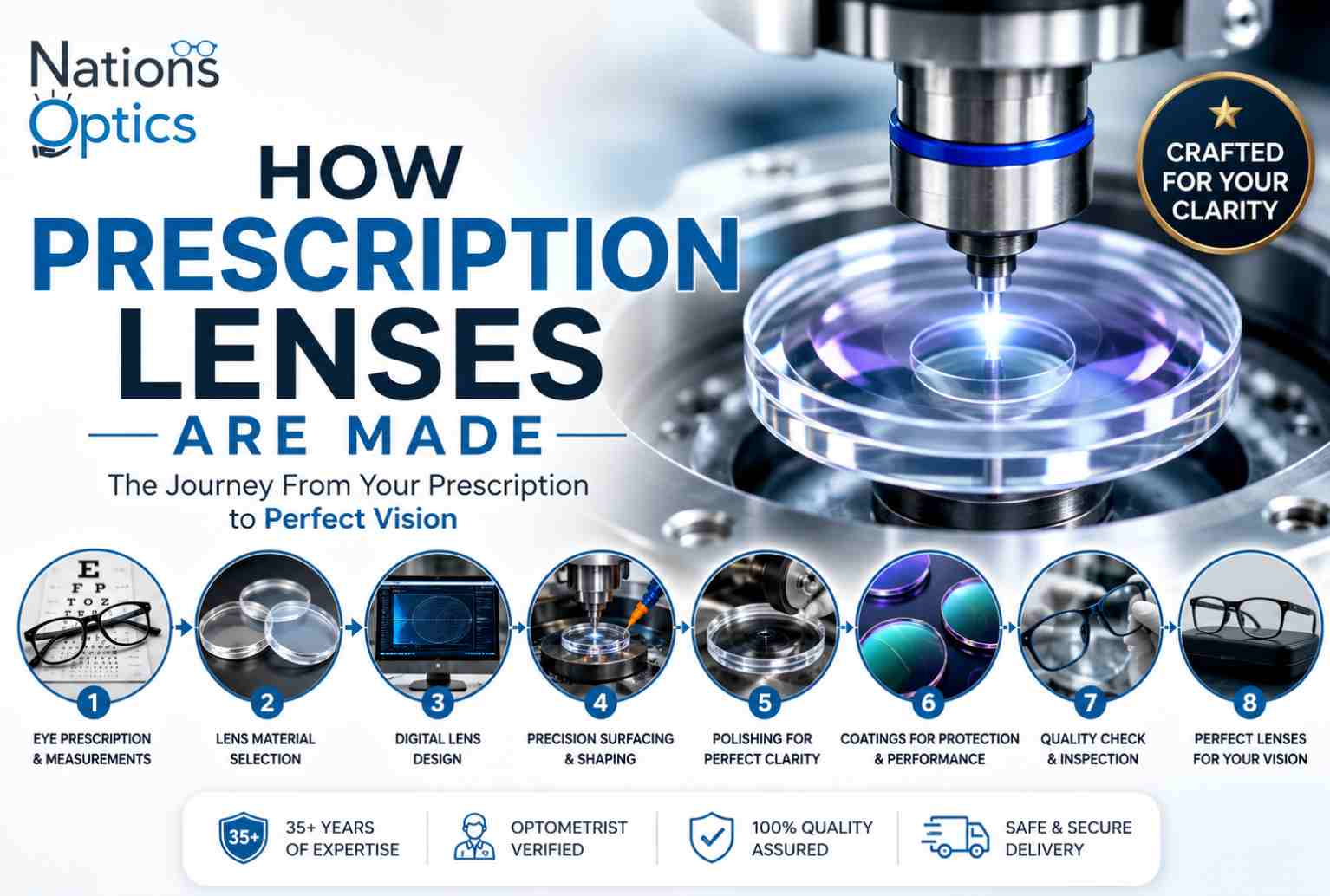
Have you ever wondered what happens after your eye doctor hands you a prescription? While glasses may seem simple, every prescription lens is custom-manufactured using advanced optical technology, precision engineering, and rigorous quality control. Modern optical laboratories use digital equipment to turn your prescription into lenses tuned to your unique needs.
Whether you need single-vision, bifocal, or progressive lenses, the process follows a series of carefully controlled steps. Understanding it helps you appreciate the craftsmanship behind every pair, and make better decisions when choosing your next lenses.
What Are Prescription Lenses?
Prescription lenses are custom-designed optical lenses that correct vision problems such as nearsightedness (myopia), farsightedness (hyperopia), astigmatism, and presbyopia. Unlike ready-made reading glasses, they're manufactured specifically for your eye measurements, prescription values, and frame choice. Every lens is unique, because no two prescriptions are exactly alike. The process combines optical science, computer-controlled machinery, and skilled technicians to deliver accurate correction every time.
The Manufacturing Process, Step by Step
1
Prescription
Understanding Your Eye Prescription
It begins with a comprehensive eye exam. Your optometrist measures several values, then converts them into digital manufacturing instructions that guide every stage of production. Labs also factor in frame dimensions, fitting height, and visual habits so the optical centre aligns perfectly with your eyes.
SPH — SphereLens power for near/farsightedness
CYL — CylinderCorrection for astigmatism
AxisOrientation of the cylinder correction
Add PowerExtra power for progressive lenses
PD — Pupillary DistanceDistance between pupil centres
Fitting HeightVertical lens positioning in the frame
2
Material
Selecting the Right Lens Material
One of the most important decisions, the material affects weight, thickness, durability, and visual performance.
CR-39 PlasticReliable everyday choice
PolycarbonateImpact-resistant & lightweight
High-IndexThinner profile for strong prescriptions
TrivexExcellent clarity & durability
Mineral GlassExceptional scratch resistance
3
Blank Selection
Choosing a Semi-Finished Lens Blank
Every lens starts as a semi-finished blank, sometimes called a "puck." The front already carries a predefined curve, while the back is customised to your prescription. The lab selects the correct blank based on prescription strength, base curve, material, and intended frame, ensuring efficient manufacturing with excellent optical quality.
4
Digital Design
Digital Lens Design
Modern manufacturing leans heavily on computer-aided design (CAD). Software calculates the exact geometry needed for accurate correction. For premium lenses, labs use digital freeform technology, thousands of tiny customised adjustments across the lens surface that sharpen vision, widen the field of view, and reduce distortion, especially in progressives.
5
Surfacing
Surfacing the Lens
One of the most fascinating stages. High-precision CNC machines remove microscopic amounts of material from the back surface, following the digital prescription with accuracy measured in microns. Automated systems reduce human error while increasing efficiency, so even complex prescriptions are produced precisely.
6
Polishing
Fine Grinding and Polishing
After surfacing, the lens still carries microscopic machining marks. Several stages of fine grinding and polishing, using special compounds and precision equipment, create an optically smooth surface. Without it, lenses would appear cloudy. This step produces the crystal-clear finish expected from premium lenses.
7
Coatings
Applying Protective Coatings
Once polishing is done, coatings are added for durability, comfort, and performance, applied via vacuum deposition or specialised chemical treatments. Premium coatings reduce glare, improve night vision, boost durability, and make lenses easier to clean.
Scratch-resistant
Anti-reflective (AR)
UV protection
Blue light filtering
Water-repellent
Smudge-resistant
8
Quality Control
Quality Inspection
A critical checkpoint. Each finished lens undergoes multiple inspections using digital lensmeters and specialised instruments. Only lenses that pass every check move forward.
Every lens is verified for
Prescription accuracy
Optical power
Surface quality
Coating consistency
Thickness
Optical centre alignment
Cosmetic appearance
9
Edging & Fitting
Lens Edging and Frame Fitting
Lenses are made as circular blanks, so they must be cut to fit your frame. A digital tracer scans the inside shape of the frame, then an automated edging machine trims each lens to the exact size while positioning the optical centre correctly. Plastic frames let lenses snap into place; metal frames use screws or nylon cords. Accurate edging ensures a secure fit without stress that could affect vision.
From puck to finished lens
The back surface is precision-cut, polished, then the lens is edged to match your frame shape.
Final Inspection and Packaging
Before shipment, the completed glasses undergo one last inspection. Technicians verify the prescription, frame alignment, lens cleanliness, and overall cosmetic quality. Once everything passes, the glasses are cleaned, securely packaged, and prepared for delivery, so you receive eyewear that delivers clear vision, comfortable wear, and long-lasting durability.
Ready for lenses made just for you?
From material to coatings, every Nations Optics lens is custom-built to your prescription. Upload your Rx and let us handle the rest.
Shop Prescription GlassesExclusive Offers
Sitewide
33%
OFF
Flat 33% off on all products
Already applied on every price · no coupon needed
Auto-applied
10%
OFF
On orders ₹1,200 – ₹1,799
No coupon needed · saves automatically
Auto-applied
15%
OFF
On orders ₹1,800 – ₹3,199
No coupon needed · saves automatically
Best Deal 🔥
20%
OFF
On orders above ₹3,200
No coupon needed · saves automatically
Pay Advance
₹50
SAVED
Pay advance amount at checkout
Flat ₹50 off · pay balance on delivery
Pay Full ✓
₹100
SAVED
Pay full amount at checkout
Maximum saving · instant confirmation
N
Nations Optics Assistant
● Online
👋 Hi! I'm your Nations Optics assistant. Ask me anything about lenses, frames, or prescriptions!