
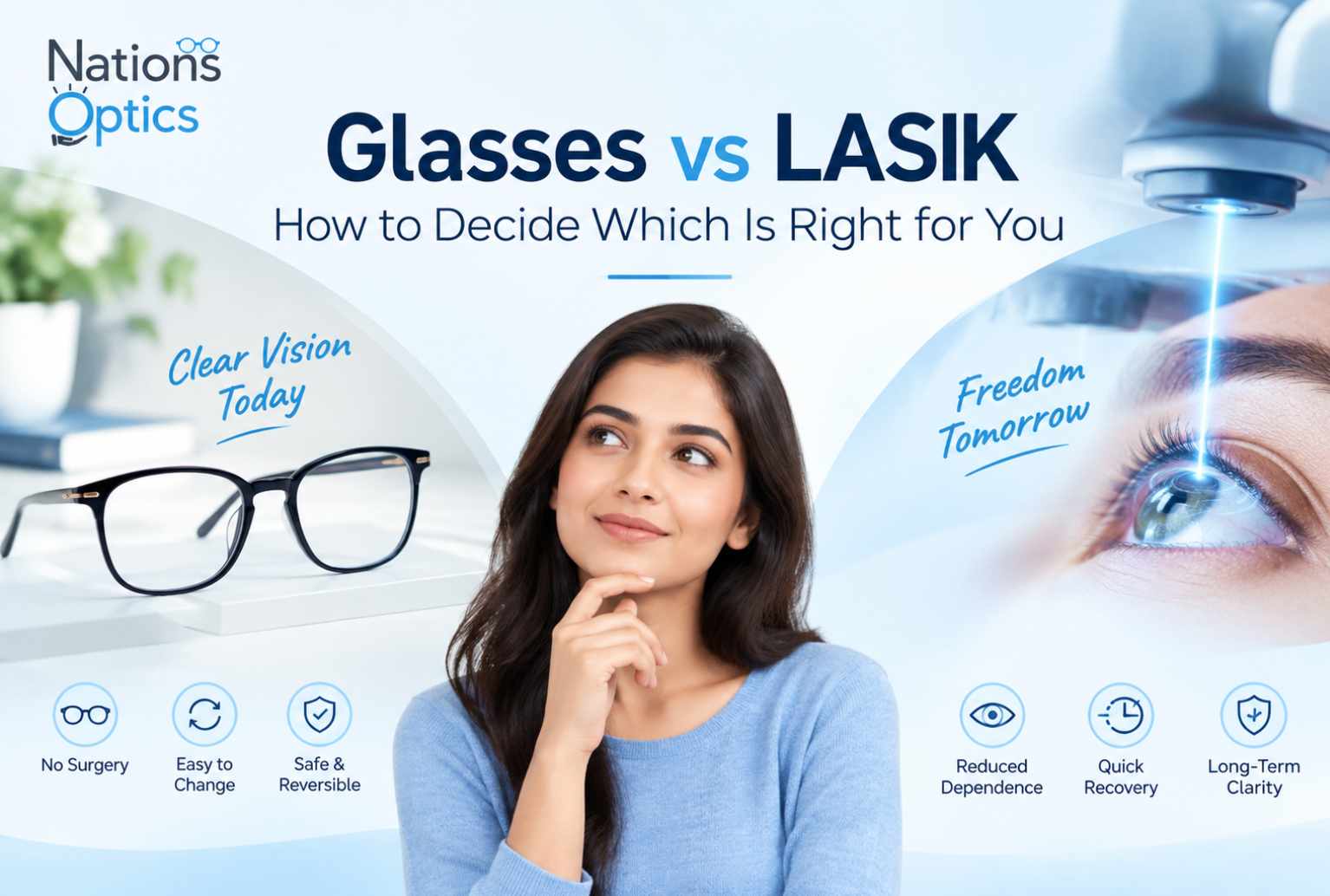
Glasses vs LASIK: Which Vision Correction Is Right for You?
Sep 23, 2026
By Saksham Dhiman
0 comment(s)
A note before you read: This article is for general educational purposes only and is not medical advice. LASIK is a surgical procedure, and candidacy, risks, and outcomes vary by individual. Any decision about LASIK should be made in consultation with a qualified ophthalmologist after a proper eye evaluation.
Vision Correction Decisions
Glasses vs LASIK: How to Decide Which Is Right for You
Neither option is automatically better. They solve vision correction in very different ways — here's how to think it through.
If you wear prescription glasses, you may have wondered: should I continue wearing glasses, or consider LASIK? The choice is not simply about getting rid of spectacles — it involves your prescription, eye health, lifestyle, expectations, cost, convenience, and willingness to undergo an eye procedure.
In this guide, we explain how both options work, their advantages and limitations, LASIK eligibility, possible risks, costs to consider, and what to discuss with an eye-care professional before making a decision. The important point up front: LASIK is not automatically better than glasses, and glasses are not automatically better than LASIK.
LASIK Eligibility Cost Comparison Risks & Recovery FDA Guidance Lifestyle Fit
Glasses vs LASIK: What Is the Difference?
The simplest difference is how vision is corrected. Prescription glasses use lenses positioned in front of your eyes to help focus light correctly on the retina. They are non-surgical, removable, adjustable, and can be replaced when your prescription changes.
LASIK, or Laser-Assisted In Situ Keratomileusis, is a refractive surgery that permanently reshapes the cornea to change how the eye focuses light. Its purpose is to reduce dependence on glasses or contact lenses.
So the comparison is really between a non-surgical, reversible method of vision correction and a surgical procedure designed to reduce dependence on corrective lenses. Neither option is suitable for every person.
Glasses or LASIK: Which Is Better?
There is no single answer. Glasses may make sense if you want a simple, non-invasive way to correct your vision and don't mind wearing spectacles. LASIK may be considered by adults who want to reduce their dependence on glasses or contact lenses and who pass the required eye-health and suitability evaluations. Before LASIK, an eye doctor needs to assess whether your eyes are suitable and explain the benefits, limitations, and risks.
The better question isn't "Is LASIK better than glasses?" — it's "Which vision-correction option is appropriate for my eyes, lifestyle, and expectations?"
Advantages of Wearing Glasses
1
No Surgery Required
You can start using prescription glasses after an appropriate eye examination and prescription — no surgical step involved at all.
2
Easy to Change
If your prescription changes, you can get a new pair — and have different glasses for different needs: everyday wear, computer glasses, reading glasses, prescription sunglasses, progressives, or bifocals.
3
Reversible
You can remove glasses whenever you want, and simply replace your frame style, lens type, or prescription if your needs change.
4
No Surgical Recovery
Glasses don't require post-operative recovery, activity restrictions, or surgical follow-up of any kind.
5
Can Become Part of Your Style
Frame shape, material, and colour can become part of your personal appearance — for many people, glasses are both a vision-correction tool and an everyday fashion accessory.
Disadvantages of Wearing Glasses
Some people find glasses uncomfortable during sports or physically demanding activities, or dislike fogging, slipping, or pressure around the nose or ears. Common concerns include frames slipping during activity, fogging in humid conditions, adjusting to new prescriptions, scratches or accidental damage, remembering to carry glasses, and discomfort with certain frame designs. Many of these issues, however, can be reduced by choosing properly fitted frames and suitable lens materials and coatings.
What Are the Advantages of LASIK?
The main purpose of LASIK is to reduce dependence on glasses or contact lenses.
Potential Benefits
- Reduced dependence on glasses for everyday activities
- No frame or lens to wear during sports, travel, or physical activity
- Convenience for appropriately selected candidates
- Potentially clearer unaided distance vision
Important Caveat
- LASIK does not guarantee you'll never need glasses again
- Some people still require glasses for certain visual situations
- Reading glasses may still be needed as you age
- Results depend heavily on individual eye anatomy and healing
What Are the Disadvantages of LASIK?
LASIK is a surgical procedure, so it carries risks and limitations that glasses do not. Possible issues include dry eyes, glare, halos around lights, night-vision difficulties, under-correction or over-correction, residual refractive error, visual symptoms during recovery, the possibility of still needing glasses, and in some cases, the possibility of requiring additional treatment.
The FDA specifically advises patients to understand these risks and limitations before undergoing refractive surgery. LASIK should not be treated as simply a cosmetic replacement for glasses — it is an eye procedure that requires proper screening and informed consent.
LASIK Eligibility: Who Can Consider LASIK?
Not everyone who wears glasses is automatically eligible for LASIK. An eye doctor evaluates a range of factors before confirming candidacy:
Age Prescription stability Corneal thickness Corneal shape Overall eye health Tear production / dry eye Pupil size Degree of refractive error Prior eye conditions or surgeries Certain medical conditions/medications
The FDA also identifies stable refraction, corneal thickness, dry eye, and overall eye health among factors that may affect LASIK suitability.
Does Age Matter for LASIK?
Yes. LASIK is not generally performed on children, and the FDA states that approved LASIK lasers are not approved for people under 18. Prescription stability and other eye-health factors also matter. As people get older, presbyopia can affect near vision — meaning even someone who has had successful distance correction may eventually need reading glasses.
Is LASIK Permanent?
LASIK permanently changes the shape of the cornea. However, "permanent procedure" does not mean "you will never need glasses again." Your eyes can continue to change with age, and some people may still need glasses or contact lenses after LASIK — for example, as presbyopia develops. The FDA specifically notes that patients may still need glasses after surgery, including reading glasses.
LASIK is designed to reduce dependence on glasses or contact lenses, but it should not be presented as a guarantee that glasses will never be needed again. Results depend on your pre-operative prescription, eye anatomy, healing, and individual response to treatment — which is why a proper evaluation matters more than advertisements promising perfect vision.
LASIK vs Glasses Cost: What Should You Consider?
It's easy to focus only on the initial price, but a better comparison considers long-term costs and convenience for both options.
Glasses Costs May Include
- Frames
- Prescription lenses
- Lens upgrades
- Replacement glasses
- Repairs
- Sunglasses
- Prescription changes over time
LASIK Costs May Include
- Pre-operative evaluation
- The surgical procedure
- Post-operative medication
- Follow-up examinations
- Possible additional treatment, depending on outcome
The actual LASIK surgery cost in India varies considerably between providers, procedures, and locations — there's no single price that applies to everyone. When comparing LASIK cost vs glasses cost, consider the total cost over time rather than assuming one option is automatically cheaper.
Glasses vs LASIK: A Simple Comparison
| Factor | Glasses | LASIK |
|---|---|---|
| Surgery required | No | Yes |
| Removable | Yes | No |
| Can change with prescription | Yes | Eye may change over time |
| Recovery period | None | Required |
| Surgical risks | No | Yes |
| Reduces dependence on glasses | No | Usually the primary goal |
| Can require future glasses | Yes | Yes, in some situations |
| Prescription can be changed easily | Yes | Requires professional evaluation |
| Suitable for everyone | Not necessarily | Not everyone is a candidate |
| Lifestyle convenience | Depends on the wearer | May reduce dependence on eyewear |
This table is a general comparison, not a recommendation for a particular person.
LASIK Recovery Time: What Should You Expect?
LASIK recovery varies between individuals. Immediately after surgery, some people experience temporary symptoms such as blurred or hazy vision, discomfort, tearing, light sensitivity, glare, or halos. Vision can fluctuate during healing, and the FDA notes that vision may take several months to stabilize in some patients.
Your surgeon will provide specific instructions about eye drops, follow-up appointments, eye protection, exercise, swimming, contact sports, makeup, and other activities — always follow the instructions provided by your treating eye professional.
LASIK Side Effects and Risks
Potential Visual Symptoms to Understand Beforehand
- Dry eyes — some patients experience dry-eye symptoms after surgery; in some cases this can be persistent and may require treatment
- Glare and halos — particularly around lights at night, which may affect night driving in some patients
- Under- or over-correction — the intended refractive correction may not be achieved perfectly; additional treatment may be considered in some situations, though enhancement isn't appropriate or possible for everyone
- Continued need for glasses — especially relevant for reading vision and age-related changes
Should I Get LASIK or Continue Wearing Spectacles?
Ask Yourself
- Am I comfortable wearing glasses?
- Do glasses interfere with my work, sports, or hobbies?
- Is my prescription stable?
- Have I had a comprehensive eye examination?
- Do I have dry-eye symptoms?
- Am I comfortable with the potential risks of surgery?
- Do I understand that LASIK does not guarantee permanent freedom from glasses?
- Have I discussed alternatives with an eye-care professional?
- Do I understand the expected recovery period?
- Am I making this decision based on my own needs rather than advertising or pressure?
The FDA recommends that patients take time to understand the risks, benefits, and alternatives rather than feeling pressured into refractive surgery.
What If You Choose Glasses?
Choosing glasses does not mean you're choosing an outdated solution. Modern prescription eyewear can be lightweight, comfortable, and highly personalized. You can select frames based on face shape, frame size, lifestyle, material, lens requirements, prescription, and personal style. For people who prefer a non-surgical approach, prescription glasses remain a straightforward option for correcting refractive errors.
Can You Still Wear Glasses After LASIK?
Yes. Some people may still need glasses after LASIK for certain situations — for example, reading glasses may become necessary as presbyopia develops with age. The FDA also notes that some patients may continue to require glasses or contact lenses after refractive surgery. LASIK and glasses are not necessarily mutually exclusive for the rest of your life.
Frequently Asked Questions
Is LASIK better than glasses?
There's no universally better option. LASIK is a surgical procedure intended to reduce dependence on corrective lenses, while glasses provide non-surgical vision correction. The appropriate choice depends on individual eye health, prescription, lifestyle, and preferences.
Is LASIK worth it if I already wear glasses?
That depends on how you feel about wearing glasses, your suitability for surgery, your expectations, your budget, and your willingness to accept surgical risks. A qualified eye-care professional should assess whether LASIK is appropriate for you.
Can LASIK permanently remove glasses?
LASIK can reduce dependence on glasses, but it does not guarantee you'll never need glasses again. Some people may require glasses after surgery, particularly for certain visual tasks or age-related changes.
At what age should you get LASIK?
There's no single ideal age for everyone. Adult age, stable prescription, and overall eye health are important considerations — your eye doctor can determine whether you're an appropriate candidate.
Who should not get LASIK?
People with certain eye conditions, unstable prescriptions, inadequate corneal thickness, significant dry-eye problems, or other risk factors may not be suitable. Only a comprehensive professional evaluation can determine individual eligibility.
How long does LASIK recovery take?
Many people notice improvement quickly, but complete visual stabilization can take longer. The FDA notes that vision may fluctuate during the first few months and can take three to six months to stabilize in some patients.
Whichever You Choose, We're Here
If you decide glasses are the right vision-correction option for you, Nations Optics can help you explore prescription eyewear based on your prescription, face shape, and everyday requirements.
- Accurate, professionally guided prescriptions
- A wide range of frame styles for every budget
- Guidance on lens options suited to your needs
- Support for regular prescription updates
- Comfortable, durable everyday eyewear
The decision between glasses and LASIK should be based on your eyes, lifestyle, expectations, and willingness to undergo surgery — not simply on the promise of being glasses-free. Glasses offer a non-surgical, adjustable, and reversible approach to vision correction. LASIK can reduce dependence on glasses for appropriately selected patients, but it's a surgical procedure with potential risks, limitations, and the possibility that glasses may still be needed.
If you're considering LASIK, schedule a comprehensive evaluation with a qualified eye-care professional and ask about your eligibility, expected results, risks, alternatives, and long-term vision needs. And if you prefer to continue with glasses, modern prescription eyewear can provide clear vision while also fitting your lifestyle and personal style. Your eyesight is personal — the right choice should be based on your individual eye examination and informed discussion with an eye-care professional.
Exclusive Offers
Sitewide
33%
OFF
Flat 33% off on all products
Already applied on every price · no coupon needed
Auto-applied
10%
OFF
On orders ₹1,200 – ₹1,799
No coupon needed · saves automatically
Auto-applied
15%
OFF
On orders ₹1,800 – ₹3,199
No coupon needed · saves automatically
Best Deal 🔥
20%
OFF
On orders above ₹3,200
No coupon needed · saves automatically
Pay Advance
₹50
SAVED
Pay advance amount at checkout
Flat ₹50 off · pay balance on delivery
Pay Full ✓
₹100
SAVED
Pay full amount at checkout
Maximum saving · instant confirmation
N
Nations Optics Assistant
● Online
👋 Hi! I'm your Nations Optics assistant. Ask me anything about lenses, frames, or prescriptions!