
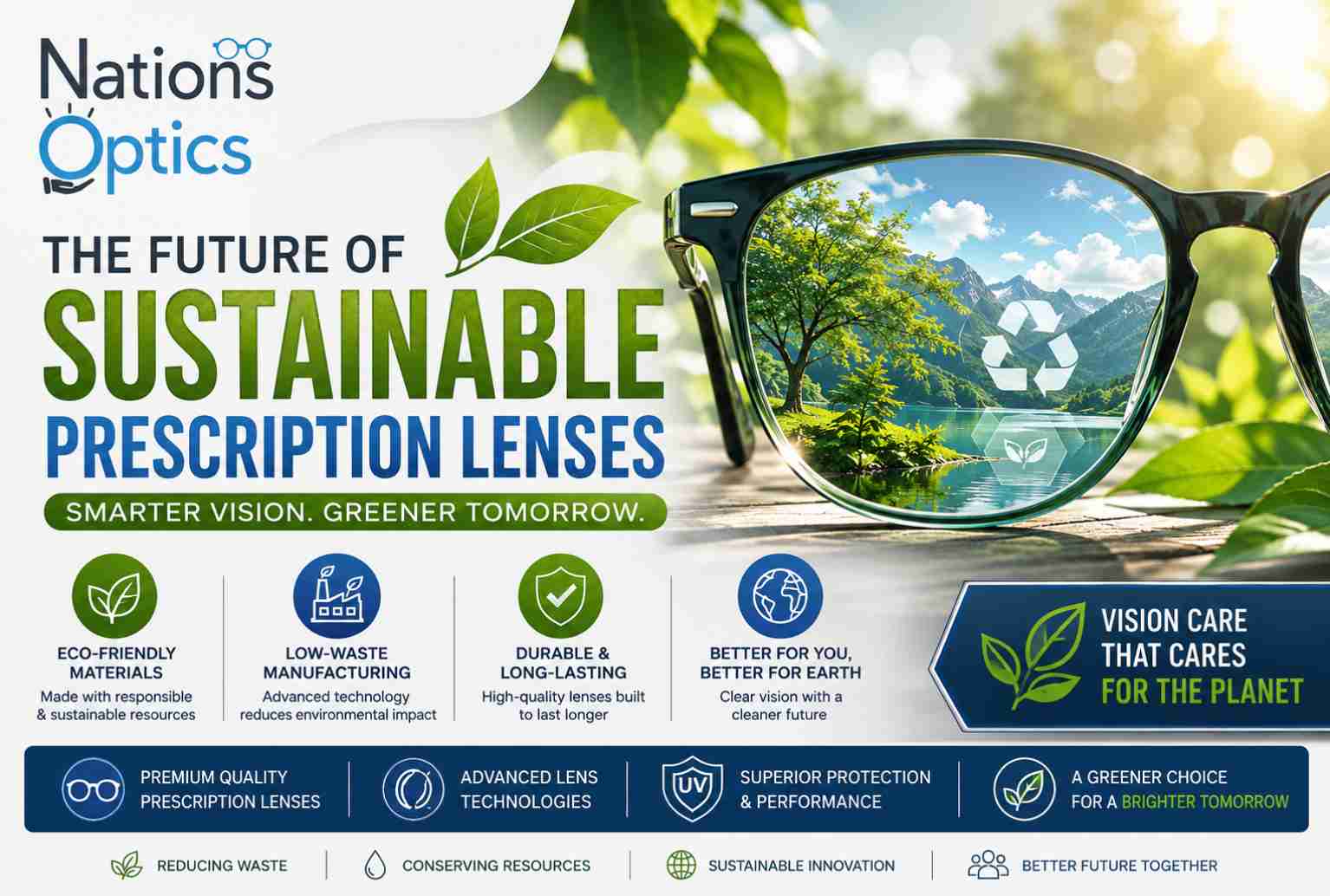
The Future of Sustainable Prescription Lenses | Eco-Friendly Eyewear
Jun 23, 2026
By Rahul Jain
0 comment(s)
The Future of Sustainable Prescription Lenses: How Eyewear Is Becoming Greener
Discover how sustainable prescription lenses, eco-friendly materials, advanced manufacturing technologies, and responsible innovation are transforming the future of eyewear.
Sustainability is no longer limited to electric vehicles, renewable energy, and eco-friendly packaging. Today, even the eyewear industry is evolving toward a more sustainable future. Consumers increasingly want products that are not only high-performing but also responsibly manufactured.
Prescription lenses have traditionally required significant amounts of raw materials, water, energy, and manufacturing processes. However, modern lens manufacturers are exploring new ways to reduce waste, lower carbon emissions, and improve resource efficiency while maintaining excellent optical quality.
SEO Keywords: Sustainable Prescription Lenses, Eco Friendly Eyewear, Sustainable Lens Technology, Green Eyewear, Sustainable Eyeglass Lenses, Lens Manufacturing, Future of Eyewear, Prescription Lenses, Optical Industry Innovation, Nations Optics
The future of prescription lenses is not only about seeing better—it's also about making smarter choices for the environment and future generations.
Why Sustainability Matters in the Eyewear Industry
The global eyewear industry produces millions of lenses and frames every year. While modern eyewear improves quality of life for billions of people, manufacturing processes inevitably consume resources.
Consumers are becoming more aware of how products are made and where materials come from. Younger generations, in particular, increasingly consider environmental responsibility when making purchasing decisions. Major lens manufacturers have publicly highlighted sustainability initiatives focused on reducing waste, energy consumption, water usage, and carbon emissions. :contentReference[oaicite:0]{index=0}
As awareness grows, sustainable eyewear is becoming an important part of the future optical industry.
How Prescription Lenses Are Traditionally Manufactured
Traditional prescription lens production involves multiple stages including lens blank creation, surfacing, grinding, polishing, coating, inspection, and finishing.
Although modern production is highly precise, traditional manufacturing methods often remove significant amounts of material during the shaping process. Industry discussions around sustainability increasingly focus on reducing material waste generated during these steps. :contentReference[oaicite:1]{index=1}
Because millions of lenses are manufactured every year, even small improvements in efficiency can have a substantial environmental impact.
The Rise of Sustainable Lens Materials
One of the most exciting developments in eyewear sustainability is the emergence of alternative materials and bio-based resources.
Some manufacturers are exploring bio-based polymers derived from renewable resources instead of relying exclusively on traditional fossil-based materials. These innovations can help reduce dependence on petroleum-based inputs while supporting more sustainable production practices. :contentReference[oaicite:2]{index=2}
Benefits of Sustainable Materials
- Reduced reliance on fossil resources
- Lower environmental impact
- Improved resource efficiency
- Support for circular economy initiatives
- Potential reduction in carbon emissions
Reducing Waste in Lens Manufacturing
One of the biggest challenges in lens production is material waste.
Recent research has explored additive and near-zero-waste manufacturing approaches that could dramatically reduce the amount of material discarded during lens production. Researchers have even proposed manufacturing techniques designed to eliminate many traditional subtractive processes entirely. :contentReference[oaicite:3]{index=3}
Innovation Insight: Researchers have described experimental ophthalmic lens manufacturing approaches aimed at creating prescription lenses with virtually no material waste compared with conventional grinding and edging methods. :contentReference[oaicite:4]{index=4}
While these technologies are still emerging, they highlight the direction in which the industry is moving.
Energy and Water Efficiency Improvements
Sustainability is not only about materials. Modern manufacturers are also improving how resources are used throughout the production process.
Industry sustainability programs have highlighted initiatives focused on reducing water consumption, lowering energy usage, minimizing waste generation, and improving packaging efficiency. Some facilities have adopted renewable energy sources and water reuse systems to reduce environmental impact. :contentReference[oaicite:5]{index=5}
| Area | Sustainability Focus |
|---|---|
| Energy | Renewable power adoption |
| Water | Reuse and conservation systems |
| Materials | Bio-based alternatives |
| Waste | Reduced manufacturing waste |
| Packaging | Lower paper and plastic usage |
The Role of Photochromic and Smart Lens Technologies
Future eyewear innovation is expected to combine sustainability with performance.
Consumers increasingly want products that are durable, versatile, and capable of replacing multiple pairs of glasses. Technologies such as photochromic lenses help users transition between indoor and outdoor environments without switching eyewear, supporting convenience and potentially extending product usefulness.
The future optical market is expected to continue focusing on personalization, advanced lens technology, and sustainability simultaneously. :contentReference[oaicite:6]{index=6}
What Consumers Can Do Today
Sustainability isn't only the responsibility of manufacturers. Consumers can also make choices that reduce waste and extend the lifespan of their eyewear.
Practical Steps
- Choose durable lenses with quality coatings
- Maintain lenses properly
- Use protective cases
- Replace lenses when appropriate instead of replacing entire eyewear
- Recycle eyewear where programs exist
- Invest in long-lasting lens technologies
Quality products that last longer can reduce unnecessary replacements and contribute to a more sustainable eyewear lifecycle.
Why Sustainable Eyewear Is the Future
The future of prescription lenses will likely be defined by a combination of innovation, performance, and environmental responsibility.
Manufacturers are exploring renewable materials, reducing waste, improving energy efficiency, and investing in cleaner production methods. At the same time, consumers are becoming more conscious about durability, product lifespan, and responsible purchasing decisions. :contentReference[oaicite:7]{index=7}
As these trends continue, sustainable prescription lenses are expected to become an increasingly important part of the global eyewear industry.
How Nations Optics Supports Smarter Eyewear Choices
At Nations Optics, we believe that high-quality lenses should provide long-lasting value. Durable materials, premium coatings, accurate prescriptions, and proper lens selection help customers enjoy better vision while maximizing product longevity.
- Premium Prescription Lenses
- Photochromic Lens Options
- Anti-Glare Coatings
- Polycarbonate Lens Solutions
- Custom Prescription Manufacturing
- Long-Lasting Lens Technologies
Investing in durable eyewear is one of the simplest ways to reduce waste and enjoy better long-term performance.
Better Vision. Smarter Choices. Greener Future.
The future of eyewear is about more than clear vision. It's about responsible innovation, durable products, and technologies that help reduce environmental impact while delivering outstanding optical performance.
✅ Premium Durable Lenses
✅ Advanced Lens Technologies
✅ Long-Lasting Coatings
✅ Future-Ready Vision Solutions
Exclusive Offers
Sitewide
33%
OFF
Flat 33% off on all products
Already applied on every price · no coupon needed
Auto-applied
10%
OFF
On orders ₹1,200 – ₹1,799
No coupon needed · saves automatically
Auto-applied
15%
OFF
On orders ₹1,800 – ₹3,199
No coupon needed · saves automatically
Best Deal 🔥
20%
OFF
On orders above ₹3,200
No coupon needed · saves automatically
Pay Advance
₹50
SAVED
Pay advance amount at checkout
Flat ₹50 off · pay balance on delivery
Pay Full ✓
₹100
SAVED
Pay full amount at checkout
Maximum saving · instant confirmation
N
Nations Optics Assistant
● Online
👋 Hi! I'm your Nations Optics assistant. Ask me anything about lenses, frames, or prescriptions!