
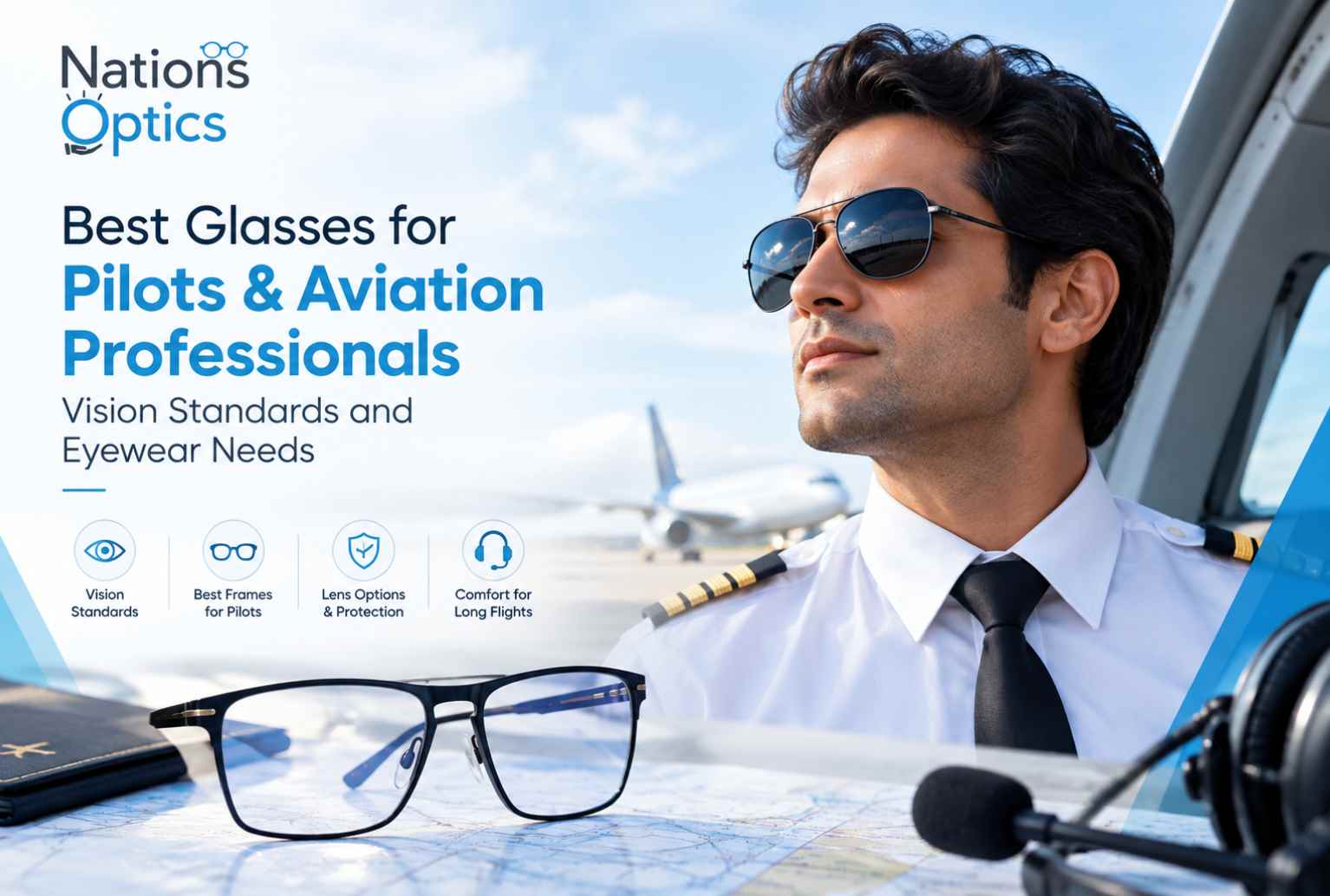
Best Glasses for Pilots: Vision Standards & Eyewear Guide
Sep 24, 2026
By Rahul Jain
0 comment(s)
A note before you read: This article covers general eyewear considerations for pilots and aviation professionals and is not a substitute for official aviation medical guidance. Vision requirements for pilot licensing vary by aviation authority, licence type, and medical category — always confirm current requirements with an authorized aviation medical examiner (in India, per applicable DGCA requirements).
Professional Eyewear
Best Glasses for Pilots & Aviation Professionals: Vision Standards and Eyewear Needs
Wearing glasses doesn't ground your aviation career. Here's what actually matters for vision requirements — and for choosing eyewear that works in the cockpit.
For pilots, clear and comfortable vision is essential — from reading cockpit instruments and displays to maintaining visual awareness outside the aircraft. But what if you wear glasses? A common question among aspiring and professional aviators is: can pilots wear glasses? The answer is generally yes, provided their vision meets the applicable aviation medical and regulatory requirements.
Choosing the right eyewear for aviation involves more than finding a frame that looks good — lens clarity, comfort, glare, UV exposure, prescription accuracy, and headset compatibility all matter. This guide covers pilot vision requirements, prescription glasses for pilots, suitable frame features, pilot sunglasses, and what to consider when choosing aviation eyewear.
Pilot Vision Standards Headset-Compatible Frames Anti-Reflective Coating Prescription Sunglasses Aviation Professionals
Can Pilots Wear Glasses?
Yes, pilots can wear glasses, provided they satisfy the vision requirements established by the relevant aviation authority and their aviation medical examiner. Many people assume pilots need naturally perfect eyesight or 20/20 vision without correction — that isn't necessarily the case. Aviation medical standards generally assess whether a pilot can achieve the required level of visual function, including corrected vision where permitted.
If you're pursuing a pilot licence, don't rely solely on general information found online. The exact requirements can depend on the country, licence type, commercial or private flying, class of medical certificate, age and medical history, visual acuity, refractive error, colour vision, binocular vision, field of vision, and other eye conditions.
For pilots in India: applicants should refer to the applicable DGCA requirements and an authorized aviation medical examiner for the current requirements applicable to their licence and medical category.
Do Pilots Need 20/20 Vision?
The answer depends on the applicable aviation medical standards. A pilot's visual ability isn't determined only by whether they naturally have 20/20 eyesight — corrected vision can be acceptable depending on the pilot category and medical requirements. A person who needs glasses for myopia, hyperopia, or astigmatism may still qualify as a pilot if their corrected vision and other visual functions satisfy the applicable requirements. If you're preparing for an aviation medical examination, get your eyes professionally evaluated and confirm current requirements with the relevant aviation authority.
Pilot Vision Requirements: What Is Actually Important?
Visual acuity is only one part of the picture. Depending on the applicable standard, an assessment may consider several aspects of vision:
1
Visual Acuity
The ability to clearly identify cockpit instruments, displays, runway environments, aircraft traffic, and external visual references. If uncorrected vision isn't sufficiently clear, prescription glasses or contact lenses may be used where permitted.
2
Near Vision
Cockpit displays, charts, checklists, and navigation information may require good near vision — particularly relevant as near-vision requirements change with age.
3
Colour Vision
Pilots may encounter colour-coded information, lighting systems, instruments, and signals — applicable standards may include specific colour-vision requirements.
4
Field of Vision
Adequate awareness of the surrounding visual environment, allowing detection of objects and movement outside the central point of focus.
5
Binocular Vision & Depth Perception
How well both eyes work together, contributing to spatial awareness — relevant to overall visual function assessment.
6
Eye Health
Aviation medical assessments also consider eye conditions that may affect safe performance — a comprehensive eye exam is more useful than simply reading a standard vision chart.
Best Glasses for Pilots: What Should You Look For?
The best glasses for pilots aren't necessarily the most expensive or a particular frame style. Good pilot glasses should combine clear prescription correction, comfortable fit, stable positioning, appropriate lens coatings, lightweight construction, good peripheral visibility, headset compatibility where required, appropriate UV protection, and minimal distracting reflections. The ideal choice can also vary depending on whether you're a student pilot, airline pilot, private pilot, flight instructor, cabin professional, or another aviation worker.
Prescription Glasses for Pilots
For people who require vision correction, prescription glasses can provide clear vision while flying. Before ordering, make sure your prescription is current — important information includes sphere, cylinder, axis, pupillary distance (PD), and addition where applicable. For aviation use, accurate prescription measurements are particularly important because visual clarity affects how comfortably you view instruments and the outside environment. If your prescription has changed, schedule an eye examination rather than continuing to use an outdated one.
Thin or Comfortable Temples
Reduces friction and pressure points, especially with headset use.
Secure Nose Fit
Keeps glasses stable without repeated adjustment during flight.
Appropriate Frame Width
Not so wide it interferes with equipment, not so narrow it pinches.
Lightweight Construction
Minimizes fatigue during long periods of wear in the cockpit.
Minimal Pressure Behind the Ears
Particularly important when worn together with a headset for hours.
Stable Bridge Design
Keeps the frame in position through normal head movement.
What Type of Glasses Can Pilots Wear?
There's no single frame shape every pilot must wear — the choice depends on prescription, comfort, personal preference, headset use, and visual needs. Some pilots prefer rectangular frames, others round, oval, square, or aviator-inspired designs. The more important consideration is whether the glasses fit securely, remain comfortable, provide the required prescription correction, don't significantly interfere with equipment, provide clear vision, and have suitable lenses for the intended environment.
Anti-Reflective Glasses for Pilots
Reflections from lenses can be distracting in certain lighting conditions. An anti-reflective coating can reduce reflections from the lens surfaces and improve the appearance of the lenses — useful for people who spend substantial time looking at illuminated displays. However, an anti-reflective coating should not be treated as a substitute for meeting aviation medical requirements; the coating is an eyewear feature, while the pilot's medical eligibility is determined separately.
In eyewear marketing, "anti-glare" commonly refers to this anti-reflective treatment. When choosing lenses, ask your optician what coating is actually being provided and what it's designed to do — a quality anti-reflective treatment can help reduce distracting reflections, but it doesn't automatically make a lens suitable for every aviation situation.
Pilot Sunglasses and Prescription Sunglasses
Sunglasses can be useful when pilots are exposed to bright sunlight, particularly during daytime flying, but should be selected carefully. Important considerations include appropriate lens tint, UV protection, optical quality, comfort, prescription requirements, and compatibility with the aircraft environment. For people who require vision correction, prescription sunglasses can combine corrective vision with sun protection — but pilots should ensure the sunglasses don't interfere with their ability to see required displays, instruments, or visual cues.
Are Polarized Sunglasses Suitable for Pilots?
Polarized sunglasses can reduce certain types of reflected glare, but they aren't automatically the right choice for every aviation environment. Depending on the aircraft, displays, and operating conditions, polarization may affect how certain screens or reflections are perceived — pilots should check requirements applicable to their aircraft and operation before choosing polarized eyewear, rather than assuming polarized lenses are always better.
UV Protection
High-quality sunglasses should provide appropriate UV protection. Look for clearly specified UV protection rather than relying only on dark lens colour — a darker lens does not automatically mean better UV protection.
Glasses for Pilots Who Wear Headsets
Aviation headsets are an important part of cockpit equipment for many pilots. Thick temples may create pressure points where the headset seals around the ears. For improved comfort, pilots may consider slimmer temple designs, lightweight frames, properly adjusted nose pads, appropriate frame width, and a frame that doesn't create excessive pressure under the headset. The exact experience varies depending on the headset and the individual's head and face shape.
Can You Become a Pilot With Poor Eyesight, Myopia, or Astigmatism?
The phrase "poor eyesight" can be misleading, because aviation medical certification is based on defined visual standards rather than a simple description of good or bad eyesight. Someone who needs corrective lenses may still qualify if their vision meets the applicable requirements. The correct question isn't "Is my eyesight perfect?" — it's "Does my vision, with or without correction as permitted, meet the applicable aviation medical standards for the licence I'm pursuing?"
The same logic applies to specific conditions: myopia (blurred distance vision without correction) and astigmatism (blurred or distorted vision at different distances) can often be corrected with prescription lenses, and whether a person qualifies depends on the applicable aviation medical standards and examination results — not the presence of the condition alone.
Eyewear Considerations by Aviation Role
Commercial Pilots
Long-duration comfort matters most — accurate prescription lenses, lightweight construction, secure fitting, appropriate coatings, and good compatibility with cockpit equipment.
Flight Instructors
Many hours in the cockpit while communicating with students — comfort, stability, clear vision, and headset compatibility are priorities, since pressure around the ears and nose becomes especially noticeable over time.
Aviation Professionals
Ground personnel, aviation technicians, flight crew, and other airport professionals may have different visual requirements — eyewear should be selected according to individual correction needs, working environment, and applicable occupational requirements.
Glasses vs Contact Lenses for Pilots
Glasses
- Easy to remove
- Simple to maintain
- Convenient for many users
- Available with multiple lens options
Contact Lenses
- Wider unobstructed field of view
- No frame interference
- Compatibility with many headset types
- Can cause dryness or discomfort for some wearers
The choice should be based on individual comfort, visual requirements, medical advice, and applicable aviation regulations.
How to Choose Glasses for Aviation
1
Start with a current prescription — don't purchase aviation eyewear based on an old prescription if your vision has changed.
2
Confirm your aviation medical requirements — check the current requirements applicable to your licence and aviation authority.
3
Choose a comfortable frame that remains comfortable during long periods of wear.
4
Consider headset compatibility — make sure the frame doesn't create excessive pressure if you regularly use one.
5
Consider an anti-reflective coating to reduce distracting reflections.
6
Consider UV protection for sunglasses, confirming actual protection rather than judging by lens darkness.
7
Prioritize optical quality — lenses should provide accurate correction and clear vision.
8
Get the frame properly adjusted — even a good frame can become uncomfortable if incorrectly fitted.
Common Mistakes When Choosing Pilot Glasses
Watch Out For
- Choosing style over fit — a fashionable frame isn't necessarily comfortable for long cockpit sessions
- Buying an extremely dark lens, assuming darkness means better protection or performance
- Ignoring headset compatibility — a frame comfortable without a headset can feel very different underneath one
- Using an outdated prescription, which can affect visual clarity and comfort
- Assuming one rule applies to every pilot — always verify the requirements applicable to you
Frequently Asked Questions
Can pilots wear glasses?
Yes. Wearing glasses does not automatically prevent someone from becoming a pilot — the person's vision must satisfy the applicable aviation medical requirements.
Do pilots need perfect vision?
Not necessarily. Applicable aviation standards may permit corrected vision, and requirements vary according to the aviation authority and licence category.
Can airline pilots wear prescription glasses?
Yes, where the pilot's corrected vision and other visual requirements meet the applicable aviation medical standards.
Are anti-glare glasses good for pilots?
Anti-reflective coatings can reduce reflections from lens surfaces. Whether a particular lens setup is suitable should be considered alongside the pilot's prescription and operating environment.
Can someone with myopia or astigmatism become a pilot?
Potentially yes, if their corrected vision and overall visual assessment meet the applicable aviation medical standards — this should be confirmed through an aviation medical examination, not assumed.
Can pilots wear glasses under a headset?
Yes, many pilots do. Frame design and temple thickness affect comfort, so a properly fitted lightweight frame is useful.
Clear Vision Starts With the Right Prescription
Nations Optics offers prescription eyewear designed around individual vision needs and frame preferences — comfortable vision starts with the right fit.
- Lightweight frame options for extended wear
- Anti-reflective lens coatings
- Prescription sunglasses with UV protection
- Frames suited to headset compatibility
- Accurate prescription fitting
The right eyewear can make a significant difference to everyday comfort for pilots and aviation professionals. If you wear glasses, you don't necessarily need to give up your aviation goals — what matters is whether your vision meets the applicable pilot vision requirements and whether your eyewear provides the correction and comfort you need.
When choosing glasses for aviation, focus on prescription accuracy, comfortable fitting, lens quality, anti-reflective options, UV protection for appropriate sunglasses, and compatibility with aviation headsets. Most importantly, remember that eyewear selection and aviation medical certification are two different things — your glasses can help correct your vision, but only the applicable aviation medical assessment can determine whether your vision meets the requirements for your particular licence.
Exclusive Offers
Sitewide
33%
OFF
Flat 33% off on all products
Already applied on every price · no coupon needed
Auto-applied
10%
OFF
On orders ₹1,200 – ₹1,799
No coupon needed · saves automatically
Auto-applied
15%
OFF
On orders ₹1,800 – ₹3,199
No coupon needed · saves automatically
Best Deal 🔥
20%
OFF
On orders above ₹3,200
No coupon needed · saves automatically
Pay Advance
₹50
SAVED
Pay advance amount at checkout
Flat ₹50 off · pay balance on delivery
Pay Full ✓
₹100
SAVED
Pay full amount at checkout
Maximum saving · instant confirmation
N
Nations Optics Assistant
● Online
👋 Hi! I'm your Nations Optics assistant. Ask me anything about lenses, frames, or prescriptions!