Astigmatism Glasses Guide: Symptoms, CYL & Best Lenses
Aug 7, 2026
By Rahul Jain
0 comment(s)
Prescription & Eye Health
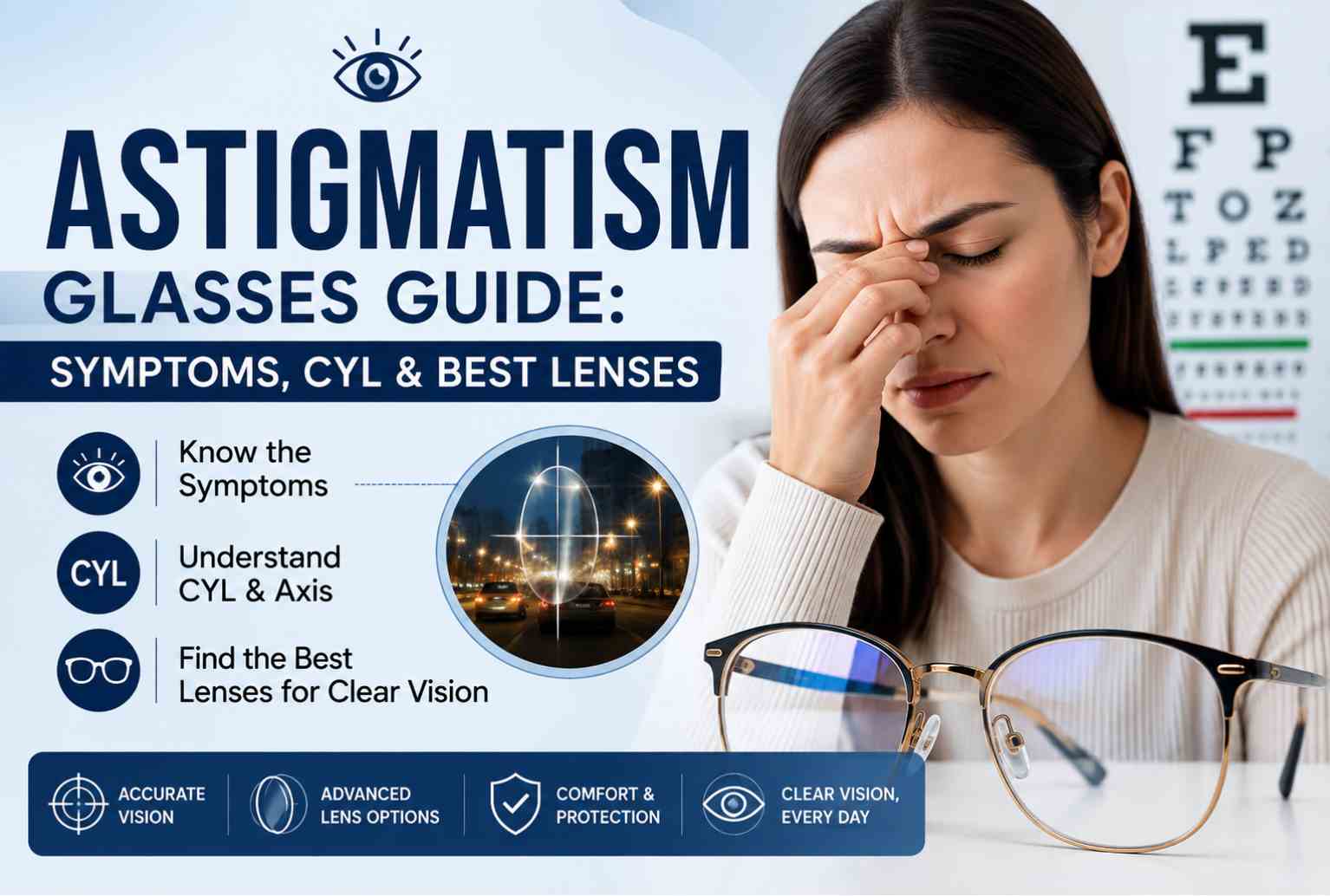
Astigmatism Glasses Guide: Symptoms, Cylinder Power & Choosing the Right Lenses
If your prescription has a CYL and AXIS number, you have astigmatism. Here's what that actually means — and how to get lenses that fit it properly.
Astigmatism is one of the most common vision conditions, yet it's also one of the most misunderstood. Many people assume it's a disease or something rare, when in reality it's simply a difference in the shape of the eye — and it's present, to some degree, in most people who wear glasses.
In this guide, we explain what astigmatism actually is, the symptoms to watch for, how to read the cylinder (CYL) and axis numbers on your prescription, and how to choose the right lenses so your vision stays sharp and comfortable.
Cylinder (CYL)
Axis
Toric Lenses
Blurred Vision
Astigmatism + Myopia
What Is Astigmatism?
Astigmatism happens when the cornea (the clear front surface of the eye) or the lens inside the eye isn't perfectly round. Instead of a smooth, basketball-like curve, it's shaped more like a rugby ball — more curved in one direction than the other.
Because light entering the eye hits this uneven surface, it focuses at more than one point instead of a single sharp point on the retina. The result is blurred or distorted vision at any distance, whether you're looking at something near or far.
Astigmatism is extremely common. It frequently occurs alongside myopia (nearsightedness) or hyperopia (farsightedness), and mild astigmatism is present in a large portion of the population without ever causing noticeable problems.
Reading Astigmatism on Your Prescription
If you have astigmatism, your prescription will include two extra values beyond SPH (sphere): CYL and AXIS. For example:
SPH -2.00 CYL -1.25 AXIS 180
SPH
Sphere
Overall focusing power — corrects near- or farsightedness.
CYL
Cylinder
The amount of astigmatism correction needed.
AXIS
Axis
The orientation of the astigmatism, measured 0°–180°.
A higher CYL number means a greater degree of astigmatism, and therefore a more noticeable correction in the lens. The AXIS number doesn't indicate severity — it simply tells the lab which direction to orient the correction so it lines up correctly with your eye.
Symptoms of Astigmatism
Common Symptoms
- Blurred or distorted vision
- Difficulty seeing fine details
- Eye strain or discomfort
- Headaches, especially after reading
- Squinting to see clearly
- Difficulty with night vision
- Halos or streaks around lights
- Tilting your head to focus
Mild astigmatism may cause no noticeable symptoms at all. Moderate to high astigmatism is more likely to cause consistent blur or visual fatigue that gets worse throughout the day.
What Causes Astigmatism?
1
Genetics
Astigmatism often runs in families and is frequently present from birth, sometimes changing gradually as the eye grows.
2
Corneal Shape
Most astigmatism comes from an irregular corneal curve rather than the internal lens — this is called corneal astigmatism.
3
Lenticular Astigmatism
Less commonly, the irregularity is in the eye's internal lens rather than the cornea — this is called lenticular astigmatism.
4
Eye Injury or Surgery
Trauma, scarring, or previous eye surgery can alter the shape of the cornea and introduce or change astigmatism.
5
Keratoconus
A progressive thinning and bulging of the cornea that causes irregular, often more significant astigmatism — requires specialist monitoring.
Best Lenses for Astigmatism
Glasses vs Contact Lenses for Astigmatism
| Feature | Glasses | Toric Contact Lenses |
|---|---|---|
| Correction accuracy | Fixed lens orientation in frame | Must stay properly rotated on eye |
| Comfort | No eye contact required | Natural field of vision |
| Fitting | Standard prescription fitting | Requires a specific contact lens fitting |
| Best for | Most astigmatism prescriptions | Active lifestyles, sports, no-frame preference |
Both can correct astigmatism effectively — the right choice depends on your lifestyle, the degree of astigmatism, and comfort preference. A contact lens fitting is especially important for toric contacts, since the lens must stay correctly rotated on the eye to work properly.
How Astigmatism Is Diagnosed
1
Visual acuity test — reading letters at a distance to assess overall clarity.
2
Keratometry — measuring the curvature of the cornea.
3
Refraction test — determining the exact SPH, CYL, and AXIS needed for correction.
4
Corneal topography (if needed) — a detailed map of the cornea's surface for irregular or higher astigmatism.
Can Astigmatism Change or Get Worse?
Yes. Astigmatism can shift gradually over time, particularly during childhood and adolescence as the eye grows, or after an eye injury or surgery. It can also change alongside other prescription changes, such as increasing myopia. Regular eye exams help catch these shifts before they cause significant discomfort.
Can LASIK correct astigmatism? In many cases, yes — modern laser vision correction can treat astigmatism alongside myopia or hyperopia. Eligibility depends on corneal thickness, prescription stability, and overall eye health, so a full evaluation from an eye surgeon is necessary.
Frequently Asked Questions
What is astigmatism in simple terms?
It's an irregular curve in the cornea or the eye's internal lens that causes light to focus at more than one point, resulting in blurred or distorted vision.
Is astigmatism serious?
Most astigmatism is mild and easily corrected with glasses or contact lenses. It's not a disease and generally doesn't threaten eye health on its own, though it should be monitored with regular eye exams.
What does CYL mean on a prescription?
CYL, or cylinder, indicates the amount of astigmatism correction needed. The AXIS value indicates the direction of that correction.
Can astigmatism be corrected with regular glasses?
Yes. Standard prescription lenses ground with the correct SPH, CYL, and AXIS values correct astigmatism effectively for most people.
Do I need special contact lenses for astigmatism?
Yes — toric contact lenses are specifically designed for astigmatism and require a dedicated fitting to ensure they stay correctly oriented on the eye.
Can astigmatism go away on its own?
It typically doesn't disappear on its own, though it can change over time. Most people manage it long-term with accurately prescribed lenses.
Does astigmatism get worse with age?
It can shift gradually, especially during childhood eye growth or due to age-related changes, injury, or certain eye conditions. Regular eye exams help track any changes.
Get Lenses Precisely Fitted to Your Astigmatism
At Nations Optics, every lens is ground to your exact SPH, CYL, and AXIS — not just a rounded approximation.
- Accurate toric lens grinding
- High-index options for stronger CYL powers
- Aspheric designs for a flatter profile
- Anti-reflective & UV coatings available
- Guidance based on your exact prescription
Astigmatism is far more common than most people realize, and in almost all cases it's straightforward to correct with the right lenses. The key is making sure your CYL and AXIS values are measured accurately and ground precisely into your lenses — approximations or outdated prescriptions are one of the most common causes of ongoing blur and discomfort.
If you've noticed blurred vision, eye strain, or headaches that don't seem to match a simple near- or farsighted prescription, astigmatism may be the missing piece. A comprehensive eye exam is the best way to find out.
Exclusive Offers
Sitewide
33%
OFF
Flat 33% off on all products
Already applied on every price · no coupon needed
Auto-applied
10%
OFF
On orders ₹1,200 – ₹1,799
No coupon needed · saves automatically
Auto-applied
15%
OFF
On orders ₹1,800 – ₹3,199
No coupon needed · saves automatically
Best Deal 🔥
20%
OFF
On orders above ₹3,200
No coupon needed · saves automatically
Pay Advance
₹50
SAVED
Pay advance amount at checkout
Flat ₹50 off · pay balance on delivery
Pay Full ✓
₹100
SAVED
Pay full amount at checkout
Maximum saving · instant confirmation
N
Nations Optics Assistant
● Online
👋 Hi! I'm your Nations Optics assistant. Ask me anything about lenses, frames, or prescriptions!