
5 Things to Check Before Buying Glasses Online in India | NationsOptics
Mar 30, 2026
By Saksham Dhiman
0 comment(s)
NationsOptics
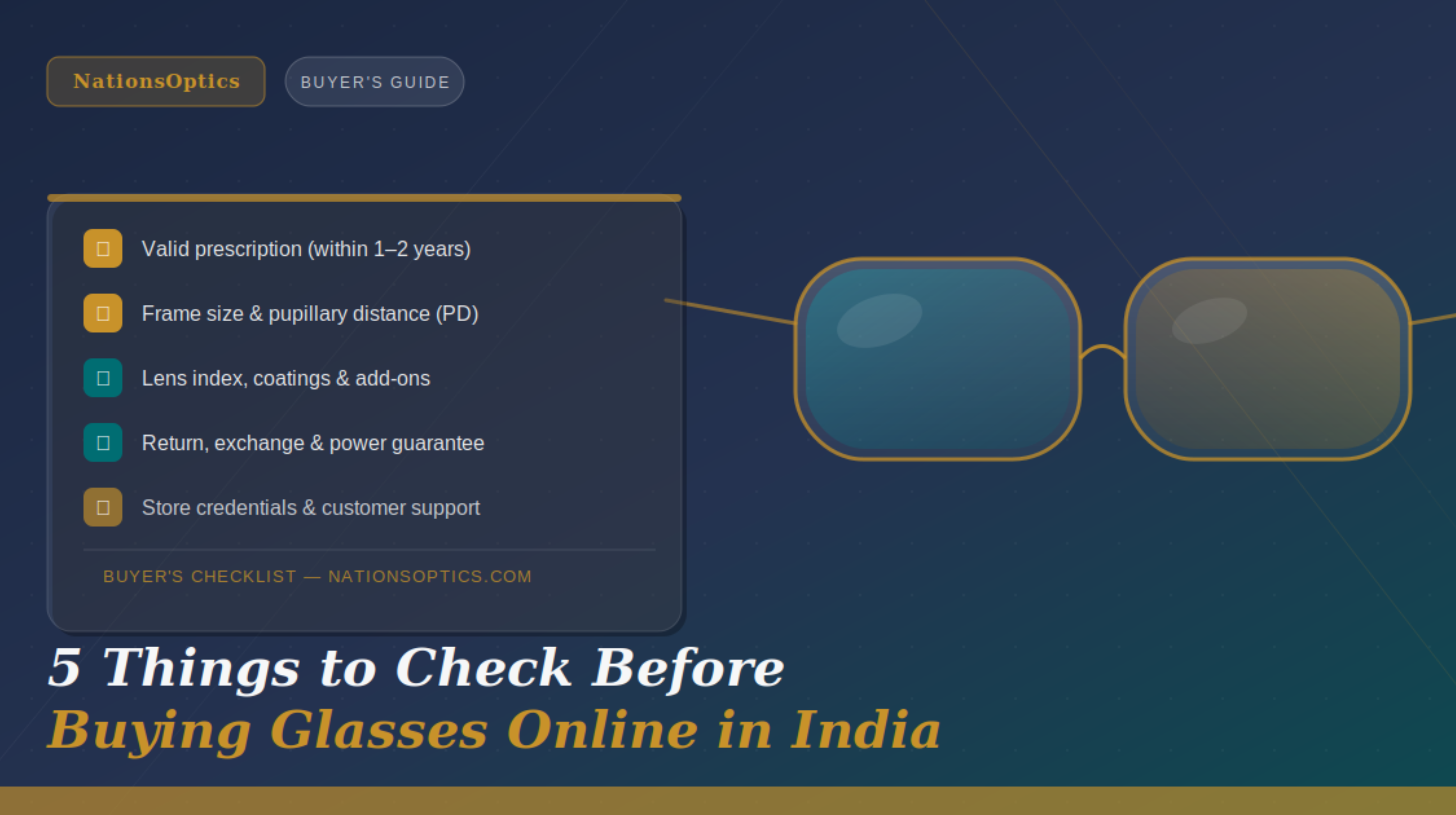
5 Things to Check Before Buying Glasses Online in India
Prescription accuracy, frame fit, return policies — here's what you need to confirm before you hit "Order Now".
Buying glasses online in India has never been easier — but it's still not quite the same as walking into a store. You can't try on twenty frames in ten minutes, and you can't hand your prescription slip directly to an optician standing in front of you. The good news? A little preparation goes a long way. Here are the five things every first-time (and even experienced) buyer should verify before placing an order.
1
The most important step Have a Valid, Recent Prescription
This sounds obvious — but many buyers either use an old prescription or order based on a rough recollection of their power. Your eyesight can change meaningfully year to year, and ordering glasses with an outdated prescription means you'll be wearing the wrong correction from day one.
A good prescription should be no more than 1–2 years old. It should clearly mention your SPH (sphere), CYL (cylinder), AXIS, and ADD values (for bifocal or progressive lenses). If you haven't had an eye test recently, most cities in India have walk-in optometry clinics where you can get checked in under 30 minutes — often for free or for a nominal fee.
Pro tip: Take a clear photo of your prescription before uploading it. Blurry uploads are the single biggest cause of dispensing errors in online orders — a crisp, well-lit image means your lenses will be cut exactly right.
2
Frame fit matters more than it seems Know Your Measurements Before You Browse
Frames that look beautiful on a model may sit entirely differently on your face. The three numbers printed on the inside of most frames — for example, 52-18-140 — tell you the lens width, bridge width, and temple (arm) length in millimetres. If you have a pair of glasses you already love the fit of, find those numbers and use them as your baseline.
Separately, know your Pupillary Distance (PD) — the measurement in millimetres between the centre of your pupils. This is critical for optical accuracy; a PD that's even 2mm off-centre can cause eye strain and distorted vision. Your optometrist will usually have it on file. Alternatively, there are free mobile apps that can measure it using your phone's front camera.
Quick tip
If you're between frame sizes, opt for the slightly larger one — frames that are too tight are uncomfortable and can bend out of shape. You can always have an optician adjust the fit, but a frame that's too small can't be stretched.
3
Not all lenses are equal Understand Your Lens Options Before Checkout
Reputable online optical stores give you several lens choices when you enter your prescription — and the differences between them genuinely matter for your daily comfort. Here are the main options you'll typically encounter:
Lens index (1.5, 1.56, 1.61, 1.67, 1.74) determines thickness. Higher prescriptions — anything above ±4.00 — benefit significantly from a higher-index lens, which is thinner and lighter. For low prescriptions, a standard 1.5 index is usually fine.
Coatings are where most buyers under-invest. An anti-reflective (AR) coating is nearly non-negotiable if you spend time on screens or drive at night. A UV coating protects your eyes from sun damage. Blue light blocking lenses reduce eye strain for heavy screen users. Photochromic lenses darken automatically in sunlight — great if you move between indoors and outdoors frequently.
Watch out for: "Free lenses" promotions that only include a basic 1.5 index with no coating. These are perfectly fine for mild prescriptions, but if your power is above ±3.00, the lenses may end up noticeably thick — which can affect both appearance and optical performance.
4
Protect yourself as a buyer Read the Return, Exchange & Warranty Policy
Prescription glasses are a medical device — if they're wrong, you can't simply ignore it. Before you pay, make sure you understand the seller's policy on three things:
Power guarantee: Does the store offer a free remake if the prescription is dispensed incorrectly? Reputable sellers do. This is your most important protection.
Frame exchanges: What if the frame doesn't suit you as well as you hoped? Look for stores that allow a trial period or offer at least one free exchange. Some stores in India also offer a home trial service in select cities.
Lens warranty: Scratches happen. A basic warranty against coating peel or manufacturing defects (usually 6–12 months) is a sign the seller stands behind their product quality.
What to look for
A seller confident in their quality will make their return and exchange policy easy to find — not buried in a FAQ page. If you have to hunt for it, that tells you something.
5
The detail most buyers skip Verify the Store's Credentials & Customer Support
Prescription eyewear isn't a commodity purchase — you're trusting a store to accurately manufacture a medical product to your exact specification. It's worth spending two minutes checking a few signals of reliability before you buy.
Look for a store that has qualified opticians or optical technicians available — either via chat, phone, or email. If you have doubts about your prescription or which lenses to choose, you should be able to ask a real expert, not a chatbot. Also check customer reviews specifically for prescription accuracy and post-sales support, not just frame aesthetics.
A GST-registered business, a clear physical address, and visible contact information are baseline signals of a legitimate operation in India's growing online eyewear market.
Quick sanity check: Can you find a phone number or WhatsApp on the website? Did anyone respond within a reasonable time when you tested it? Good support before purchase usually means good support after, if something goes wrong.
Your Pre-Order Checklist
Run through these before hitting "Add to Cart".
- My prescription is dated within the last 1–2 years
- I know my frame measurements (lens / bridge / temple) and PD
- I've chosen the right lens index for my prescription power
- I've selected the coatings I actually need (AR, UV, blue light, photochromic)
- I've read the return, exchange, and power-correction policy
- The store has accessible customer support and visible credentials
Ready to Order With Confidence?
Browse NationsOptics' range of prescription glasses, progressive lenses, and coated lens options — with expert support at every step.
Shop at NationsOptics →