Single Vision vs Progressive & Bifocal Lenses: Which Do You Need? | NationsOptics
Mar 24, 2026
By Saksham Dhiman
0 comment(s)
Choosing the right lenses is just as important as choosing the right frames. Whether you're picking up your first pair of glasses or updating a long-standing prescription, understanding the difference between single vision and multi vision lenses (progressive or bifocal) can make or break your visual comfort. This guide breaks it all down — simply and clearly.
01 What Are Single Vision Lenses?
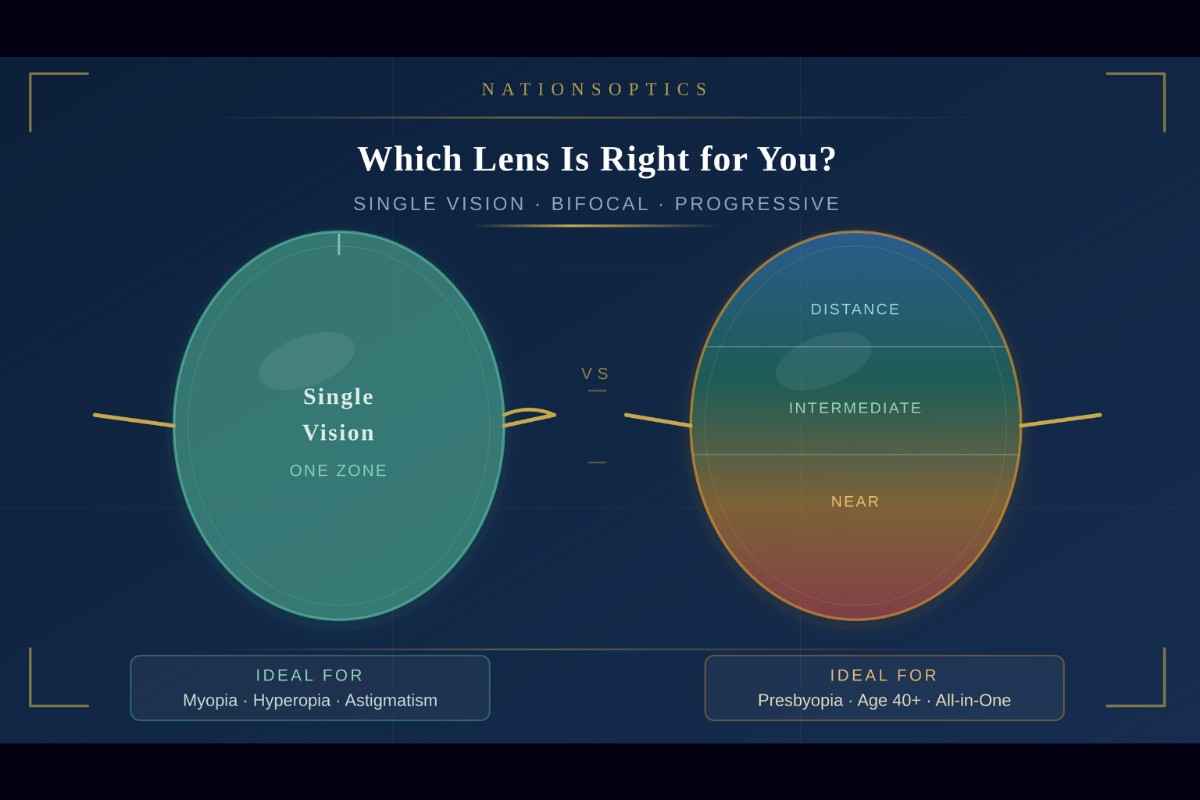
Single vision lenses have one prescription power across the entire lens surface. They are designed to correct one field of vision — either near or far — but not both simultaneously.
These are the most common type of prescription lenses and are prescribed for people who have:
- Myopia (nearsightedness) — difficulty seeing distant objects clearly
- Hyperopia (farsightedness) — difficulty seeing near objects clearly
- Astigmatism — blurred vision caused by an irregularly shaped cornea or lens
They work beautifully for children, teens, and younger adults whose eyes can still naturally adjust focus between near and far — a process called accommodation.
Did You Know?
Single vision lenses can also be made specifically for computer use — designed to reduce eye strain at intermediate distances. These are sometimes called "office lenses" or "computer glasses."
02 What Are Multi Vision Lenses?
Multi vision lenses contain two or more prescription zones in a single lens, allowing you to see clearly at multiple distances without switching between different pairs of glasses.
Bifocal Lenses
Bifocals have two distinct zones: the upper portion for distance vision and a small segment at the bottom for near vision. There is a visible line separating the two zones. While effective, that line can be noticeable and may cause a "jump" in vision when your eyes cross the boundary.
Progressive Lenses
Progressives — sometimes called "no-line bifocals" — offer a smooth, gradual transition between near, intermediate, and distance zones with no visible line. Most wearers find them more natural and aesthetically appealing.
Trifocal Lenses
A less common option, trifocals include three distinct zones separated by two visible lines. They are largely being replaced by progressive lenses.
Progressive lenses are currently the most popular multi-vision option worldwide — offering a full range of vision with no visible line and a natural, seamless look.
03 Key Differences at a Glance
| Feature | Single Vision | Bifocal | Progressive |
|---|---|---|---|
| Prescription Zones | 1 | 2 | 3 (seamless) |
| Visible Line | None | Yes | None |
| Distance Vision | ✓ (if prescribed) | ✓ | ✓ |
| Near Vision | ✓ (if prescribed) | ✓ | ✓ |
| Intermediate Vision | ✗ | Limited | ✓ |
| Adjustment Period | Minimal | Short | 1–2 weeks |
| Cosmetic Appeal | High | Moderate | High |
| Cost | Lower | Moderate | Higher |
| Best For | Single-distance correction | Budget presbyopia | Modern all-in-one vision |
04 Single Vision Lenses: Pros & Cons
Advantages
- Simple, sharp correction for one distance
- Typically the most affordable option
- Wider field of clear vision within their zone
- Easiest to adapt to — no adjustment period
- Lightweight, available in all lens materials
- Ideal for children and younger adults
Limitations
- Corrects only one distance (near or far)
- May need multiple pairs as you age
- Not suitable for presbyopia on their own
- Constant switching if you need both distances
05 Multi Vision Lenses: Pros & Cons
Progressive Lenses
Advantages
- All-in-one near, intermediate & distance vision
- No visible lines — look like regular lenses
- Natural, seamless visual transitions
- Eliminates need for multiple pairs
- Modern lifestyle-friendly
Limitations
- Higher cost than single vision or bifocal
- Adaptation period of 1–2 weeks
- Peripheral distortion in early adaptation
- Not ideal for very wide reading zones
Bifocal Lenses
Advantages
- Wider near-reading zone than progressives
- Clear, predictable zones
- More affordable than progressives
- Quicker adaptation than progressives
Limitations
- Visible line can be cosmetically undesirable
- "Image jump" at the lens boundary
- No intermediate vision zone
- May look dated to some wearers
06 Who Needs Which Lens?
Your ideal lens depends on your age, lifestyle, prescription, and vision goals.
Children & Teens
Single vision lenses are the standard. Young eyes accommodate naturally.
Young Adults (20s–30s)
Single vision for myopia or hyperopia. Screen users may benefit from blue-light optimized lenses.
Adults 40+ (Presbyopia)
Progressive lenses are the gold standard. Bifocals offer a budget-friendly alternative.
Active Lifestyles
Progressives for everyday use. Athletes may prefer single vision sports glasses.
Office Workers
Progressives or dedicated computer glasses to reduce digital eye strain.
Budget-Conscious
Single vision for younger wearers, bifocals for multi-distance on a budget.
07 Understanding Presbyopia
Presbyopia is the gradual loss of the eye's ability to focus on close objects — a perfectly normal part of aging that typically begins around age 40. It happens because the lens inside your eye slowly loses its flexibility over time.
If you find yourself holding your phone at arm's length to read, or needing brighter light for tasks that didn't require it before — you're likely experiencing presbyopia.
Important
Presbyopia cannot be corrected with a single-vision lens alone unless you're willing to carry separate pairs. If you're over 40 and squinting to read, speak to your optometrist about multi vision options.
08 Cost Considerations
Lens cost varies based on type, material, coatings, and brand. Here's a general range to keep in mind:
| Lens Type | Relative Cost | Notes |
|---|---|---|
| Single Vision (Basic) | $ Low | Most affordable; widely available |
| Single Vision (Premium) | $$ Low-Mid | With AR, blue light, UV coatings |
| Bifocal | $$ Mid | More than SV, less than progressives |
| Progressive (Standard) | $$$ Mid-High | Good quality, some adaptation needed |
| Progressive (Premium) | $$$$ High | Wider zones, least distortion, easiest adaptation |
At NationsOptics, we believe quality vision shouldn't be a luxury. Our team helps you find the best value for your specific prescription and lifestyle.
09 Frequently Asked Questions
Can I switch from bifocals to progressive lenses?
Absolutely. Many people make this switch for a more modern look or improved intermediate vision. Most adapt within 1–2 weeks. Our opticians at NationsOptics can guide you through the transition.
Do progressive lenses work for all prescriptions?
Progressive lenses work for a wide range of prescriptions. Very high prescriptions or significant differences between eyes can sometimes make adaptation harder. Your optometrist will advise on the best fit.
At what age should I consider multi vision lenses?
Most people begin to notice presbyopia around age 40–45. If reading up close has become a challenge, it's time to discuss multi vision options with your eye doctor.
Are progressive lenses worth the extra cost?
For most adults with presbyopia, yes. The convenience of one pair for all distances combined with no visible line makes them the preferred choice for an active, modern lifestyle.
What coatings should I add to my lenses?
We recommend anti-reflective (AR) coating for all lenses, UV protection for outdoor wear, and blue-light filtering for heavy screen users. Ask our team what suits your lifestyle best.
10 The NationsOptics Verdict
There's no universally "better" lens — only the right lens for you. Here's a quick decision guide:
- Under 40, one vision issue? — Single Vision is your lens.
- Over 40, struggling to read or switch distances? — Progressive lenses are the modern gold standard.
- Need multi-distance correction on a budget? — Bifocals are a proven, practical choice.
- Heavy screen user? — Ask about computer-optimized single vision or progressive office lenses.
The best decision comes from an up-to-date eye exam and a conversation with an optician who understands your vision, lifestyle, and budget — that's exactly what you'll find at NationsOptics.
Exclusive Offers
Sitewide
33%
OFF
Flat 33% off on all products
Already applied on every price · no coupon needed
Auto-applied
10%
OFF
On orders ₹1,200 – ₹1,799
No coupon needed · saves automatically
Auto-applied
15%
OFF
On orders ₹1,800 – ₹3,199
No coupon needed · saves automatically
Best Deal 🔥
20%
OFF
On orders above ₹3,200
No coupon needed · saves automatically
Pay Advance
₹50
SAVED
Pay advance amount at checkout
Flat ₹50 off · pay balance on delivery
Pay Full ✓
₹100
SAVED
Pay full amount at checkout
Maximum saving · instant confirmation
N
Nations Optics Assistant
● Online
👋 Hi! I'm your Nations Optics assistant. Ask me anything about lenses, frames, or prescriptions!